


SAT Exam > SAT Questions > Comprehension:Directions: Consider the follow... Start Learning for Free
Comprehension:
Directions: Consider the following data and answer questions:
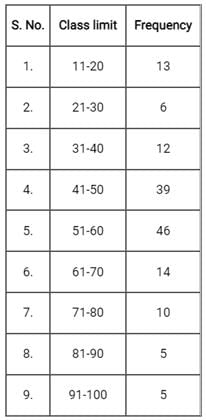
Which one of the following is the cumulative frequency of the entire data set?
Which one of the following is the cumulative frequency of the entire data set?
- a)150
- b)160
- c)140
- d)120
Correct answer is option 'A'. Can you explain this answer?

Verified Answer
Comprehension:Directions: Consider the following data and answer quest...
Key Points
- In Statistics, a cumulative frequency is defined as the total of frequencies, that are distributed over different class intervals. It means that the data and the total are represented in the form of a table in which the frequencies are distributed according to the class interval.
- The cumulative frequency is calculated by adding each frequency from a frequency distribution table to the sum of its predecessors. The last value will always be equal to the total for all observations since all frequencies will already have been added to the previous total.
- A table that displays the cumulative frequencies that are distributed over various classes is called a cumulative frequency distribution or cumulative frequency table.
- There are two types of cumulative frequency - lesser than type and greater than typical. Cumulative frequency is used to know the number of observations that lie above (or below) a particular frequency in a given data set. Let us look at a few examples that are used in many real-world situations.
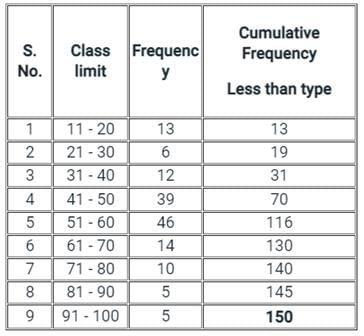
- In general the cumulative frequency( less than) type is considered as a cumulative frequency for the whole dataset.
- Therefore the cumulative frequency of the entire dataset is 150.
Most Upvoted Answer
Comprehension:Directions: Consider the following data and answer quest...
Key Points
- In Statistics, a cumulative frequency is defined as the total of frequencies, that are distributed over different class intervals. It means that the data and the total are represented in the form of a table in which the frequencies are distributed according to the class interval.
- The cumulative frequency is calculated by adding each frequency from a frequency distribution table to the sum of its predecessors. The last value will always be equal to the total for all observations since all frequencies will already have been added to the previous total.
- A table that displays the cumulative frequencies that are distributed over various classes is called a cumulative frequency distribution or cumulative frequency table.
- There are two types of cumulative frequency - lesser than type and greater than typical. Cumulative frequency is used to know the number of observations that lie above (or below) a particular frequency in a given data set. Let us look at a few examples that are used in many real-world situations.
- In general the cumulative frequency( less than) type is considered as a cumulative frequency for the whole dataset.
- Therefore the cumulative frequency of the entire dataset is 150.
 | Explore Courses for SAT exam |  |
Top Courses for SATView all





Top Courses for SAT
Question Description
Comprehension:Directions: Consider the following data and answer questions:Which one of the following is the cumulative frequency of the entire data set?a)150b)160c)140d)120Correct answer is option 'A'. Can you explain this answer? for SAT 2026 is part of SAT preparation. The Question and answers have been prepared according to the SAT exam syllabus. Information about Comprehension:Directions: Consider the following data and answer questions:Which one of the following is the cumulative frequency of the entire data set?a)150b)160c)140d)120Correct answer is option 'A'. Can you explain this answer? covers all topics & solutions for SAT 2026 Exam. Find important definitions, questions, meanings, examples, exercises and tests below for Comprehension:Directions: Consider the following data and answer questions:Which one of the following is the cumulative frequency of the entire data set?a)150b)160c)140d)120Correct answer is option 'A'. Can you explain this answer?.
Comprehension:Directions: Consider the following data and answer questions:Which one of the following is the cumulative frequency of the entire data set?a)150b)160c)140d)120Correct answer is option 'A'. Can you explain this answer? for SAT 2026 is part of SAT preparation. The Question and answers have been prepared according to the SAT exam syllabus. Information about Comprehension:Directions: Consider the following data and answer questions:Which one of the following is the cumulative frequency of the entire data set?a)150b)160c)140d)120Correct answer is option 'A'. Can you explain this answer? covers all topics & solutions for SAT 2026 Exam. Find important definitions, questions, meanings, examples, exercises and tests below for Comprehension:Directions: Consider the following data and answer questions:Which one of the following is the cumulative frequency of the entire data set?a)150b)160c)140d)120Correct answer is option 'A'. Can you explain this answer?.
Solutions for Comprehension:Directions: Consider the following data and answer questions:Which one of the following is the cumulative frequency of the entire data set?a)150b)160c)140d)120Correct answer is option 'A'. Can you explain this answer? in English & in Hindi are available as part of our courses for SAT. Download more important topics, notes, lectures and mock test series for SAT Exam by signing up for free.
Here you can find the meaning of Comprehension:Directions: Consider the following data and answer questions:Which one of the following is the cumulative frequency of the entire data set?a)150b)160c)140d)120Correct answer is option 'A'. Can you explain this answer? defined & explained in the simplest way possible. Besides giving the explanation of Comprehension:Directions: Consider the following data and answer questions:Which one of the following is the cumulative frequency of the entire data set?a)150b)160c)140d)120Correct answer is option 'A'. Can you explain this answer?, a detailed solution for Comprehension:Directions: Consider the following data and answer questions:Which one of the following is the cumulative frequency of the entire data set?a)150b)160c)140d)120Correct answer is option 'A'. Can you explain this answer? has been provided alongside types of Comprehension:Directions: Consider the following data and answer questions:Which one of the following is the cumulative frequency of the entire data set?a)150b)160c)140d)120Correct answer is option 'A'. Can you explain this answer? theory, EduRev gives you an ample number of questions to practice Comprehension:Directions: Consider the following data and answer questions:Which one of the following is the cumulative frequency of the entire data set?a)150b)160c)140d)120Correct answer is option 'A'. Can you explain this answer? tests, examples and also practice SAT tests.
| Explore Courses for SAT exam | |
Top Courses for SAT
Explore Courses
Signup for Free!
Signup to see your scores go up within 7 days! Learn & Practice with 1000+ FREE Notes, Videos & Tests.


