


Electrical Engineering (EE) Exam > Electrical Engineering (EE) Questions > A string is wound over a circular disc. It is... Start Learning for Free
A string is wound over a circular disc. It is now unwound with its “free end” letting it remain tight and tangent to the disc. The curve traced by the “free end” is
- a)Spiral
- b)Involute
- c)Cycloid
- d)Epicycloid
Correct answer is option 'B'. Can you explain this answer?

Most Upvoted Answer
A string is wound over a circular disc. It is now unwound with its &ld...
Involute
- Involute is the curve traced by a point on a chord as it unwinds (but remains tight) around a circle
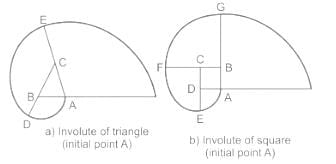
- Alternatively, an involute may be defined as the curve traced by a point on a straight line which rolls around a circle or polygon without slip
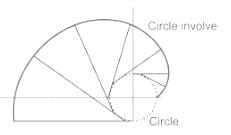
- Depending on the plane shape around which the line rolls, the involutes are named as involute of a triangle, involute of a square, involute of a polygon, involute of a circle etc
- Application: The most common application of involute is seen in the manufacture of gears. The profile of a gear tooth is the shape of an involute
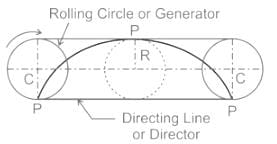
Cycloid: When the generating circle rolls on a straight line, the path of the point is a cycloid.
Epicycloid: When the generating circle rolls on the outside (convex side) of a larger circle, the path of the point is an epicycloid.
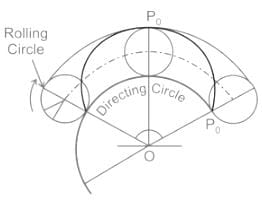
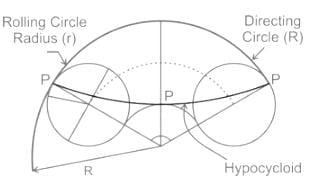
Hypocycloid: When the generating circle rolls on the inside (concave side) of a larger circle, the path of the point is a hypocycloid.
Free Test
FREE
| Start Free Test |
Community Answer
A string is wound over a circular disc. It is now unwound with its &ld...
Understanding the Involute Curve
When a string is wound around a circular disc and unwound while maintaining tension, the path traced by the free end of the string forms a specific geometric shape known as an involute.
Key Characteristics of the Involute:
- The involute of a curve is generated by tracing the end of a taut string as it unwinds from the curve.
- For a circular disc, the involute is derived from the circular path of the disc.
- As the string unwinds, it remains tangent to the disc at the point of contact.
Why the Involute?
- The involute reflects the relationship between the length of the string and the radius of the disc.
- The unwinding process keeps the string straight and tight, creating a unique spiral-like path that diverges from the disc.
- As the radius of the disc decreases (due to unwinding), the involute continues to extend outward.
Visual Representation:
- Imagine the disc as a circle and the string as a line that starts from the edge of the circle.
- As you pull the string away from the disc, the path it traces is not simply circular but forms a spiral-like curve that is characteristic of an involute.
Conclusion:
The curve traced by the free end of the unwound string is an involute, showcasing the elegant geometric properties of curves and the relationship between tension and motion. Understanding this concept has applications in various fields, including mechanical engineering and design, particularly in the analysis of gears and belts.
When a string is wound around a circular disc and unwound while maintaining tension, the path traced by the free end of the string forms a specific geometric shape known as an involute.
Key Characteristics of the Involute:
- The involute of a curve is generated by tracing the end of a taut string as it unwinds from the curve.
- For a circular disc, the involute is derived from the circular path of the disc.
- As the string unwinds, it remains tangent to the disc at the point of contact.
Why the Involute?
- The involute reflects the relationship between the length of the string and the radius of the disc.
- The unwinding process keeps the string straight and tight, creating a unique spiral-like path that diverges from the disc.
- As the radius of the disc decreases (due to unwinding), the involute continues to extend outward.
Visual Representation:
- Imagine the disc as a circle and the string as a line that starts from the edge of the circle.
- As you pull the string away from the disc, the path it traces is not simply circular but forms a spiral-like curve that is characteristic of an involute.
Conclusion:
The curve traced by the free end of the unwound string is an involute, showcasing the elegant geometric properties of curves and the relationship between tension and motion. Understanding this concept has applications in various fields, including mechanical engineering and design, particularly in the analysis of gears and belts.
 | Explore Courses for Electrical Engineering (EE) exam |  |
Top Courses for Electrical Engineering (EE)View all




Top Courses for Electrical Engineering (EE)
Question Description
A string is wound over a circular disc. It is now unwound with its “free end” letting it remain tight and tangent to the disc. The curve traced by the “free end” isa)Spiralb)Involutec)Cycloidd)EpicycloidCorrect answer is option 'B'. Can you explain this answer? for Electrical Engineering (EE) 2026 is part of Electrical Engineering (EE) preparation. The Question and answers have been prepared according to the Electrical Engineering (EE) exam syllabus. Information about A string is wound over a circular disc. It is now unwound with its “free end” letting it remain tight and tangent to the disc. The curve traced by the “free end” isa)Spiralb)Involutec)Cycloidd)EpicycloidCorrect answer is option 'B'. Can you explain this answer? covers all topics & solutions for Electrical Engineering (EE) 2026 Exam. Find important definitions, questions, meanings, examples, exercises and tests below for A string is wound over a circular disc. It is now unwound with its “free end” letting it remain tight and tangent to the disc. The curve traced by the “free end” isa)Spiralb)Involutec)Cycloidd)EpicycloidCorrect answer is option 'B'. Can you explain this answer?.
A string is wound over a circular disc. It is now unwound with its “free end” letting it remain tight and tangent to the disc. The curve traced by the “free end” isa)Spiralb)Involutec)Cycloidd)EpicycloidCorrect answer is option 'B'. Can you explain this answer? for Electrical Engineering (EE) 2026 is part of Electrical Engineering (EE) preparation. The Question and answers have been prepared according to the Electrical Engineering (EE) exam syllabus. Information about A string is wound over a circular disc. It is now unwound with its “free end” letting it remain tight and tangent to the disc. The curve traced by the “free end” isa)Spiralb)Involutec)Cycloidd)EpicycloidCorrect answer is option 'B'. Can you explain this answer? covers all topics & solutions for Electrical Engineering (EE) 2026 Exam. Find important definitions, questions, meanings, examples, exercises and tests below for A string is wound over a circular disc. It is now unwound with its “free end” letting it remain tight and tangent to the disc. The curve traced by the “free end” isa)Spiralb)Involutec)Cycloidd)EpicycloidCorrect answer is option 'B'. Can you explain this answer?.
Solutions for A string is wound over a circular disc. It is now unwound with its “free end” letting it remain tight and tangent to the disc. The curve traced by the “free end” isa)Spiralb)Involutec)Cycloidd)EpicycloidCorrect answer is option 'B'. Can you explain this answer? in English & in Hindi are available as part of our courses for Electrical Engineering (EE). Download more important topics, notes, lectures and mock test series for Electrical Engineering (EE) Exam by signing up for free.
Here you can find the meaning of A string is wound over a circular disc. It is now unwound with its “free end” letting it remain tight and tangent to the disc. The curve traced by the “free end” isa)Spiralb)Involutec)Cycloidd)EpicycloidCorrect answer is option 'B'. Can you explain this answer? defined & explained in the simplest way possible. Besides giving the explanation of A string is wound over a circular disc. It is now unwound with its “free end” letting it remain tight and tangent to the disc. The curve traced by the “free end” isa)Spiralb)Involutec)Cycloidd)EpicycloidCorrect answer is option 'B'. Can you explain this answer?, a detailed solution for A string is wound over a circular disc. It is now unwound with its “free end” letting it remain tight and tangent to the disc. The curve traced by the “free end” isa)Spiralb)Involutec)Cycloidd)EpicycloidCorrect answer is option 'B'. Can you explain this answer? has been provided alongside types of A string is wound over a circular disc. It is now unwound with its “free end” letting it remain tight and tangent to the disc. The curve traced by the “free end” isa)Spiralb)Involutec)Cycloidd)EpicycloidCorrect answer is option 'B'. Can you explain this answer? theory, EduRev gives you an ample number of questions to practice A string is wound over a circular disc. It is now unwound with its “free end” letting it remain tight and tangent to the disc. The curve traced by the “free end” isa)Spiralb)Involutec)Cycloidd)EpicycloidCorrect answer is option 'B'. Can you explain this answer? tests, examples and also practice Electrical Engineering (EE) tests.
| Explore Courses for Electrical Engineering (EE) exam | |
Top Courses for Electrical Engineering (EE)
Explore Courses
Signup for Free!
Signup to see your scores go up within 7 days! Learn & Practice with 1000+ FREE Notes, Videos & Tests.


