


MCAT Exam > MCAT Questions > Which of the following cyclic hydrocarbon str... Start Learning for Free
Which of the following cyclic hydrocarbon structures would be NOT categorized as an achiral compound?
- a)
- b)
- c)
- d)
Correct answer is option 'D'. Can you explain this answer?

Most Upvoted Answer
Which of the following cyclic hydrocarbon structures would be NOT cate...
- There are two possibilities here for achirality. The first case is that there are no stereocenters on a particular molecule, and the second case is when a compound has a stereocenter, it can be achiral only when it is a meso compound.
- A meso compound is the non-optically active member of a set of stereoisomers, which necessarily have at least 2 stereocenters. It can be identified by an internal plane of symmetry, but sometimes a point or axis of symmetry, like in axial symmetry.
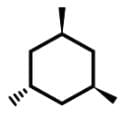
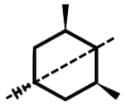
- For c,c,t-1, 3, 5-trimethylcyclohexane, this achiral compound has a plane of symmetry through C2 and C5:
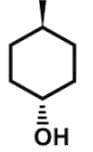
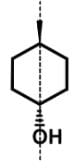
- For 4-methyl-1-cyclohexanol, this achiral compound has a plane of symmetry through C1 and C4:
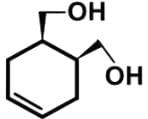
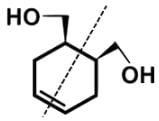
- For cyclohex-4-ene-1,2-diyldimethanol, there is a plane of symmetry bisecting the double bond between C-4 and C-5:
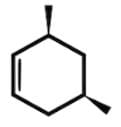
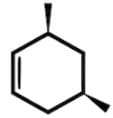
- The remaining compound, 3,5-dimethyl-cyclo-1-hexene, is not an achiral compound and will rotate plane-polarized light as a chiral compound due to a lack of a plane or axis of symmetry.
Free Test
FREE
| Start Free Test |
Community Answer
Which of the following cyclic hydrocarbon structures would be NOT cate...
- There are two possibilities here for achirality. The first case is that there are no stereocenters on a particular molecule, and the second case is when a compound has a stereocenter, it can be achiral only when it is a meso compound.
- A meso compound is the non-optically active member of a set of stereoisomers, which necessarily have at least 2 stereocenters. It can be identified by an internal plane of symmetry, but sometimes a point or axis of symmetry, like in axial symmetry.
- For c,c,t-1, 3, 5-trimethylcyclohexane, this achiral compound has a plane of symmetry through C2 and C5:
- For 4-methyl-1-cyclohexanol, this achiral compound has a plane of symmetry through C1 and C4:
- For cyclohex-4-ene-1,2-diyldimethanol, there is a plane of symmetry bisecting the double bond between C-4 and C-5:
- The remaining compound, 3,5-dimethyl-cyclo-1-hexene, is not an achiral compound and will rotate plane-polarized light as a chiral compound due to a lack of a plane or axis of symmetry.
 | Explore Courses for MCAT exam |  |
Top Courses for MCATView all





Top Courses for MCAT
Question Description
Which of the following cyclic hydrocarbon structures would be NOT categorized as an achiral compound?a)b)c)d)Correct answer is option 'D'. Can you explain this answer? for MCAT 2026 is part of MCAT preparation. The Question and answers have been prepared according to the MCAT exam syllabus. Information about Which of the following cyclic hydrocarbon structures would be NOT categorized as an achiral compound?a)b)c)d)Correct answer is option 'D'. Can you explain this answer? covers all topics & solutions for MCAT 2026 Exam. Find important definitions, questions, meanings, examples, exercises and tests below for Which of the following cyclic hydrocarbon structures would be NOT categorized as an achiral compound?a)b)c)d)Correct answer is option 'D'. Can you explain this answer?.
Which of the following cyclic hydrocarbon structures would be NOT categorized as an achiral compound?a)b)c)d)Correct answer is option 'D'. Can you explain this answer? for MCAT 2026 is part of MCAT preparation. The Question and answers have been prepared according to the MCAT exam syllabus. Information about Which of the following cyclic hydrocarbon structures would be NOT categorized as an achiral compound?a)b)c)d)Correct answer is option 'D'. Can you explain this answer? covers all topics & solutions for MCAT 2026 Exam. Find important definitions, questions, meanings, examples, exercises and tests below for Which of the following cyclic hydrocarbon structures would be NOT categorized as an achiral compound?a)b)c)d)Correct answer is option 'D'. Can you explain this answer?.
Solutions for Which of the following cyclic hydrocarbon structures would be NOT categorized as an achiral compound?a)b)c)d)Correct answer is option 'D'. Can you explain this answer? in English & in Hindi are available as part of our courses for MCAT. Download more important topics, notes, lectures and mock test series for MCAT Exam by signing up for free.
Here you can find the meaning of Which of the following cyclic hydrocarbon structures would be NOT categorized as an achiral compound?a)b)c)d)Correct answer is option 'D'. Can you explain this answer? defined & explained in the simplest way possible. Besides giving the explanation of Which of the following cyclic hydrocarbon structures would be NOT categorized as an achiral compound?a)b)c)d)Correct answer is option 'D'. Can you explain this answer?, a detailed solution for Which of the following cyclic hydrocarbon structures would be NOT categorized as an achiral compound?a)b)c)d)Correct answer is option 'D'. Can you explain this answer? has been provided alongside types of Which of the following cyclic hydrocarbon structures would be NOT categorized as an achiral compound?a)b)c)d)Correct answer is option 'D'. Can you explain this answer? theory, EduRev gives you an ample number of questions to practice Which of the following cyclic hydrocarbon structures would be NOT categorized as an achiral compound?a)b)c)d)Correct answer is option 'D'. Can you explain this answer? tests, examples and also practice MCAT tests.
| Explore Courses for MCAT exam | |
Top Courses for MCAT
Explore Courses
Signup for Free!
Signup to see your scores go up within 7 days! Learn & Practice with 1000+ FREE Notes, Videos & Tests.


