


Class 11 Exam > Class 11 Questions > Which statement is true for a ball thrown at ... Start Learning for Free
Which statement is true for a ball thrown at 20 degrees with the horizontal, when it is at the highest point in its trajectory?
- a)Its velocity is zero but its acceleration is nonzero
- b)Its velocity is nonzero but its acceleration is zero
- c)Its velocity and acceleration are both zero
- d)Its velocity is perpendicular to its acceleration
Correct answer is option 'D'. Can you explain this answer?

Verified Answer
Which statement is true for a ball thrown at 20 degrees with the horiz...
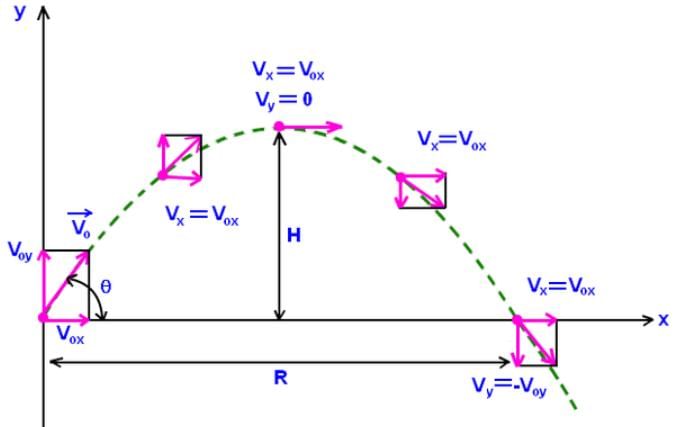
At the highest point in its trajectory, the acceleration (g) is acting in downward direction, whereas velocity of the projectile is only in the X (horizontal) direction.
Most Upvoted Answer
Which statement is true for a ball thrown at 20 degrees with the horiz...
Explanation:
When a ball is thrown at 20 degrees with the horizontal, it follows a curved path called a projectile motion. At the highest point, the ball stops moving upwards and starts to fall back down.
Velocity:
At the highest point, the ball's velocity is zero. This is because the ball has stopped moving upwards and has not yet started to fall downwards. Its velocity is perpendicular to the acceleration due to gravity.
Acceleration:
The acceleration due to gravity always acts downwards, towards the center of the earth. At the highest point, the ball's acceleration is still acting downwards, but its magnitude is zero. This is because the ball has momentarily stopped moving upwards and has not yet started to fall downwards.
Velocity and acceleration:
At the highest point, the ball's velocity and acceleration are perpendicular to each other. This is because the velocity is zero, and the acceleration is acting downwards towards the center of the earth.
Conclusion:
Therefore, option 'D' is the correct answer, as at the highest point in its trajectory, a ball thrown at 20 degrees with the horizontal has a velocity perpendicular to its acceleration.
When a ball is thrown at 20 degrees with the horizontal, it follows a curved path called a projectile motion. At the highest point, the ball stops moving upwards and starts to fall back down.
Velocity:
At the highest point, the ball's velocity is zero. This is because the ball has stopped moving upwards and has not yet started to fall downwards. Its velocity is perpendicular to the acceleration due to gravity.
Acceleration:
The acceleration due to gravity always acts downwards, towards the center of the earth. At the highest point, the ball's acceleration is still acting downwards, but its magnitude is zero. This is because the ball has momentarily stopped moving upwards and has not yet started to fall downwards.
Velocity and acceleration:
At the highest point, the ball's velocity and acceleration are perpendicular to each other. This is because the velocity is zero, and the acceleration is acting downwards towards the center of the earth.
Conclusion:
Therefore, option 'D' is the correct answer, as at the highest point in its trajectory, a ball thrown at 20 degrees with the horizontal has a velocity perpendicular to its acceleration.
Free Test
FREE
| Start Free Test |
Community Answer
Which statement is true for a ball thrown at 20 degrees with the horiz...
At max height a= gravity acts downwards and u acts horizontally always in projectiles

 | Explore Courses for Class 11 exam |  |
Top Courses for Class 11View all





Top Courses for Class 11
Question Description
Which statement is true for a ball thrown at 20 degrees with the horizontal, when it is at the highest point in its trajectory?a)Its velocity is zero but its acceleration is nonzerob)Its velocity is nonzero but its acceleration is zeroc)Its velocity and acceleration are both zerod)Its velocity is perpendicular to its accelerationCorrect answer is option 'D'. Can you explain this answer? for Class 11 2026 is part of Class 11 preparation. The Question and answers have been prepared according to the Class 11 exam syllabus. Information about Which statement is true for a ball thrown at 20 degrees with the horizontal, when it is at the highest point in its trajectory?a)Its velocity is zero but its acceleration is nonzerob)Its velocity is nonzero but its acceleration is zeroc)Its velocity and acceleration are both zerod)Its velocity is perpendicular to its accelerationCorrect answer is option 'D'. Can you explain this answer? covers all topics & solutions for Class 11 2026 Exam. Find important definitions, questions, meanings, examples, exercises and tests below for Which statement is true for a ball thrown at 20 degrees with the horizontal, when it is at the highest point in its trajectory?a)Its velocity is zero but its acceleration is nonzerob)Its velocity is nonzero but its acceleration is zeroc)Its velocity and acceleration are both zerod)Its velocity is perpendicular to its accelerationCorrect answer is option 'D'. Can you explain this answer?.
Which statement is true for a ball thrown at 20 degrees with the horizontal, when it is at the highest point in its trajectory?a)Its velocity is zero but its acceleration is nonzerob)Its velocity is nonzero but its acceleration is zeroc)Its velocity and acceleration are both zerod)Its velocity is perpendicular to its accelerationCorrect answer is option 'D'. Can you explain this answer? for Class 11 2026 is part of Class 11 preparation. The Question and answers have been prepared according to the Class 11 exam syllabus. Information about Which statement is true for a ball thrown at 20 degrees with the horizontal, when it is at the highest point in its trajectory?a)Its velocity is zero but its acceleration is nonzerob)Its velocity is nonzero but its acceleration is zeroc)Its velocity and acceleration are both zerod)Its velocity is perpendicular to its accelerationCorrect answer is option 'D'. Can you explain this answer? covers all topics & solutions for Class 11 2026 Exam. Find important definitions, questions, meanings, examples, exercises and tests below for Which statement is true for a ball thrown at 20 degrees with the horizontal, when it is at the highest point in its trajectory?a)Its velocity is zero but its acceleration is nonzerob)Its velocity is nonzero but its acceleration is zeroc)Its velocity and acceleration are both zerod)Its velocity is perpendicular to its accelerationCorrect answer is option 'D'. Can you explain this answer?.
Solutions for Which statement is true for a ball thrown at 20 degrees with the horizontal, when it is at the highest point in its trajectory?a)Its velocity is zero but its acceleration is nonzerob)Its velocity is nonzero but its acceleration is zeroc)Its velocity and acceleration are both zerod)Its velocity is perpendicular to its accelerationCorrect answer is option 'D'. Can you explain this answer? in English & in Hindi are available as part of our courses for Class 11. Download more important topics, notes, lectures and mock test series for Class 11 Exam by signing up for free.
Here you can find the meaning of Which statement is true for a ball thrown at 20 degrees with the horizontal, when it is at the highest point in its trajectory?a)Its velocity is zero but its acceleration is nonzerob)Its velocity is nonzero but its acceleration is zeroc)Its velocity and acceleration are both zerod)Its velocity is perpendicular to its accelerationCorrect answer is option 'D'. Can you explain this answer? defined & explained in the simplest way possible. Besides giving the explanation of Which statement is true for a ball thrown at 20 degrees with the horizontal, when it is at the highest point in its trajectory?a)Its velocity is zero but its acceleration is nonzerob)Its velocity is nonzero but its acceleration is zeroc)Its velocity and acceleration are both zerod)Its velocity is perpendicular to its accelerationCorrect answer is option 'D'. Can you explain this answer?, a detailed solution for Which statement is true for a ball thrown at 20 degrees with the horizontal, when it is at the highest point in its trajectory?a)Its velocity is zero but its acceleration is nonzerob)Its velocity is nonzero but its acceleration is zeroc)Its velocity and acceleration are both zerod)Its velocity is perpendicular to its accelerationCorrect answer is option 'D'. Can you explain this answer? has been provided alongside types of Which statement is true for a ball thrown at 20 degrees with the horizontal, when it is at the highest point in its trajectory?a)Its velocity is zero but its acceleration is nonzerob)Its velocity is nonzero but its acceleration is zeroc)Its velocity and acceleration are both zerod)Its velocity is perpendicular to its accelerationCorrect answer is option 'D'. Can you explain this answer? theory, EduRev gives you an ample number of questions to practice Which statement is true for a ball thrown at 20 degrees with the horizontal, when it is at the highest point in its trajectory?a)Its velocity is zero but its acceleration is nonzerob)Its velocity is nonzero but its acceleration is zeroc)Its velocity and acceleration are both zerod)Its velocity is perpendicular to its accelerationCorrect answer is option 'D'. Can you explain this answer? tests, examples and also practice Class 11 tests.
| Explore Courses for Class 11 exam | |
Top Courses for Class 11
Explore Courses
Signup for Free!
Signup to see your scores go up within 7 days! Learn & Practice with 1000+ FREE Notes, Videos & Tests.


