


Class 12 Exam > Class 12 Questions > The critical angle for the material of a pris... Start Learning for Free
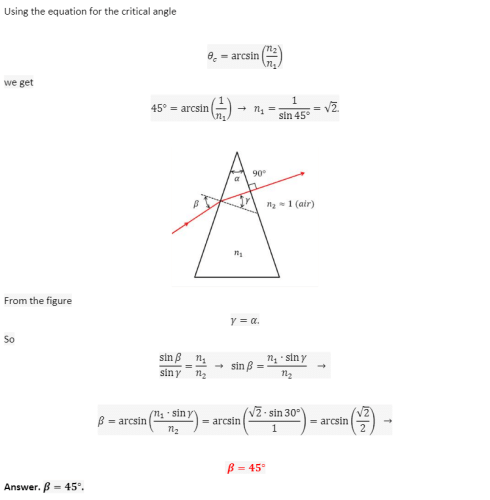
The critical angle for the material of a prism is 45° and its refracting angle is 30°. A monochromatic ray goes out perpendicular to the surface of emergence from the prism. What is the angle of incidence on the prism?
- a)60°
- b)75°
- c)30°
- d)45°
Correct answer is option 'D'. Can you explain this answer?

Verified Answer
The critical angle for the material of a prism is 45° and its ref...
Most Upvoted Answer
The critical angle for the material of a prism is 45° and its ref...
°. This means that when light enters the prism at an angle greater than 45° with respect to the normal (the perpendicular line to the surface of the prism), it will be totally reflected back into the material of the prism. This phenomenon is known as total internal reflection.
The critical angle is dependent on the refractive index of the material of the prism, which is a measure of how much the material bends light as it passes through it. Different materials have different refractive indices, which is why the critical angle varies from material to material.
Prisms are commonly used in optics to bend and refract light, and they are an important component in many optical devices such as cameras, telescopes, and microscopes. Understanding the critical angle of a prism is crucial for designing and optimizing these devices.
The critical angle is dependent on the refractive index of the material of the prism, which is a measure of how much the material bends light as it passes through it. Different materials have different refractive indices, which is why the critical angle varies from material to material.
Prisms are commonly used in optics to bend and refract light, and they are an important component in many optical devices such as cameras, telescopes, and microscopes. Understanding the critical angle of a prism is crucial for designing and optimizing these devices.
Free Test
FREE
| Start Free Test |
Community Answer
The critical angle for the material of a prism is 45° and its ref...
This 45
 | Explore Courses for Class 12 exam |  |
Top Courses for Class 12View all





Top Courses for Class 12
Question Description
The critical angle for the material of a prism is 45° and its refracting angle is 30°. A monochromatic ray goes out perpendicular to the surface of emergence from the prism. What is the angle of incidence on the prism?a)60°b)75°c)30°d)45°Correct answer is option 'D'. Can you explain this answer? for Class 12 2026 is part of Class 12 preparation. The Question and answers have been prepared according to the Class 12 exam syllabus. Information about The critical angle for the material of a prism is 45° and its refracting angle is 30°. A monochromatic ray goes out perpendicular to the surface of emergence from the prism. What is the angle of incidence on the prism?a)60°b)75°c)30°d)45°Correct answer is option 'D'. Can you explain this answer? covers all topics & solutions for Class 12 2026 Exam. Find important definitions, questions, meanings, examples, exercises and tests below for The critical angle for the material of a prism is 45° and its refracting angle is 30°. A monochromatic ray goes out perpendicular to the surface of emergence from the prism. What is the angle of incidence on the prism?a)60°b)75°c)30°d)45°Correct answer is option 'D'. Can you explain this answer?.
The critical angle for the material of a prism is 45° and its refracting angle is 30°. A monochromatic ray goes out perpendicular to the surface of emergence from the prism. What is the angle of incidence on the prism?a)60°b)75°c)30°d)45°Correct answer is option 'D'. Can you explain this answer? for Class 12 2026 is part of Class 12 preparation. The Question and answers have been prepared according to the Class 12 exam syllabus. Information about The critical angle for the material of a prism is 45° and its refracting angle is 30°. A monochromatic ray goes out perpendicular to the surface of emergence from the prism. What is the angle of incidence on the prism?a)60°b)75°c)30°d)45°Correct answer is option 'D'. Can you explain this answer? covers all topics & solutions for Class 12 2026 Exam. Find important definitions, questions, meanings, examples, exercises and tests below for The critical angle for the material of a prism is 45° and its refracting angle is 30°. A monochromatic ray goes out perpendicular to the surface of emergence from the prism. What is the angle of incidence on the prism?a)60°b)75°c)30°d)45°Correct answer is option 'D'. Can you explain this answer?.
Solutions for The critical angle for the material of a prism is 45° and its refracting angle is 30°. A monochromatic ray goes out perpendicular to the surface of emergence from the prism. What is the angle of incidence on the prism?a)60°b)75°c)30°d)45°Correct answer is option 'D'. Can you explain this answer? in English & in Hindi are available as part of our courses for Class 12. Download more important topics, notes, lectures and mock test series for Class 12 Exam by signing up for free.
Here you can find the meaning of The critical angle for the material of a prism is 45° and its refracting angle is 30°. A monochromatic ray goes out perpendicular to the surface of emergence from the prism. What is the angle of incidence on the prism?a)60°b)75°c)30°d)45°Correct answer is option 'D'. Can you explain this answer? defined & explained in the simplest way possible. Besides giving the explanation of The critical angle for the material of a prism is 45° and its refracting angle is 30°. A monochromatic ray goes out perpendicular to the surface of emergence from the prism. What is the angle of incidence on the prism?a)60°b)75°c)30°d)45°Correct answer is option 'D'. Can you explain this answer?, a detailed solution for The critical angle for the material of a prism is 45° and its refracting angle is 30°. A monochromatic ray goes out perpendicular to the surface of emergence from the prism. What is the angle of incidence on the prism?a)60°b)75°c)30°d)45°Correct answer is option 'D'. Can you explain this answer? has been provided alongside types of The critical angle for the material of a prism is 45° and its refracting angle is 30°. A monochromatic ray goes out perpendicular to the surface of emergence from the prism. What is the angle of incidence on the prism?a)60°b)75°c)30°d)45°Correct answer is option 'D'. Can you explain this answer? theory, EduRev gives you an ample number of questions to practice The critical angle for the material of a prism is 45° and its refracting angle is 30°. A monochromatic ray goes out perpendicular to the surface of emergence from the prism. What is the angle of incidence on the prism?a)60°b)75°c)30°d)45°Correct answer is option 'D'. Can you explain this answer? tests, examples and also practice Class 12 tests.
| Explore Courses for Class 12 exam | |
Top Courses for Class 12
Explore Courses
Signup for Free!
Signup to see your scores go up within 7 days! Learn & Practice with 1000+ FREE Notes, Videos & Tests.


