


NEET Exam > NEET Questions > Fill in the blanks in the different columns o... Start Learning for Free
Fill in the blanks in the different columns of the table given below
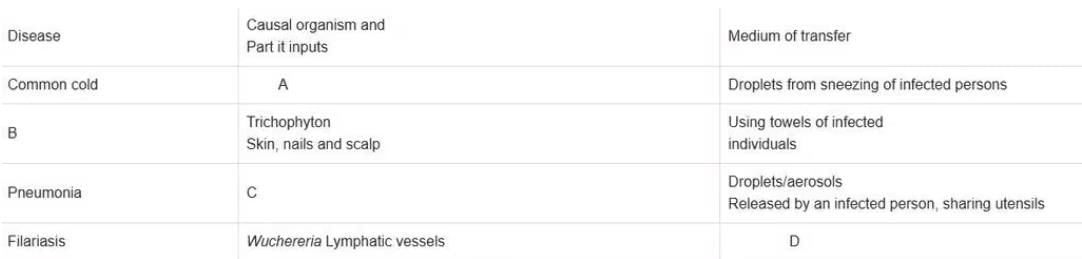
- a)A- Rhinovirus. Nose and respiratory passage not lungs
B - Ringworm
C - Haemophilus influenzae. Alveoli of lungs
D - Contaminated food and water - b)A- Coryza virus. Alveoli of lungs
B - Ringworm
C - Streptococcus pneumoniae. Nose and respiratory passage
D - Culex mosquito - c)A- Rhinovirus. Nose and respiratory passage not lungs
B - Ascariasis
C - Haemophilus influenzae. Lungs
D - Culex mosquito - d)A- Rhinovirus. Nose and respiratory passage not lungs
B - Ringworm
C - Haemophilus influenzae. Alveoli of lungs
D - Culex mosquito
Correct answer is option 'D'. Can you explain this answer?

Most Upvoted Answer
Fill in the blanks in the different columns of the table given belowa)...
-Rhino viruses represent one such group of viruses which cause one of the most infectious human ailments – the common cold. They infect the nose and respiratory passage but not the lungs. The common cold is characterised by nasal congestion and discharge, sore throat, hoarseness, cough, headache, tiredness, etc., which usually last for 3-7 days. Droplets resulting from cough or sneezes of an infected person.
-Bacteria like Streptococcus pneumoniae and Haemophilus influenzae are responsible for the disease pneumonia in humans which infects the alveoli (air filled sacs) of the lungs. As a result of the infection, the alveoli get filled with fluid leading to severe problems in respiration. The symptoms of pneumonia include fever, chills, cough and headache.
- Wuchereria (W. bancrofti and W. malayi), the filarial worms cause a slowly developing chronic inflammation of the organs in which they live for many years, usually the lymphatic vessels of the lower limbs and the disease is called elephantiasis or filariasis . The genital organs are also often affected, resulting in gross deformities. The pathogens are transmitted to a healthy person through the bite by the female mosquito vectors - culex mosquito
- Many fungi belonging to the genera Microsporum, Trichophyton and Epidermophyton are responsible for ringworms which is one of the most common infectious diseases in man. Appearance of dry, scaly lesions on various parts of the body such as skin, nails and scalp (Figure 7.3) are the main symptoms of the disease
-Bacteria like Streptococcus pneumoniae and Haemophilus influenzae are responsible for the disease pneumonia in humans which infects the alveoli (air filled sacs) of the lungs. As a result of the infection, the alveoli get filled with fluid leading to severe problems in respiration. The symptoms of pneumonia include fever, chills, cough and headache.
- Wuchereria (W. bancrofti and W. malayi), the filarial worms cause a slowly developing chronic inflammation of the organs in which they live for many years, usually the lymphatic vessels of the lower limbs and the disease is called elephantiasis or filariasis . The genital organs are also often affected, resulting in gross deformities. The pathogens are transmitted to a healthy person through the bite by the female mosquito vectors - culex mosquito
- Many fungi belonging to the genera Microsporum, Trichophyton and Epidermophyton are responsible for ringworms which is one of the most common infectious diseases in man. Appearance of dry, scaly lesions on various parts of the body such as skin, nails and scalp (Figure 7.3) are the main symptoms of the disease
 | Explore Courses for NEET exam |  |
Top Courses for NEETView all





Top Courses for NEET
Question Description
Fill in the blanks in the different columns of the table given belowa)A- Rhinovirus. Nose and respiratory passage not lungsB - RingwormC -Haemophilus influenzae. Alveoli of lungsD - Contaminated food and waterb)A- Coryza virus. Alveoli of lungsB - RingwormC -Streptococcus pneumoniae. Nose and respiratory passageD -Culexmosquitoc)A- Rhinovirus. Nose and respiratory passage not lungsB - AscariasisC -Haemophilus influenzae. LungsD -Culexmosquitod)A- Rhinovirus. Nose and respiratory passage not lungsB - RingwormC -Haemophilus influenzae. Alveoli of lungsD -CulexmosquitoCorrect answer is option 'D'. Can you explain this answer? for NEET 2026 is part of NEET preparation. The Question and answers have been prepared according to the NEET exam syllabus. Information about Fill in the blanks in the different columns of the table given belowa)A- Rhinovirus. Nose and respiratory passage not lungsB - RingwormC -Haemophilus influenzae. Alveoli of lungsD - Contaminated food and waterb)A- Coryza virus. Alveoli of lungsB - RingwormC -Streptococcus pneumoniae. Nose and respiratory passageD -Culexmosquitoc)A- Rhinovirus. Nose and respiratory passage not lungsB - AscariasisC -Haemophilus influenzae. LungsD -Culexmosquitod)A- Rhinovirus. Nose and respiratory passage not lungsB - RingwormC -Haemophilus influenzae. Alveoli of lungsD -CulexmosquitoCorrect answer is option 'D'. Can you explain this answer? covers all topics & solutions for NEET 2026 Exam. Find important definitions, questions, meanings, examples, exercises and tests below for Fill in the blanks in the different columns of the table given belowa)A- Rhinovirus. Nose and respiratory passage not lungsB - RingwormC -Haemophilus influenzae. Alveoli of lungsD - Contaminated food and waterb)A- Coryza virus. Alveoli of lungsB - RingwormC -Streptococcus pneumoniae. Nose and respiratory passageD -Culexmosquitoc)A- Rhinovirus. Nose and respiratory passage not lungsB - AscariasisC -Haemophilus influenzae. LungsD -Culexmosquitod)A- Rhinovirus. Nose and respiratory passage not lungsB - RingwormC -Haemophilus influenzae. Alveoli of lungsD -CulexmosquitoCorrect answer is option 'D'. Can you explain this answer?.
Fill in the blanks in the different columns of the table given belowa)A- Rhinovirus. Nose and respiratory passage not lungsB - RingwormC -Haemophilus influenzae. Alveoli of lungsD - Contaminated food and waterb)A- Coryza virus. Alveoli of lungsB - RingwormC -Streptococcus pneumoniae. Nose and respiratory passageD -Culexmosquitoc)A- Rhinovirus. Nose and respiratory passage not lungsB - AscariasisC -Haemophilus influenzae. LungsD -Culexmosquitod)A- Rhinovirus. Nose and respiratory passage not lungsB - RingwormC -Haemophilus influenzae. Alveoli of lungsD -CulexmosquitoCorrect answer is option 'D'. Can you explain this answer? for NEET 2026 is part of NEET preparation. The Question and answers have been prepared according to the NEET exam syllabus. Information about Fill in the blanks in the different columns of the table given belowa)A- Rhinovirus. Nose and respiratory passage not lungsB - RingwormC -Haemophilus influenzae. Alveoli of lungsD - Contaminated food and waterb)A- Coryza virus. Alveoli of lungsB - RingwormC -Streptococcus pneumoniae. Nose and respiratory passageD -Culexmosquitoc)A- Rhinovirus. Nose and respiratory passage not lungsB - AscariasisC -Haemophilus influenzae. LungsD -Culexmosquitod)A- Rhinovirus. Nose and respiratory passage not lungsB - RingwormC -Haemophilus influenzae. Alveoli of lungsD -CulexmosquitoCorrect answer is option 'D'. Can you explain this answer? covers all topics & solutions for NEET 2026 Exam. Find important definitions, questions, meanings, examples, exercises and tests below for Fill in the blanks in the different columns of the table given belowa)A- Rhinovirus. Nose and respiratory passage not lungsB - RingwormC -Haemophilus influenzae. Alveoli of lungsD - Contaminated food and waterb)A- Coryza virus. Alveoli of lungsB - RingwormC -Streptococcus pneumoniae. Nose and respiratory passageD -Culexmosquitoc)A- Rhinovirus. Nose and respiratory passage not lungsB - AscariasisC -Haemophilus influenzae. LungsD -Culexmosquitod)A- Rhinovirus. Nose and respiratory passage not lungsB - RingwormC -Haemophilus influenzae. Alveoli of lungsD -CulexmosquitoCorrect answer is option 'D'. Can you explain this answer?.
Solutions for Fill in the blanks in the different columns of the table given belowa)A- Rhinovirus. Nose and respiratory passage not lungsB - RingwormC -Haemophilus influenzae. Alveoli of lungsD - Contaminated food and waterb)A- Coryza virus. Alveoli of lungsB - RingwormC -Streptococcus pneumoniae. Nose and respiratory passageD -Culexmosquitoc)A- Rhinovirus. Nose and respiratory passage not lungsB - AscariasisC -Haemophilus influenzae. LungsD -Culexmosquitod)A- Rhinovirus. Nose and respiratory passage not lungsB - RingwormC -Haemophilus influenzae. Alveoli of lungsD -CulexmosquitoCorrect answer is option 'D'. Can you explain this answer? in English & in Hindi are available as part of our courses for NEET. Download more important topics, notes, lectures and mock test series for NEET Exam by signing up for free.
Here you can find the meaning of Fill in the blanks in the different columns of the table given belowa)A- Rhinovirus. Nose and respiratory passage not lungsB - RingwormC -Haemophilus influenzae. Alveoli of lungsD - Contaminated food and waterb)A- Coryza virus. Alveoli of lungsB - RingwormC -Streptococcus pneumoniae. Nose and respiratory passageD -Culexmosquitoc)A- Rhinovirus. Nose and respiratory passage not lungsB - AscariasisC -Haemophilus influenzae. LungsD -Culexmosquitod)A- Rhinovirus. Nose and respiratory passage not lungsB - RingwormC -Haemophilus influenzae. Alveoli of lungsD -CulexmosquitoCorrect answer is option 'D'. Can you explain this answer? defined & explained in the simplest way possible. Besides giving the explanation of Fill in the blanks in the different columns of the table given belowa)A- Rhinovirus. Nose and respiratory passage not lungsB - RingwormC -Haemophilus influenzae. Alveoli of lungsD - Contaminated food and waterb)A- Coryza virus. Alveoli of lungsB - RingwormC -Streptococcus pneumoniae. Nose and respiratory passageD -Culexmosquitoc)A- Rhinovirus. Nose and respiratory passage not lungsB - AscariasisC -Haemophilus influenzae. LungsD -Culexmosquitod)A- Rhinovirus. Nose and respiratory passage not lungsB - RingwormC -Haemophilus influenzae. Alveoli of lungsD -CulexmosquitoCorrect answer is option 'D'. Can you explain this answer?, a detailed solution for Fill in the blanks in the different columns of the table given belowa)A- Rhinovirus. Nose and respiratory passage not lungsB - RingwormC -Haemophilus influenzae. Alveoli of lungsD - Contaminated food and waterb)A- Coryza virus. Alveoli of lungsB - RingwormC -Streptococcus pneumoniae. Nose and respiratory passageD -Culexmosquitoc)A- Rhinovirus. Nose and respiratory passage not lungsB - AscariasisC -Haemophilus influenzae. LungsD -Culexmosquitod)A- Rhinovirus. Nose and respiratory passage not lungsB - RingwormC -Haemophilus influenzae. Alveoli of lungsD -CulexmosquitoCorrect answer is option 'D'. Can you explain this answer? has been provided alongside types of Fill in the blanks in the different columns of the table given belowa)A- Rhinovirus. Nose and respiratory passage not lungsB - RingwormC -Haemophilus influenzae. Alveoli of lungsD - Contaminated food and waterb)A- Coryza virus. Alveoli of lungsB - RingwormC -Streptococcus pneumoniae. Nose and respiratory passageD -Culexmosquitoc)A- Rhinovirus. Nose and respiratory passage not lungsB - AscariasisC -Haemophilus influenzae. LungsD -Culexmosquitod)A- Rhinovirus. Nose and respiratory passage not lungsB - RingwormC -Haemophilus influenzae. Alveoli of lungsD -CulexmosquitoCorrect answer is option 'D'. Can you explain this answer? theory, EduRev gives you an ample number of questions to practice Fill in the blanks in the different columns of the table given belowa)A- Rhinovirus. Nose and respiratory passage not lungsB - RingwormC -Haemophilus influenzae. Alveoli of lungsD - Contaminated food and waterb)A- Coryza virus. Alveoli of lungsB - RingwormC -Streptococcus pneumoniae. Nose and respiratory passageD -Culexmosquitoc)A- Rhinovirus. Nose and respiratory passage not lungsB - AscariasisC -Haemophilus influenzae. LungsD -Culexmosquitod)A- Rhinovirus. Nose and respiratory passage not lungsB - RingwormC -Haemophilus influenzae. Alveoli of lungsD -CulexmosquitoCorrect answer is option 'D'. Can you explain this answer? tests, examples and also practice NEET tests.
| Explore Courses for NEET exam | |
Top Courses for NEET
Explore Courses
Signup for Free!
Signup to see your scores go up within 7 days! Learn & Practice with 1000+ FREE Notes, Videos & Tests.


