


Class 11 Exam > Class 11 Questions > The escape velocity from a planet is v0. The ... Start Learning for Free
The escape velocity from a planet is v0. The escape velocity from a planet having twice the radius but same density will be -
- a)0.5 v0
- b)v0
- c)2v0
- d)4v0
Correct answer is option 'C'. Can you explain this answer?

Most Upvoted Answer
The escape velocity from a planet is v0. The escape velocity from a pl...
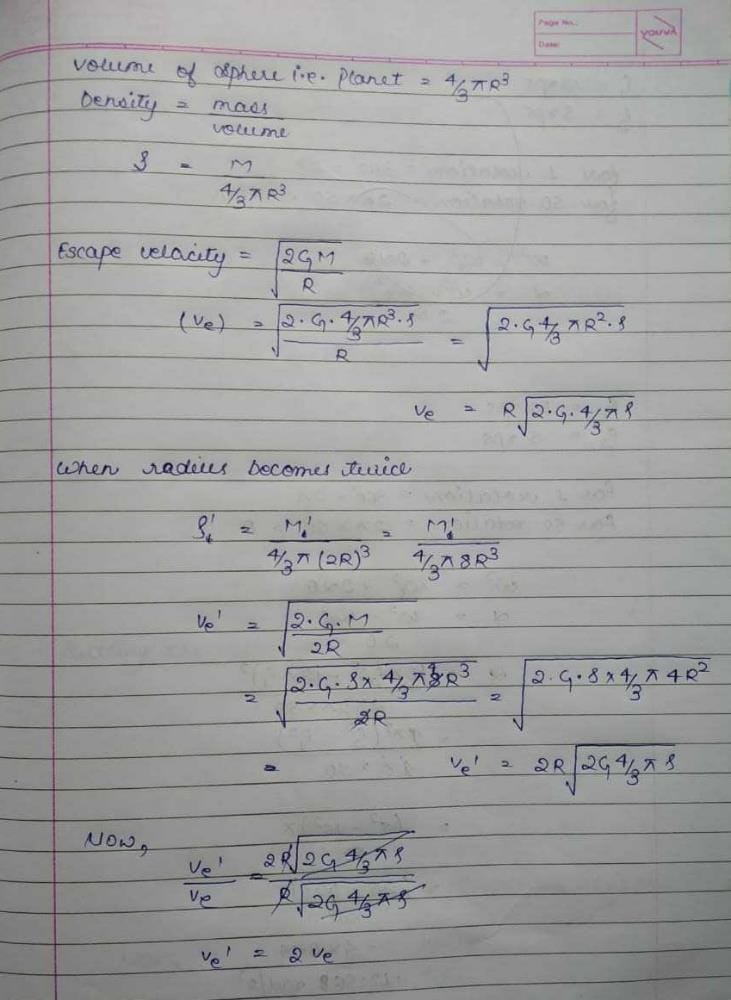
Community Answer
The escape velocity from a planet is v0. The escape velocity from a pl...
Escape Velocity and its Dependence on Radius and Density
Escape velocity is defined as the minimum velocity required by an object to escape the gravitational pull of a massive body. Mathematically, it is given by the formula:
v0 = sqrt(2GM/R)
where v0 is the escape velocity, G is the universal gravitational constant, M is the mass of the planet, and R is its radius.
Dependence on Radius
It is clear from the formula that the escape velocity is directly proportional to the square root of the mass of the planet and inversely proportional to the square root of its radius. Therefore, if we keep the mass of the planet constant and increase its radius, the escape velocity will decrease. This can be explained as follows:
As we increase the radius of the planet, the distance between the object and the center of the planet increases. This means that the gravitational force between the object and the planet decreases, since it is inversely proportional to the square of the distance between them. Therefore, the object needs a lower velocity to overcome the weaker gravitational pull and escape from the planet.
Dependence on Density
The density of a planet also affects its escape velocity. If we keep the mass and radius of the planet constant and change its density, the escape velocity will remain the same. This can be explained as follows:
The mass of the planet is directly proportional to its volume, which is given by the formula:
V = (4/3)πR^3
Since density is defined as mass per unit volume, we can write:
ρ = M/V = 3M/(4πR^3)
Therefore, if we increase the density of the planet, its mass will increase proportionately, but its radius will remain the same. This means that the escape velocity will also increase proportionately, since it is directly proportional to the square root of the mass and inversely proportional to the square root of the radius.
Answer to the Question
Now let's apply these concepts to answer the given question. We are given that the density of the planet remains the same, but its radius becomes twice the original value. Therefore, we can write:
R' = 2R
Since the mass of the planet remains the same, we can use the formula for escape velocity to find the new value:
v0' = sqrt(2GM/R')
= sqrt(2GM/(2R))
= sqrt(GM/R)
= sqrt(v0^2)
= v0
Therefore, the escape velocity from a planet having twice the radius but same density will be the same as the original escape velocity, which is given by option (b). However, it is important to note that if the density of the planet had also changed, the escape velocity would have been different, as explained above.
Escape velocity is defined as the minimum velocity required by an object to escape the gravitational pull of a massive body. Mathematically, it is given by the formula:
v0 = sqrt(2GM/R)
where v0 is the escape velocity, G is the universal gravitational constant, M is the mass of the planet, and R is its radius.
Dependence on Radius
It is clear from the formula that the escape velocity is directly proportional to the square root of the mass of the planet and inversely proportional to the square root of its radius. Therefore, if we keep the mass of the planet constant and increase its radius, the escape velocity will decrease. This can be explained as follows:
As we increase the radius of the planet, the distance between the object and the center of the planet increases. This means that the gravitational force between the object and the planet decreases, since it is inversely proportional to the square of the distance between them. Therefore, the object needs a lower velocity to overcome the weaker gravitational pull and escape from the planet.
Dependence on Density
The density of a planet also affects its escape velocity. If we keep the mass and radius of the planet constant and change its density, the escape velocity will remain the same. This can be explained as follows:
The mass of the planet is directly proportional to its volume, which is given by the formula:
V = (4/3)πR^3
Since density is defined as mass per unit volume, we can write:
ρ = M/V = 3M/(4πR^3)
Therefore, if we increase the density of the planet, its mass will increase proportionately, but its radius will remain the same. This means that the escape velocity will also increase proportionately, since it is directly proportional to the square root of the mass and inversely proportional to the square root of the radius.
Answer to the Question
Now let's apply these concepts to answer the given question. We are given that the density of the planet remains the same, but its radius becomes twice the original value. Therefore, we can write:
R' = 2R
Since the mass of the planet remains the same, we can use the formula for escape velocity to find the new value:
v0' = sqrt(2GM/R')
= sqrt(2GM/(2R))
= sqrt(GM/R)
= sqrt(v0^2)
= v0
Therefore, the escape velocity from a planet having twice the radius but same density will be the same as the original escape velocity, which is given by option (b). However, it is important to note that if the density of the planet had also changed, the escape velocity would have been different, as explained above.

 | Explore Courses for Class 11 exam |  |
Top Courses for Class 11View all




Top Courses for Class 11
Question Description
The escape velocity from a planet is v0. The escape velocity from a planet having twice the radius but same density will be -a)0.5 v0b)v0c)2v0d)4v0Correct answer is option 'C'. Can you explain this answer? for Class 11 2026 is part of Class 11 preparation. The Question and answers have been prepared according to the Class 11 exam syllabus. Information about The escape velocity from a planet is v0. The escape velocity from a planet having twice the radius but same density will be -a)0.5 v0b)v0c)2v0d)4v0Correct answer is option 'C'. Can you explain this answer? covers all topics & solutions for Class 11 2026 Exam. Find important definitions, questions, meanings, examples, exercises and tests below for The escape velocity from a planet is v0. The escape velocity from a planet having twice the radius but same density will be -a)0.5 v0b)v0c)2v0d)4v0Correct answer is option 'C'. Can you explain this answer?.
The escape velocity from a planet is v0. The escape velocity from a planet having twice the radius but same density will be -a)0.5 v0b)v0c)2v0d)4v0Correct answer is option 'C'. Can you explain this answer? for Class 11 2026 is part of Class 11 preparation. The Question and answers have been prepared according to the Class 11 exam syllabus. Information about The escape velocity from a planet is v0. The escape velocity from a planet having twice the radius but same density will be -a)0.5 v0b)v0c)2v0d)4v0Correct answer is option 'C'. Can you explain this answer? covers all topics & solutions for Class 11 2026 Exam. Find important definitions, questions, meanings, examples, exercises and tests below for The escape velocity from a planet is v0. The escape velocity from a planet having twice the radius but same density will be -a)0.5 v0b)v0c)2v0d)4v0Correct answer is option 'C'. Can you explain this answer?.
Solutions for The escape velocity from a planet is v0. The escape velocity from a planet having twice the radius but same density will be -a)0.5 v0b)v0c)2v0d)4v0Correct answer is option 'C'. Can you explain this answer? in English & in Hindi are available as part of our courses for Class 11. Download more important topics, notes, lectures and mock test series for Class 11 Exam by signing up for free.
Here you can find the meaning of The escape velocity from a planet is v0. The escape velocity from a planet having twice the radius but same density will be -a)0.5 v0b)v0c)2v0d)4v0Correct answer is option 'C'. Can you explain this answer? defined & explained in the simplest way possible. Besides giving the explanation of The escape velocity from a planet is v0. The escape velocity from a planet having twice the radius but same density will be -a)0.5 v0b)v0c)2v0d)4v0Correct answer is option 'C'. Can you explain this answer?, a detailed solution for The escape velocity from a planet is v0. The escape velocity from a planet having twice the radius but same density will be -a)0.5 v0b)v0c)2v0d)4v0Correct answer is option 'C'. Can you explain this answer? has been provided alongside types of The escape velocity from a planet is v0. The escape velocity from a planet having twice the radius but same density will be -a)0.5 v0b)v0c)2v0d)4v0Correct answer is option 'C'. Can you explain this answer? theory, EduRev gives you an ample number of questions to practice The escape velocity from a planet is v0. The escape velocity from a planet having twice the radius but same density will be -a)0.5 v0b)v0c)2v0d)4v0Correct answer is option 'C'. Can you explain this answer? tests, examples and also practice Class 11 tests.
| Explore Courses for Class 11 exam | |
Top Courses for Class 11
Explore Courses
Signup for Free!
Signup to see your scores go up within 7 days! Learn & Practice with 1000+ FREE Notes, Videos & Tests.


