Mnemonics: Animal Kingdom

This document will help you remember important information about animals in a fun and easy way. Inside, you'll find mnemonics-memory tricks-that will make it easier for you to remember key concepts, examples, and classifications related to animals.
Whether you're studying for an exam, preparing for a quiz, or simply looking to enhance your understanding of plant classification, these mnemonics will serve as valuable memory tools. Utilize them alongside your regular study routine to reinforce your knowledge and increase your recall ability.
Happy mnemonic learning!
Phylum: Porifera
Mnemonic: "Pore Bearers"
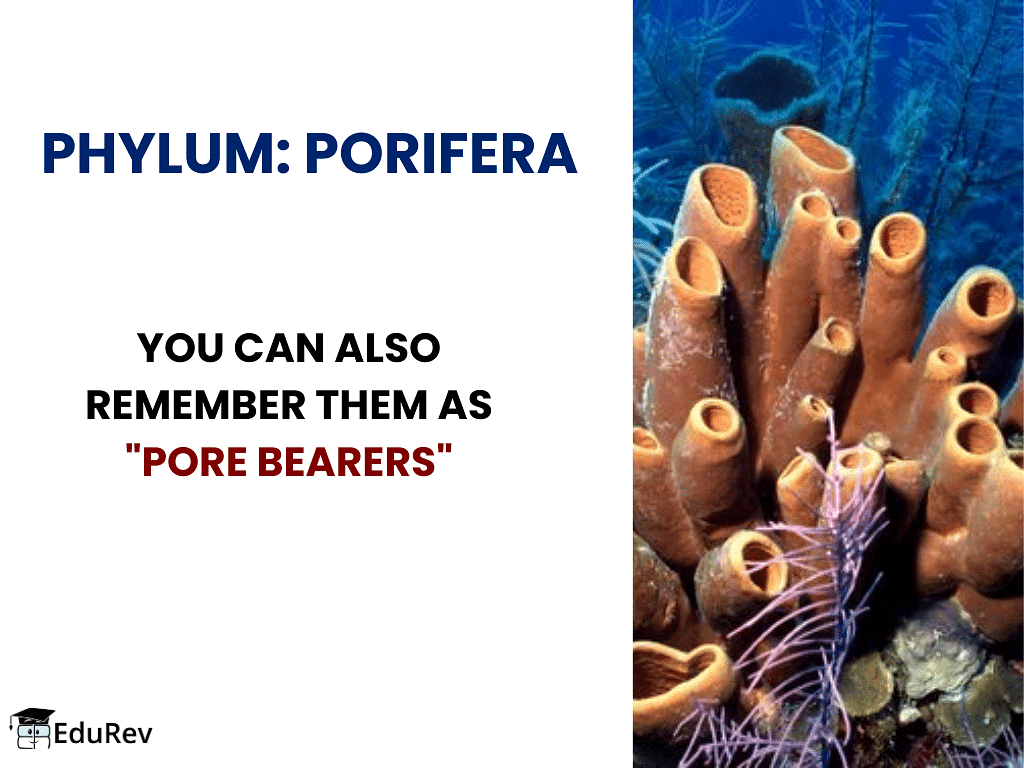
Explanation: Porifera refers to sponges, which have tiny pores on their bodies. The mnemonic "Pore Bearers" highlights this characteristic feature and helps you remember the phylum Porifera.
Examples of Porifera
Mnemonic: "Sunny Seas Enchant"
- Sycon (Scypha) -Sunny
- Spongilla (Fresh water sponge)- Seas
- Euspongia (Bath sponge) - Enchant
Phylum: Cnidaria
Mnemonic: "Stinging Beauty"
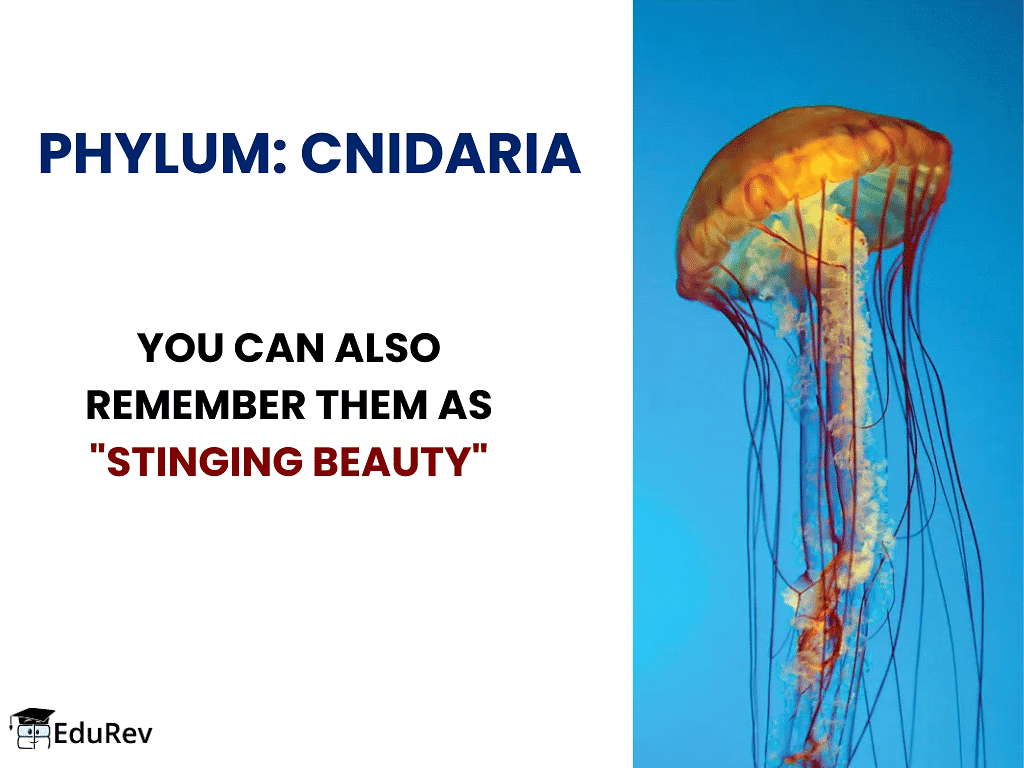
Explanation: Cnidaria includes organisms like jellyfish and sea anemones that possess specialized stinging cells called cnidocytes. The mnemonic "Stinging Beauty" represents their unique ability to capture prey using these stinging cells.
Examples of Cnidaria
Mnemonic: "Purple Anchors Promise Gentle Mornings"
- Physalia (Portuguese man-of-war) - Purple
- Adamsia (Sea anemone) - Anchors
- Pennatula (Sea-pen) - Promise
- Gorgonia (Sea-fan) - Gentle
- Meandrina (Brain coral) - Mornings
Phylum: Ctenophora
Mnemonic: "Glowing Combs"
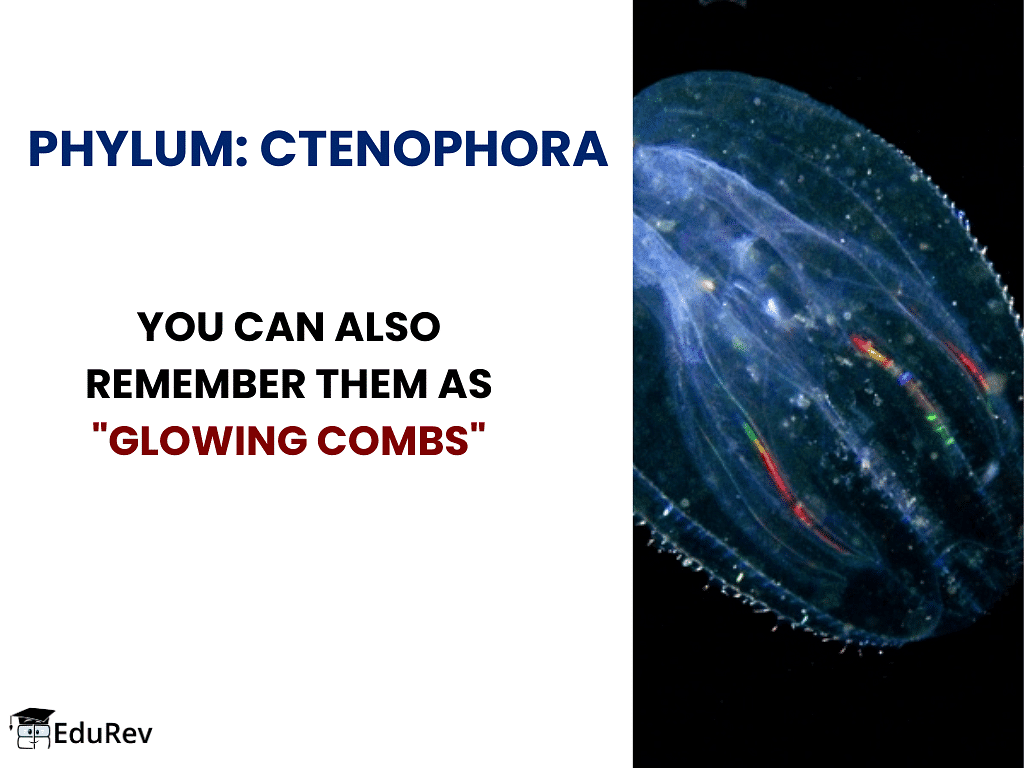
Explanation: Ctenophora, or comb jellies, are known for their bioluminescence and the presence of rows of comb-like cilia called comb plates. The mnemonic "Glowing Combs" emphasizes these distinct characteristics of Ctenophora.
Examples of Ctenophora
Mnemonic: "Playful Creatures"
- Pleurobrachia - Playful
- Ctenoplana - Creatures
Phylum:Platyhelminthes
Mnemonic: "Flatworm Fantasia"
Explanation: Platyhelminthes refers to flatworms, which have flattened bodies. The mnemonic "Flatworm Fantasia" represents their characteristic body shape and makes it easier to remember the phylum Platyhelminthes.
Examples of Platyhelminthes
Mnemonic: "Tiny Fish Play"
- Taenia (Tapeworm) - Tiny
- Fasciola (Liver fluke) - Fish
- Planaria - Play
Phylum: Nemathelminthes (Aschelminthes)
Mnemonic: "Wriggling Wonders"
Explanation: Nemathelminthes, also known as Aschelminthes, includes roundworms that have a long, cylindrical body. The mnemonic "Wriggling Wonders" represents their characteristic wriggling movement.
Examples of Aschelminthes
Mnemonic: "Always Wash Apples"
- Ascaris (Roundworm) - Always
- Wuchereria (Filaria worm) - Wash
- Ancylostoma (Hookworm) - Apples
Phylum: Annelida
Mnemonic: "Segmented Superstars"
Explanation: Annelida refers to segmented worms such as earthworms and leeches. The mnemonic "Segmented Superstars" highlights their distinct body segmentation, which helps in locomotion and other functions.
Examples of Annelida
Mnemonic: "Nice Pets Hug"
- Nereis - Nice
- Pheretima (Earthworm) - Pets
- Hirudinaria (Blood sucking leech) - Hug
Phylum: Arthropoda
Mnemonic: "Jointed Giants"
Explanation: Arthropoda includes insects, spiders, and crustaceans. The mnemonic "Jointed Giants" represents their jointed appendages, which are a defining characteristic of this phylum.
Examples of Arthropods
Mnemonic : "A Big Lion Always Chases Angry Lions Like Leopards."
- Apis (Honey bee - Economically important) - A
- Bombyx (Silkworm - Economically important) - Big
- Laccifer (Lac insect - Economically important) - Lion
- Anopheles (Mosquito - Vector of malaria) - Always
- Culex (Mosquito - Vector of filariasis) - Chases
- Aedes (Mosquito - Vector of dengue) - Angry
- Locusta (Locust - Gregarious pest) - Lions
- Limulus (King crab - Living fossil) - Like Leopards
Phylum: Mollusca
Mnemonic: "Shelled Marvels"
Explanation: Mollusca refers to organisms like snails, clams, and octopuses. The mnemonic "Shelled Marvels" emphasizes their diverse forms and the presence of shells in many mollusks.
Examples of Mollusca
Mnemonic: "Pretty Pearls Seem Like Ordinary Ancient Decorated Chests"
- Pila (Apple snail) - Pretty
- Pinctada (Pearl oyster) - Pearls
- Sepia (Cuttlefish) - Seem
- Loligo (Squid) - Like
- Octopus (Devil fish) - Ordinary
- Aplysia (Seahare) - Ancient
- Dentalium (Tusk shell) - Decorated
- Chaetopleura (Chiton) - Chests
Phylum: Echinodermata
Mnemonic: "Spiny Stars"
Explanation: Echinodermata includes organisms like sea stars and sea urchins. The mnemonic "Spiny Stars" represents their characteristic spiny surface and the presence of radial symmetry.
Examples of Echinodermata
Mnemonic: "Astronauts Explore Ancient Cosmic Oceans"
- Asterias (Star fish) - Astronauts
- Echinus (Sea urchin) - Explore
- Antedon (Sea lily) - Ancient
- Cucumaria (Sea cucumber) - Cosmic
- Ophiura (Brittle star) - Oceans
FAQs on Mnemonics: Animal Kingdom
| 1. What are the main mnemonics used to remember animal kingdom classification for NEET Biology? |  |
| 2. How do I remember the characteristics of different phyla in animal kingdom easily? | |
| 3. What's the easiest way to differentiate between vertebrates and invertebrates during exam revision? | |
| 4. Why do students struggle with remembering the class-wise characteristics of Chordata animals? | |
| 5. Which mnemonic tricks help remember the orders and families within animal kingdom taxonomy? | |





