Textbook Solutions: Mr Young's Car | Gul Mohar Class 6: Book Solutions, Summaries & Worksheets PDF Download
| Table of contents |

|
| Before You Read |
|
| While Reading |
|
| Understanding the Text |
|
| Appreciating the Text |
|

Before You Read
Q1. Why do you think the people are so excited to see the car?Ans: Cars were rare at that time, so seeing one felt new and thrilling for everyone.
Q2. Why do you think the man driving the car is waving at them?
Ans: He is acknowledging their excitement and greeting them proudly.
Q3. Which of these do you expect to find in the text—adventure / humour / fantasy / something else?
Ans: Humour and adventure, since the story is about a family’s funny and adventurous experiences with a car.
While Reading
Q1. When have you felt like dancing with joy? Which other feeling can the term express?Ans: I felt like dancing with joy when I won a prize at school. The term can also express extreme happiness, excitement, or relief.
Q2. The car was unused. Why did the speaker’s father still take Grandpa’s permission to move it?
Ans: Father respected Grandpa as the elder and close friend of the owner, so he asked him first.
Q3. The family is delighted to see the car running. However, do you think they plan to use it regularly? Why or why not?
Ans: No, they do not plan to use it regularly, as the car was very old and unreliable, and later it was discovered to have no brakes.
Q4. Is there anything unusual about Uncle’s reaction in para 17? Describe Uncle’s personality with a word or a phrase in your home language.
Ans: Yes, it is unusual because instead of panicking, Uncle stayed cheerful and treated the accident as an adventure. His personality can be described as “carefree” or “bindaas.”
Q5. In the last line of para 27, the speaker sounds like she is laughing at / feels sorry for the car.
Ans: She is laughing at the situation humorously, as the car was dismantled and its parts used elsewhere, yet it continued serving people.
Q6. Why did Grandpa have to think hard before replying to Mr Young? What did he mean by his message?
Ans: Grandpa thought carefully to avoid hurting Mr Young. By his message, he meant that although the car was no longer running as a car, its parts were still being used for the benefit of many people.
Understanding the Text
A. Complete this sequence of events in the story.
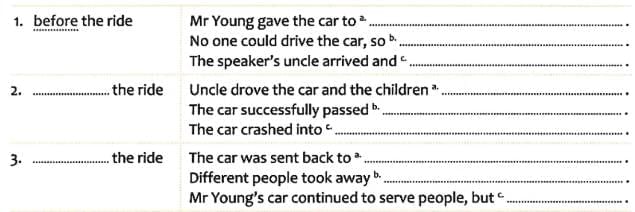
Ans: 1. before the ride
a. Mr Young gave the car to a friend (Grandpa).
b. No one could drive the car, so it was kept unused.
c. The speaker’s uncle arrived and became very excited.
2. during the ride
a. Uncle drove the car and the children sat inside happily.
b. The car successfully passed their house amidst cheering.
c. The car crashed into a mango tree after breaking through a wall.
3. after the ride
a. The car was sent back to Bhabanibabu’s repair shop.
b. Different people took away the car’s battery, seats, horn, and engine.
c. Mr Young’s car continued to serve people, but in different forms (e.g., grinding flour in a mill).
B. Answer these questions.
Q1. Based on the first paragraph, how do you think the speaker felt about the car?a. "No one can drive it, so there is no point in keeping it."
b. "It is getting rusted and eroded, so it is better to get rid of it."
c. “If only we could use this beautiful car instead of letting it go to waste.”
Would you say that this feeling remained till the end?
Ans: Yes, this feeling remained till the end, though the family could not use it properly.
Q2. We brothers and sisters were raring to ride in it. Give examples from paras 4 and 5 that demonstrate this feeling.
Ans: They crowded into the back seat eagerly and waved, yelled, and clapped with excitement when the car was driven out.
Q3. It was a historic event for our family. What was the historic event? How did everyone react to it? Did the event become memorable for other reasons too? Explain.
Ans: The car being driven for the first time was historic. Everyone cheered with joy. It became more memorable after the funny crash.
Q4. Would you say that the ride was a treat / an adventure / a disaster for the children? Why?
Ans: It was an adventure, because although it was dangerous, the children were thrilled, excited, and later laughed about it.
Q5. Different people reacted to the accident in different ways. Explain.
a. Uncle .................................................................................................................. .
b. The children .................................................................................................... .
c. Dad and Grandpa .......................................................................................... .
d. The gardener .................................................................................................. .
Ans: a. Uncle: Treated it lightly and called it “the finer touch.”
b. The children: Were frightened but later safe and amused.
c. Dad and Grandpa: Were anxious, scolded Uncle, and arranged repairs.
d. The gardener: Was angry and upset at the damage to the orchard wall.
Appreciating the Text
Q1. Find examples from the text to support these statements about the speaker’s uncle.a. He was really excited about the car.
Ans: He danced with joy on seeing the car and immediately repaired it.
b. He loved the car and the experience of driving it—to the end.
Ans: He proudly drove it and later said the crash was “the finer touch.”
c. He was not a very practical person—he did not think about all sides of a real situation.
Ans: He drove the car without brakes, risking everyone’s safety.
d. He is an important character as he brings about some of the main events in the story.
Ans: His actions caused the ride, crash, and funny ending.
Q2. Which of these add to the humour in the story? Give at least one example for every point you choose.
a. event(s)
b. character( s)
c. description( s)
d. dialogue(s)
e. something else (Name it.)
Ans: a. Event(s): The car crashing through the wall instead of stopping.
b. Character(s): Uncle’s carefree, comic personality.
c. Description(s): The car “wearing the wall like a belt.”
d. Dialogue(s): Uncle saying “This is called the finer touch.”
e. Something else: The funny ending where the car’s engine was used in a flour mill.
|
30 videos|61 docs|17 tests
|
FAQs on Textbook Solutions: Mr Young's Car - Gul Mohar Class 6: Book Solutions, Summaries & Worksheets
| 1. What is the main theme of "Mr Young's Car"? |  |
| 2. What lessons can be learned from Mr Young's experiences? | |
| 3. How does Mr Young's character develop throughout the story? | |
| 4. What challenges does Mr Young face with his car? | |
| 5. Why is the story of Mr Young's Car relevant to young readers? | |



Important questions
,Summaries & Worksheets
,mock tests for examination
,study material
,Objective type Questions
,Semester Notes
,Previous Year Questions with Solutions
,MCQs
,Summaries & Worksheets
,past year papers
,Free
,Summary
,Textbook Solutions: Mr Young's Car | Gul Mohar Class 6: Book Solutions
,video lectures
,Extra Questions
,Textbook Solutions: Mr Young's Car | Gul Mohar Class 6: Book Solutions
,Viva Questions
,Summaries & Worksheets
,Sample Paper
,Exam
,practice quizzes
,Textbook Solutions: Mr Young's Car | Gul Mohar Class 6: Book Solutions
,ppt
,shortcuts and tricks
;



Textbook Solutions: Mr Young's Car Free PDF Download
Importance of Textbook Solutions: Mr Young's Car
Textbook Solutions: Mr Young's Car Notes
Textbook Solutions: Mr Young's Car Class 6 Questions
Study Textbook Solutions: Mr Young's Car on the App
|
© EduRev
|
Education Revolution
|


|




