Textbook Solutions: Winter Oak | Gul Mohar Class 6: Book Solutions, Summaries & Worksheets PDF Download
| Table of contents |

|
| Before You Read |
|
| While Reading |
|
| Understanding the Text |
|
| Appreciating the Text |
|

Before You Read
Q1: Work in groups of four. 1. Draw a scene in nature, each of you adding at least one thing to the scene—a kind of tree, a waterfall, an animal and so on.Ans: Sketch a shared landscape (e.g., winter wood): one draws a snow-laden oak, another a brook, another birds, another a meadow.
Q2: 2. Explain what is special about the element you have added to the scene.
Ans: Each student says what’s unique (e.g., “oak = strength and shelter,” “brook = movement and life”).
Q3: 3. You can also note things that cannot be seen but can be heard (a birdcall) or smelled (a flower) in that place.
Ans: Add sensory notes like “distant birdcalls, resinous pine smell, cold clean air.”
Q4: 4. Try to make the place look and sound as attractive as possible.
Ans: Use bright details (sparkling snow, sun shafts, gentle water sounds) to make the scene inviting.
While Reading
Q1: Why has Anna Vasilyevna been compared to a schoolgirl before an examination?Ans: She is anxious and rehearsing definitions under her breath before class, just like a nervous student.
Q2: What does Anna’s decision to swap lessons tell us about her?
Ans: She is confident and competitive; she believes she can handle “first lessons” better and keep control by making them interesting.
Q3: What does the last sentence of para 13 mean?
Ans: The “ice was broken” — the class relaxed and joined in; participation started to flow easily.
Q4: In paras 23–28, underline the parts that tell you Anna Vasilyevna has fixed ideas about children.
Ans: Her instant suspicion that Savushkin is lying, her preset timing of routes, and her plan to “see your parents” show rigid assumptions.
Q5: Why was Anna Vasilyevna embarrassed? Why did she not change her decision in spite of it?
Ans: She recalls his overworked mother and feels sorry; yet she insists on visiting to uphold discipline and her authority.
Q6: In para 33, why does the writer make us notice the absence of sound?
Ans: To heighten the enchantment of the snowy wood—creating hush, awe, and a sense of another world.
Q7: Why does Savushkin sigh?
Ans: He hasn’t seen a live elk—only tracks and droppings—so he’s wistful that his knowledge is second-hand.
Q8: In paras 35–41, the teacher is __________ and the student is __________.
Ans: The teacher is curious/learning; the student is confident/guide-like.
Q9: a. The oak has been compared to a cathedral because … b. It has been called a ‘secret forest’ because … c. Anna Vasilyevna and Savushkin would remember the oak with feelings of …
Ans: a) Its grandeur and solemn beauty. b) It shelters many “lodgers” and hidden life under snow. c) Awe, tenderness, and pride.
Q10: Why did Savushkin want to promise not to be late? Why would that be a lie?
Ans: He respects his teacher, but the forest path captivates him; he knows he’ll still take it and risk delay.
Q11: Which two things is Savushkin anxious about in paras 48–51? Why is that admirable?
Ans: He worries for the teacher’s safety and for the elk’s dignity; it shows care, restraint, and love of nature.
Understanding the Text
A. Complete this map with the correct words and phrases.
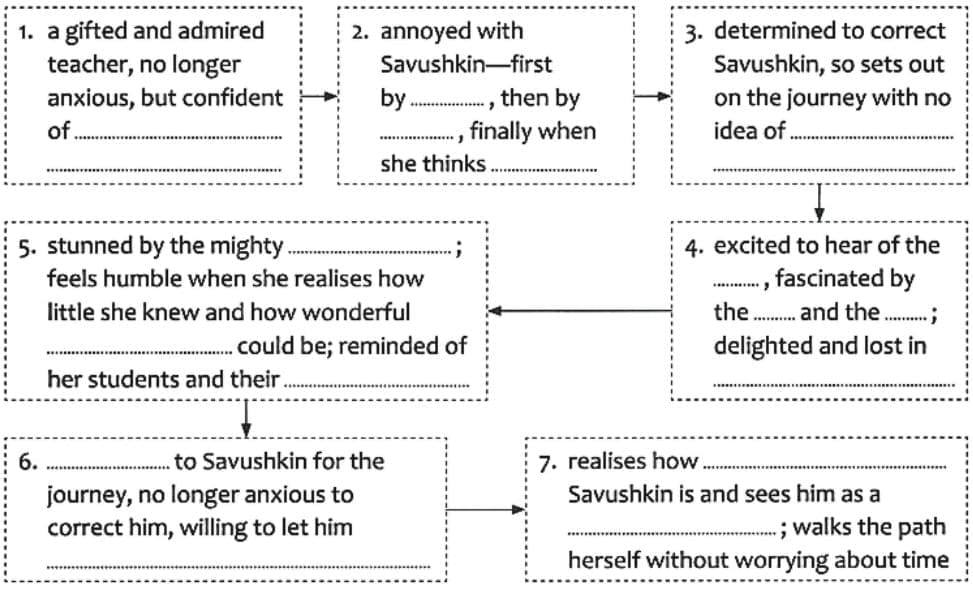
Ans: 1. a gifted and admired teacher, calm and confident.
2. annoyed with Savushkin’s tardiness.
3. determined to correct Savushkin, so sets out by visiting home; then by walking the wood path with no idea of its wonders.
4. excited to hear of the elk, fascinated by the brook and the snow-alive stream.
5. stunned by the mighty winter oak.
6. grateful to Savushkin for the journey, no longer eager to “correct” him.
7. realises how observant and good-hearted Savushkin is; she now walks the path herself without worrying about time.
B. Answer these questions.
Q1: “… it had spoilt a well-begun day.” (para 7) a. What do you think is Anna Vasilyevna’s idea of a well-begun day? Why did she think that it was spoilt? b. Would you say that the day ended well for Anna Vasilyevna? Why or why not?Ans: a) A smooth class she controls and inspires; Savushkin’s late entry cracks that rhythm.
b) Yes—she discovers wonder, gains humility, and sees the “citizen of the future.”
Q2: “‘A difficult boy,’ Anna Vasilyevna thought.” (para 21) Why did Anna Vasilyevna think this? What was the boy doing at that moment? Why?
Ans: She reads his smile and quietness as defiance; he’s absorbed in his own thoughts, guarding a “dear secret” (the winter oak), not rudeness.
Q3: Why did Anna Vasilyevna think that Savushkin was lying about coming late to school? What did she intend to do about it? (paras 25–28)
Ans: Her fixed estimate of distances made his story seem false; she planned to confront his parent(s).
Q4: “Carried away by this, she didn’t notice at first that Savushkin was waiting for her ahead.” (para 43) a. What has been referred to as ‘this’? Why was ‘she’ carried away by it? b. How does this incident prove—indirectly—that Savushkin had been telling the truth to Anna Vasilyevna earlier?
Ans: a) Watching snow become “alive” in the stream; it delights her. b) The forest truly absorbs time and attention—exactly as Savushkin implied.
Q5: “And she had thought she was a skilful teacher! …” (para 45) a. What does the first line mean? b. What ‘path’ had Anna Vasilyevna discovered … ? Why might a lifetime be too short … ? What made the path particularly special?
Ans: a) Her pride gives way to humility. b) Both the literal wood-path and a new way of seeing; nature’s richness is endless; it’s special because a child led her there.
Q6: “… the most wonderful thing about this wood wasn’t its winter oak, but this little person, this wonderful citizen of the future.” (para 53) When did Anna Vasilyevna feel this way? What do you think is meant by this line?
Ans: As she leaves and sees him keeping watch; it means the child’s character—curiosity, care, responsibility—is the true marvel.
Appreciating the Text
Q1: In the text … Look for two more examples of personification … Which example … and why?Ans: Examples: “the trees stepped aside” (meadows revealed); the oak “waved a branch in greeting.” Most effective: the oak as a welcoming guardian—makes the scene alive and sacred.
Q2: This text is full of different kinds of comparisons … add three more comparisons from the text.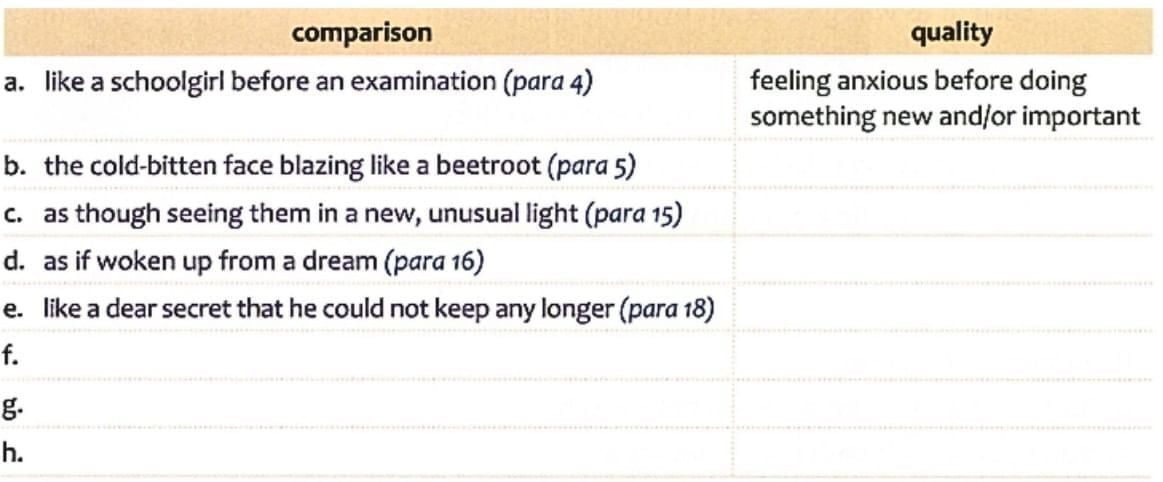 Ans:
Ans:
a) like a schoolgirl before an examination — nervous preparation.
b) the cold-bitten face blazing like a beetroot — flushed with cold.
c) as though seeing them in a new, unusual light — rediscovery.
d) as if woken up from a dream — sudden inspiration.
e) like a dear secret … — treasured feeling.
f) “tracks … like watch-chains” — neat, beaded patterns on snow.
g) trunk glittered “like silver thread” — delicate shine.
h) oak “majestic as a cathedral” — solemn grandeur.
Q3: What do you understand about the character of Savushkin from how he behaves— a. in the classroom b. with Anna Vasilyevna c. in the forest?
Ans: a) Imaginative, blurts “winter oak,” earnest not disruptive.
b) Respectful, honest, protective.
c) Observant guide, gentle toward animals, quietly brave.
|
30 videos|61 docs|17 tests
|
FAQs on Textbook Solutions: Winter Oak - Gul Mohar Class 6: Book Solutions, Summaries & Worksheets
| 1. What is the main theme of the article "Winter Oak"? |  |
| 2. How does the author use imagery to describe the winter oak? | |
| 3. What lessons can be learned from the life of the winter oak as depicted in the article? | |
| 4. In what ways does the article connect the winter oak to human experiences? | |
| 5. Why is the winter oak considered a symbol of strength and stability? | |



Textbook Solutions: Winter Oak | Gul Mohar Class 6: Book Solutions
,Previous Year Questions with Solutions
,Semester Notes
,past year papers
,Objective type Questions
,Free
,Summary
,Summaries & Worksheets
,MCQs
,study material
,Sample Paper
,mock tests for examination
,ppt
,video lectures
,practice quizzes
,Summaries & Worksheets
,Exam
,Viva Questions
,Important questions
,shortcuts and tricks
,Summaries & Worksheets
,Textbook Solutions: Winter Oak | Gul Mohar Class 6: Book Solutions
,Extra Questions
,Textbook Solutions: Winter Oak | Gul Mohar Class 6: Book Solutions
,




Textbook Solutions: Winter Oak Free PDF Download
Importance of Textbook Solutions: Winter Oak
Textbook Solutions: Winter Oak Notes
Textbook Solutions: Winter Oak Class 6 Questions
Study Textbook Solutions: Winter Oak on the App
|
© EduRev
|
Education Revolution
|


|




