Humanities/Arts Exam > Humanities/Arts Notes > History Class 11 > Revision Notes: Displacing Indigenous Peoples
Revision Notes: Displacing Indigenous Peoples


1. European Expansion and Colonisation
- From the 18th century, European settlers migrated to North & South America, Australia, New Zealand, and South Africa.
- Native peoples were pushed out, displaced, or assimilated.
- Colonies were European settlements under their "mother country."
- Independent states emerged when colonies gained independence.
- Cultural erasure occurred as native names of rivers and cities (e.g., Ohio, Mississippi, Wollongong) remained, but indigenous presence diminished.
2. European Imperialism & Settler Colonies
Expansion of European Powers
- Spain & Portugal dominated Latin America but did not expand further.
- France, England & Holland expanded into North America, Africa, and Asia.
- The British East India Company controlled South Asia, annexed land, built railways, and taxed landowners.
- In Africa, European presence was initially limited to coastal trade, but full colonisation began in the 19th century.
Settler Colonies and European Domination
- British settlers dominated Australia, Canada, and America.
- Dutch settlers (Boers) controlled South Africa.
- English became the dominant language, except in French-speaking Canada.
3. Native Societies in North America Before Colonisation
Geography and Resources
- North America had diverse landscapes, including the Rocky Mountains, Great Plains, Mississippi River, and Appalachian Mountains.
- The region had abundant natural resources such as forests, oil, gas, and minerals, which played a key role in later industrialisation.
Life of the Indigenous Peoples
- The first inhabitants arrived from Asia via the Bering Strait around 30,000 years ago.
- They relied on hunting, fishing, maize cultivation, and gathering for food.
- There was no private land ownership-land was used communally.
- Trade was based on gift exchange rather than commerce.
- Oral traditions were strong, with rich storytelling, arts, and textiles.
4. European Encounters and Native Displacement
Early Interactions
- Fur and fish trade flourished with native help.
- French traders along the Mississippi found natives engaged in regional trade.
- Europeans introduced alcohol, leading to addiction among natives.
- Tobacco was introduced to Europe by natives.
European Perception of Natives
- Europeans viewed natives as 'uncivilised' due to their lack of written language and permanent settlements.
- Rousseau admired them as 'noble savages' for their simplicity and purity.
- Wordsworth believed they lacked imagination.
- Washington Irving, who had met natives, described them as humorous and intelligent.
5. Expansion and Native Displacement
Westward Expansion of the USA
- Territorial expansion occurred through the Louisiana Purchase (1803) from France, Alaska's purchase (1867) from Russia, and the conquest of southwestern USA from Mexico.
- Native inhabitants were not consulted or compensated.
Forced Migration & Conflicts
- In 1832, the US Supreme Court ruled in favor of the Cherokee Nation, but President Andrew Jackson ignored it.
- The Trail of Tears (1838) saw 15,000 Cherokees forcibly removed, with over 25% dying on the way.
- The US-Indian Wars (1865-1890) ended with native groups defeated and confined to reservations.
- In Canada, the Metis Rebellions (1869-1885) were crushed by British authorities.
6. The Impact of European Settlers
Environmental and Economic Changes
- Forests were cleared for agriculture.
- Railways were built for faster settlement and trade.
- Bison were hunted to near extinction by 1890, ending the natives' hunting-based economy.
Slavery in North America
- Africans were enslaved to work in southern plantations.
- Slavery was abolished in 1865 after the US Civil War, but racial discrimination persisted.
Canadian Expansion
- Canada became a Confederation in 1867.
- French Canadians sought autonomy, leading to self-rule later.
7. Australia's Colonisation and Indigenous Displacement
Arrival of Europeans
- The Dutch first sighted Australia in 1606.
- In 1770, James Cook claimed it for Britain.
- By 1788, it was used as a penal colony where convicts from Britain were sent.
Effects on Aboriginal Peoples
- 90% of Aborigines died from disease, land loss, and conflicts.
- Land was taken over for sheep farms, wheat farming, and mining.
- Many were forced into hard labor under conditions close to slavery.
- In 1855, Chinese immigration was banned due to racial policies.
8. Indigenous Resistance and Recognition
Resistance Against Colonisation
- Armed uprisings occurred in the USA (1865-1890) but were crushed.
- Canada's Metis Rebellions (1869-1885) failed.
- Australia had no treaties with natives, and land was simply taken.
Modern Recognition & Apology
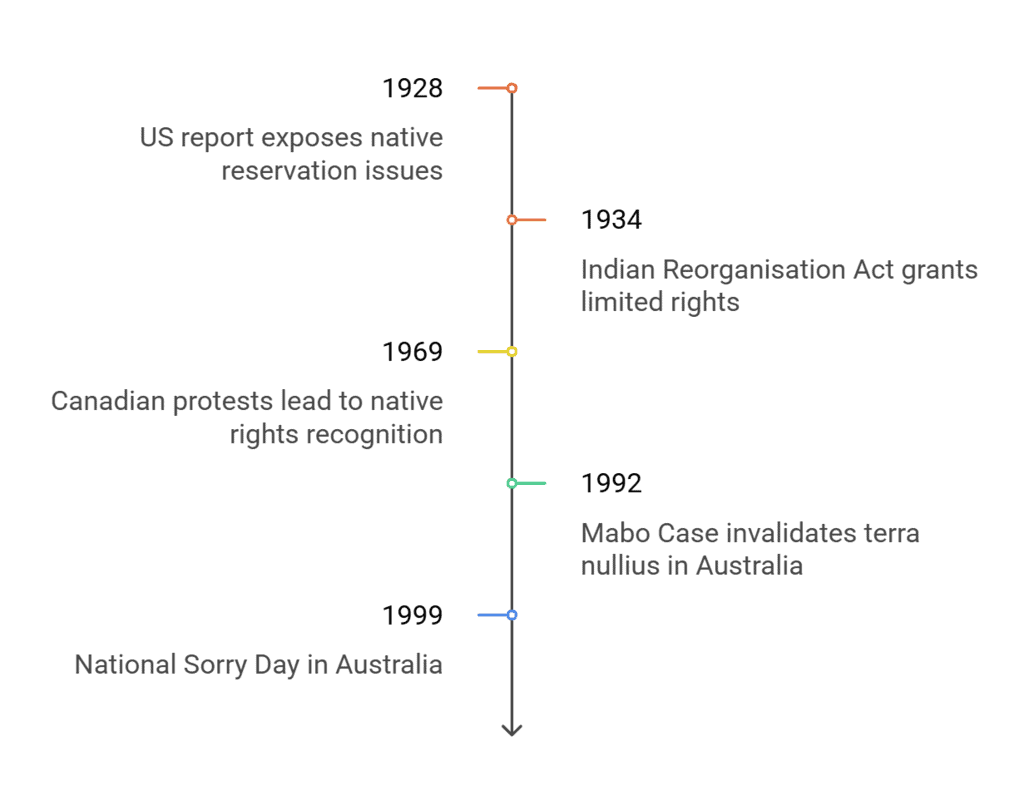
- In 1928, a US report exposed poor health and education in native reservations.
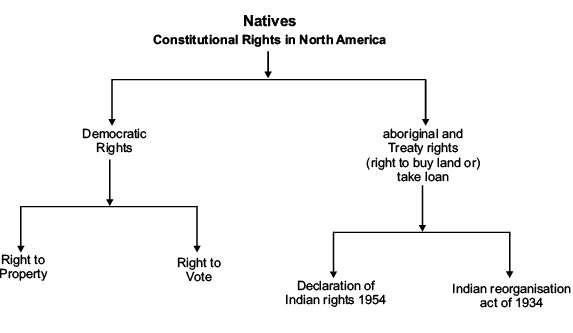
- The Indian Reorganisation Act (1934, USA) gave limited land rights to natives.
- In 1969, Canadian protests led to the recognition of native rights in the 1982 Constitution Act.
- In 1992, the Australian High Court ruled in the Mabo Case that terra nullius (land belonging to no one) was invalid.
- In 1999, Australia's "National Sorry Day" was observed as a formal apology for past injustices.
9. Conclusion: Changing Perceptions of Natives
- Natives, once seen as primitive, are now recognised as communities with distinct cultures and histories.
- There has been a shift towards respecting native rights, land claims, and heritage.
- Museums, literature, and academic research now preserve native histories.
- The transition from colonial oppression to multicultural societies is ongoing in Canada, the USA, and Australia.
Final Takeaways
- European expansion led to the displacement and marginalisation of indigenous peoples.
- Industrialisation and agricultural expansion came at the cost of native lands.
- 20th-century reforms have attempted to restore justice, but challenges remain.
- Native voices, cultures, and histories are now gaining global recognition.
The document Revision Notes: Displacing Indigenous Peoples is a part of the Humanities/Arts Course History Class 11.
All you need of Humanities/Arts at this link: Humanities/Arts
FAQs on Revision Notes: Displacing Indigenous Peoples
| 1. What exactly happened to indigenous peoples when Europeans arrived in the Americas? |  |
Ans. European colonisation caused widespread displacement of indigenous populations through military conquest, disease, and forced relocations. Indigenous peoples lost their ancestral lands, suffered demographic collapse from epidemics, and were subjugated under colonial rule. This systematic dispossession fundamentally restructured societies and economies across the Americas, destroying traditional ways of life and cultural practices.
| 2. How did colonisers justify taking over indigenous lands in their own minds? | |
Ans. European colonisers employed ideologies like the "Doctrine of Discovery" and claims of civilising missions to legitimise territorial seizure. They characterised indigenous peoples as uncivilised or pagan, using religious and racial arguments to justify dispossession. These justifications masked economic exploitation and territorial ambition, portraying colonisation as a moral or religious duty rather than aggressive conquest and land appropriation.
| 3. Why did indigenous populations decline so drastically after European contact? | |
Ans. Indigenous population collapse resulted primarily from introduced diseases like smallpox, measles, and influenza to which native populations had no immunity. Combined with warfare, malnutrition from disrupted food systems, and social breakdown from displacement, mortality rates reached catastrophic levels. Disease alone killed an estimated 90% of some indigenous communities within decades of European arrival.
| 4. What methods did colonisers use to physically displace indigenous peoples from their territories? | |
Ans. Colonisers employed forced relocations, reservations systems, and violent removal policies to displace indigenous populations. Military campaigns, broken treaties, and legal mechanisms stripped indigenous peoples of land rights. Reservation policies concentrated survivors into marginal territories, while assimilation policies attempted to erase indigenous identity, culture, and languages through systematic cultural displacement programmes.
| 5. How did indigenous resistance to displacement affect colonial expansion and settlement patterns? | |
Ans. Indigenous resistance significantly shaped colonial territorial expansion, forcing Europeans to negotiate treaties, establish fortified settlements, and modify invasion strategies. Prolonged conflicts delayed colonisation in certain regions and created buffer zones. However, despite organised resistance through leaders and alliances, technological advantages, disease, and internal divisions ultimately enabled colonial consolidation and indigenous dispossession across continents.
About this Document

16.6K Views

4.90/5
Rating

Apr 20, 2026
Last updated
Related Exams
Document Description: Revision Notes: Displacing Indigenous Peoples for Humanities/Arts 2026 is part of History Class 11 preparation.
The notes and questions for Revision Notes: Displacing Indigenous Peoples have been prepared according to the Humanities/Arts exam syllabus. Information about Revision Notes: Displacing Indigenous Peoples covers topics
like and Revision Notes: Displacing Indigenous Peoples Example, for Humanities/Arts 2026 Exam. Find important definitions, questions, notes, meanings, examples, exercises and tests below for Revision Notes: Displacing Indigenous Peoples.
Introduction of Revision Notes: Displacing Indigenous Peoples in English is available as part of our History Class 11
for Humanities/Arts & Revision Notes: Displacing Indigenous Peoples in Hindi for History Class 11 course.
Download more important topics related with notes, lectures and mock test series for Humanities/Arts
Exam by signing up for free. Humanities/Arts: Revision Notes: Displacing Indigenous Peoples
Description
Revision Notes: Displacing Indigenous Peoples of History Class 11 with clear explanations of key concepts & important topics of the chapter, to help you underst& lessons better & revise quickly, & crack the Humanities/Arts exam.
Information about Revision Notes: Displacing Indigenous Peoples
In this doc you can find the meaning of Revision Notes: Displacing Indigenous Peoples defined & explained in the simplest way possible. Besides explaining types of
Revision Notes: Displacing Indigenous Peoples theory, EduRev gives you an ample number of questions to practice Revision Notes: Displacing Indigenous Peoples tests, examples and also practice Humanities/Arts
tests



Related Searches
video lectures, Extra Questions, MCQs, mock tests for examination, Objective type Questions, practice quizzes, Summary, Previous Year Questions with Solutions, Sample Paper, Semester Notes, Revision Notes: Displacing Indigenous Peoples, Viva Questions, past year papers, study material, shortcuts and tricks, Important questions, Revision Notes: Displacing Indigenous Peoples, Free, Exam, Revision Notes: Displacing Indigenous Peoples, ppt, pdf ;