Revision Notes - Movements of Ocean Water

Introduction
- Ocean water is constantly changing and dynamic.
- Key physical characteristics of seawater are temperature, salinity and density, and these control vertical and horizontal movements.
- External forces such as the Sun, Moon and winds are the principal drivers of ocean-water motion.
- Types of motion:
- Horizontal motion - includes ocean currents and the horizontal propagation of waves (swell).
- Vertical motion - includes tides and vertical movements such as upwelling and downwelling linked to density differences.
Waves
Waves are disturbances that transfer energy across the ocean surface; the energy moves while individual water particles trace nearly closed circular orbits. Waves observed on the sea surface are most commonly generated by wind, but other processes (for example, seismic events) can create different kinds of waves.
- Generation: Wind transfers energy to the sea surface; the resulting wave characteristics depend on wind strength, duration and the distance over which the wind blows (the fetch).
- Particle motion: Water particles beneath a surface wave move in nearly circular paths; the diameter of these circles decreases rapidly with depth.
- Swell and local waves: Steep, short-lived waves are produced by local winds and are described as young waves; long-period, rounded waves that have travelled away from their source are called swell and may travel thousands of kilometres.
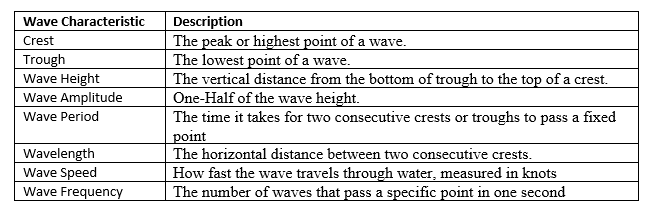
- Shoaling and breaking: As waves move into shallower water, friction with the sea floor slows the base of the wave, the wave height increases and the wave steepens. Waves normally break when the water depth is less than about half the wavelength.
- Wave size: The largest wind waves form where strong winds blow steadily for a long time over a long fetch. Whitecaps and breaking crests appear when waves become sufficiently steep.
- Surface vs deep water: Surface wave motion has little effect on stagnant deep ocean water; the circular motion becomes negligible at depths greater than about half the wavelength for ordinary wind waves.
- Non-wind waves: Tsunamis are long-wavelength waves caused by sudden displacement of the sea floor (earthquakes, landslides); they travel very fast in deep water and become destructive near coasts when the wave shoals.
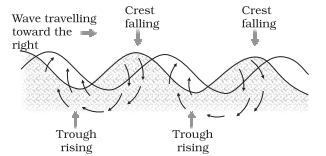
- Young, steep waves are usually generated near the wind source; swell represents waves that have travelled away from the source region and are smoother and longer.
- Wave height depends on wind strength, the time the wind blows and the fetch.
- Wind pushes water forward while gravity pulls the crest down; the combined action causes the rise and fall of the sea surface.
- Below the surface, water moves in circular paths - upward as the crest passes and downward as it moves away.
Tides
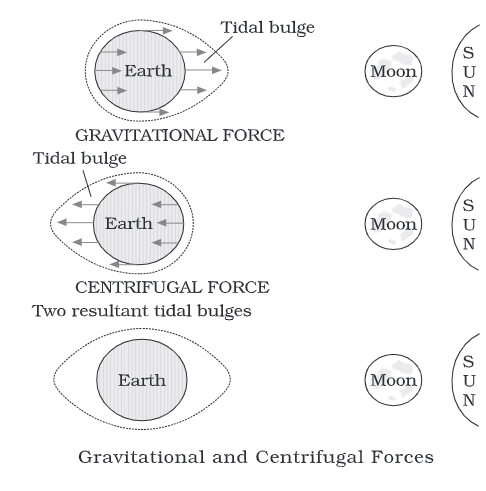
Tides are the regular rise and fall of sea level at a particular place, produced mainly by the gravitational attraction of the Moon and to a lesser extent the Sun, together with the centrifugal force arising from the Earth-Moon system. Tides are periodic and can be predicted accurately because the relative positions of the Earth, Moon and Sun follow known cycles.
- Tides vs surges: Tides are astronomical and regular; storm surges or tidal surges are irregular increases in sea level caused by strong winds and changes in atmospheric pressure during storms.
- Cause: The Moon's gravitational pull produces two tidal bulges - one on the side of the Earth facing the Moon and another on the opposite side; the net tide-generating force is the difference between local gravity and the gravitational pull of the Moon and Sun.
- Tidal bulges are modified by local continental shelves, the configuration of coastlines, ocean depth and the presence of islands.
- Funnel-shaped bays and estuaries amplify tidal ranges and can produce phenomena such as tidal bores; tidal currents form where tidal water flows between islands, into estuaries or through channels.
Tides of Bay of Fundy, Canada
The Bay of Fundy in Nova Scotia, Canada, has the highest tides in the world, with tidal ranges reaching about 15 to 16 metres. There are two high tides and two low tides roughly every 24 hours (semidiurnal pattern).
Types of tides
Tides based on frequency
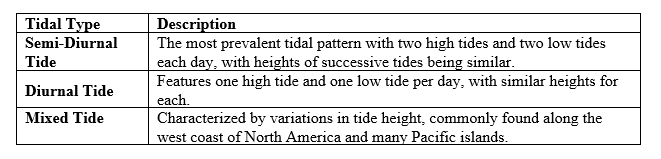
- Diurnal tides: One high tide and one low tide each lunar day (about 24 hours 50 minutes).
- Semidiurnal tides: Two nearly equal high tides and two nearly equal low tides each lunar day.
- Mixed tides: Two high and two low tides of unequal height within a lunar day.
Tides based on Sun-Moon-Earth positions
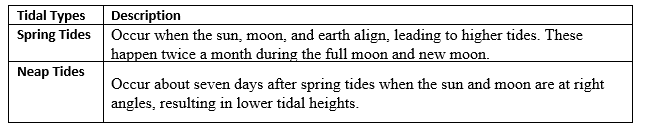
- Spring tides: Occur when the Sun, Moon and Earth are approximately in line (at full moon and new moon); gravitational forces reinforce each other and tidal range is larger.
- Neap tides: Occur when the Sun and Moon are at right angles relative to the Earth (first and third quarters of the moon); gravitational forces partially cancel and tidal range is smaller.
Additional factors influencing tides
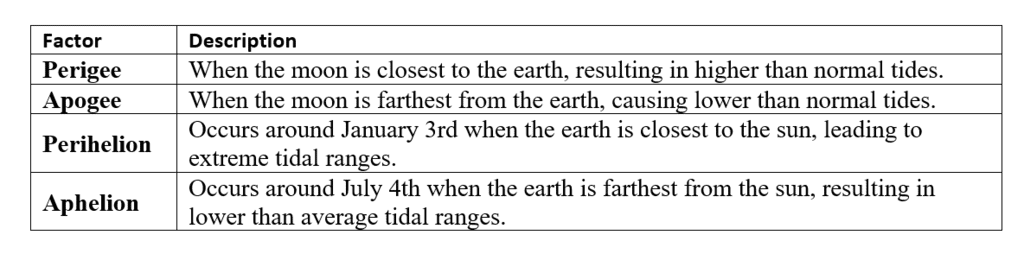
- The shape of the coastline, bathymetry (sea floor topography) and continental shelves strongly affect local tidal range.
- Resonance in bays and gulfs can amplify tides (for example, the Bay of Fundy).
- Local wind and atmospheric pressure can modify tide heights temporarily (storm surges).
Tidal terminology
- High tide, low tide, tidal range (difference between high and low tide), tidal current (horizontal flow caused by the rising and falling of the tide), and tidal bore (a breaking wave that travels upstream in some rivers and estuaries where tidal range is large).

Try yourself: Great barrier reef is in
Importance of tides
- Tides can be forecast well in advance because they depend on the known motions of the Earth, Moon and Sun; this is important for safe navigation and port operations.
- Tidal flows help in desilting and flushing estuaries and can improve water quality in coastal zones.
- Tides influence the design and management of harbours, navigation channels and coastal structures, since shallow bars at harbour entrances may be passable only at certain tidal stages.
- Tidal energy can be harnessed for electricity. Countries such as Canada, France, Russia and China use tidal power schemes.
- A small-scale tidal power project (about 3 MW) is under development at Durgaduani in the Sundarbans of West Bengal.
Ocean Currents
Ocean currents are continuous, directed movements of seawater that flow in well-defined paths. Currents transport heat, salt, nutrients and biota and play a major role in climate and marine productivity.
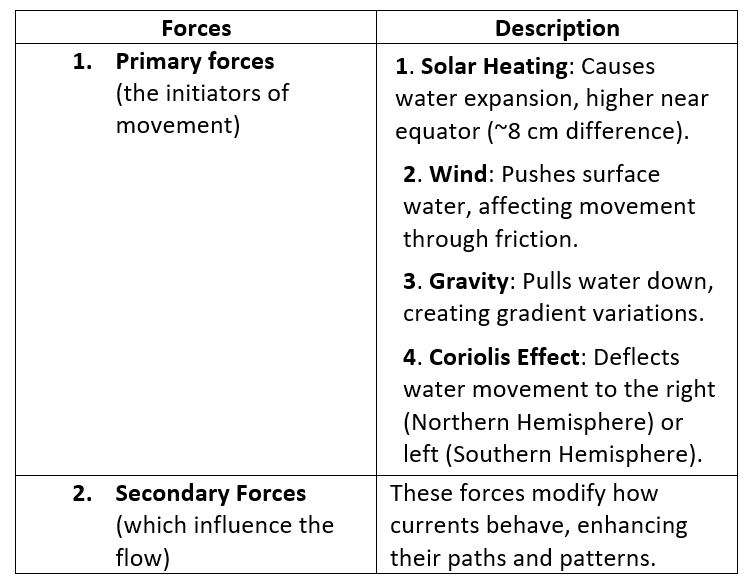
- Drivers of currents: Wind stress on the sea surface, the Coriolis force (arising from Earth's rotation), density differences caused by variations in temperature and salinity (the thermohaline mechanism), tides and the shapes of ocean basins and continental margins.
- The wind-driven component interacts with the Coriolis force and continental boundaries to form large circular systems called gyres in each ocean basin.
- Characteristics: Currents are described by their drift (direction of movement) and speed (commonly measured in knots). Surface currents are generally much faster (often several knots) than deep currents (typically less than 0.5 knots).
- Vertical movement: Water density governs vertical motion - cold, saline water is denser and sinks, forming deep currents; lighter, warmer or fresher water tends to rise.
- Thermohaline circulation: Cold, dense water formed at high latitudes sinks and flows toward the equator at depth; this deep flow is balanced by surface currents that move poleward, creating a global overturning circulation often referred to as the ocean's conveyor belt.
- Surface currents near the equator generally move from east to west under the trade winds, while mid-latitude currents are driven by westerlies and are deflected by the Coriolis effect (to the right in the Northern Hemisphere, to the left in the Southern Hemisphere).
Types and major ocean currents
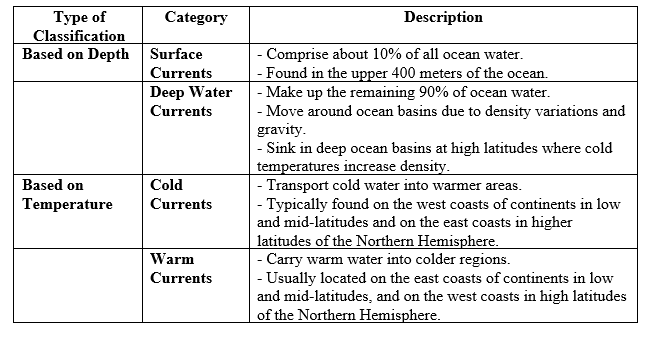
- Surface currents - wind-driven, forming gyres and boundary currents such as warm western boundary currents and cold eastern boundary currents.
- Deep currents - driven primarily by density differences (thermohaline circulation).
- Examples of well-known currents: Gulf Stream (North Atlantic, warm), Kuroshio Current (North Pacific, warm), Benguela Current (South Atlantic, cold), Humboldt or Peru Current (South-east Pacific, cold), Agulhas Current (south-west Indian Ocean, warm).
Oceanic circulation patterns and climate effects
- Oceanic circulation mirrors atmospheric circulation in transporting heat from low latitudes to higher latitudes and thus moderates climate.
- Warm currents carried poleward raise temperatures of adjacent land, producing milder winters and increased precipitation in coastal regions (for example, parts of north-western Europe are warmed by the North Atlantic Drift, an extension of the Gulf Stream).
- Cold currents along some coasts cause lower average temperatures, frequent fog and aridity because cold offshore water stabilises the lower atmosphere and reduces onshore precipitation (for example, deserts on the west coasts of continents where cold currents prevail).
- The Coriolis effect causes warm currents from low latitudes to veer right in the Northern Hemisphere and left in the Southern Hemisphere, contributing to the characteristic circulation patterns of each ocean basin.
Effects of ocean currents on marine life and human activity
- Areas where warm and cold currents meet or where upwelling brings nutrient-rich deep water to the surface are highly productive; plankton flourish there and support important fisheries.
- Major fishing grounds are often associated with upwelling zones and current convergence zones that concentrate nutrients and organisms.
- Cultural, economic and navigational activities are influenced by currents - they affect shipping routes, coastal climates, fishery locations and the distribution of marine organisms.
Try yourself: The factor that affects the origin and movement of currents is
FAQs on Revision Notes - Movements of Ocean Water
| 1. What are tides and what causes them? |  |
| 2. How do ocean currents affect global climate? | |
| 3. What is the difference between tidal currents and ocean currents? | |
| 4. How do tides and ocean currents interact with each other? | |
| 5. Why are tides important for marine life? | |