Mechanical Engineering Exam  >  Mechanical Engineering Notes  >  Thermodynamics  >  State & Path Dependent Thermodynamic Variables - Thermodynamics - Mechanical Engineering

State & Path Dependent Thermodynamic Variables - Thermodynamics - Mechanical Engineering

Introduction

Consider a gas confined in a piston-cylinder assembly (for example, fig. 1.2). If the piston position is held fixed the gas is described by the intensive variables temperature and pressure and the corresponding volume. For a simple compressible substance these intensive variables are related by an equation of state (for example, eqn. 1.12). If the piston is displaced by applying an extra force so that the volume changes, the gas evolves to a new equilibrium where pressure and temperature assume new values. If the applied extra force is removed and the gas returns to its initial state, the original pressure, temperature and volume are restored. From these observations it follows that certain quantities depend only on the instantaneous equilibrium state of the system and not on how the system reached that state. Such quantities are called state variables or point functions.

Introduction

The differential change of any state variable depends only on the initial and final states and can be represented by an exact differential. In symbols, if F denotes a state function then its differential may be written as

dF = (an exact differential)   ...(1.14)

The essential meaning of exactness is that the integral of dF between two states 1 and 2 is independent of the path taken between them, and depends only on states 1 and 2.

State variables: definition, properties and examples

  • Definition: A state variable is a macroscopic property whose value is determined solely by the thermodynamic state of the system and not by the prior history (path) of the system.
  • Examples: pressure P, temperature T, specific volume v (or volume V), internal energy U, enthalpy H, entropy S, density ρ, and other thermodynamic potentials.
  • Mathematical property: The differential of a state function is exact. For a function of two independent variables (x,y), an exact differential dF can be written as dF = M(x,y) dx + N(x,y) dy with the condition ∂M/∂y = ∂N/∂x in the domain of interest.
  • Consequences: For any cyclic process (returning to the initial state) the net change of any state variable is zero; for example, ΔU = 0 for a complete cycle if U is the internal energy.

Path variables: work and heat

Not all physically important quantities are state variables. Quantities that depend on the way a process is carried out are called path variables or process-dependent quantities. The two primary examples in classical thermodynamics are work and heat. These are not properties of the system and cannot be assigned a unique value at a single equilibrium state; they are associated with a process that connects two states.

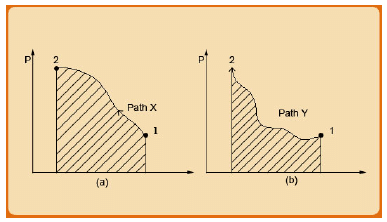
Thermodynamic work due to boundary (P-V) interaction is defined (in differential form) by equation 1.6 as a small amount of work δW associated with an infinitesimal change of volume. If the process is represented on a P-V diagram, the work done by the system when it moves from volume V1 to V2 is given by the area under the P-V curve between V1 and V2. This is illustrated in the following figure.

Fig. 1.4: Depiction of thermodynamic work on P-V plotFig. 1.4: Depiction of thermodynamic work on P-V plot

Thus, work depends on the path followed between two states. If the system goes from state 1 to state 2 by one path X and returns to state 1 by a different path Y, the work along X and along Y will in general be different; the algebraic sum around the closed loop need not be zero. For path-dependent quantities the differential is inexact; the notation δ (rather than d) is commonly used to emphasise this distinction. Hence one writes

δW = (an inexact differential)   ...(1.15)

Path variables: work and heat

Similarly, heat transferred between a system and its surroundings also depends on the process and thus is a path variable. One writes

δQ = (an inexact differential)   ...(1.16)

Path variables: work and heat

Because heat and work are process quantities, they appear only when there is a change in the system. If no change occurs, no heat is transferred and no work is done. Although time is not a thermodynamic coordinate, passage of time is necessary whenever heat transfer or work transfer occurs; the process occurs in time, but the thermodynamic description focuses on states and the transfers between them rather than on time as an independent thermodynamic variable.

Exact and inexact differentials: brief mathematical clarification

If a differential expression of two independent variables x and y is written as

M(x,y) dx + N(x,y) dy

this differential represents an exact differential (i.e., equals dF for some state function F(x,y)) if and only if the cross partial derivatives are equal in the region of interest:

∂M/∂y = ∂N/∂x

If the above condition is not satisfied, the differential is inexact and corresponds to a path function (for example δQ or δW). In some cases an integrating factor μ(x,y) can be found such that μM dx + μN dy becomes exact; this idea is important in deriving state functions like entropy from heat in reversible processes (δQ_rev/T is an exact differential of S), but details of integrating factors are treated in later chapters.

Representative examples and short calculations

  • Isothermal reversible expansion of an ideal gas (work):

    For n moles of an ideal gas undergoing a quasi-static reversible isothermal process at temperature T the pressure at each instant is P = nRT/V. The work done by the gas when it expands from V1 to V2 is

    w = -∫(from V1 to V2) P dV

    w = -∫(from V1 to V2) nRT/V dV

    w = -nRT ln(V2/V1)

    Thus the work depends on the path; if the same end states are connected by an adiabatic process, the work would be different.

  • Cyclic process:

    For any state function F, the change over a complete cycle is zero: ∮ dF = 0. For path functions, such as heat and work, the cyclic integral need not vanish: ∮ δQ = ∮ δW (related by the first law) and may be nonzero.

  • Comparison of two different paths between the same states:

    Consider two processes between the same end states, one isothermal and the other isobaric (constant pressure). The heat exchanged and the work done are in general different for these two processes even though initial and final pressures and temperatures might coincide; only state variables (for example, ΔU for an ideal gas depends only on temperature change) are path independent.

Remarks, practical relevance and examination tips

  • Conceptual distinction: Always distinguish between properties (state variables) and process quantities (path variables). State variables characterise equilibrium states; path variables describe transfer during processes.
  • Notation: Use d for exact differentials (state functions) and δ for inexact differentials (heat, work) to avoid confusion in derivations and integrations.
  • Use of P-V diagrams: The P-V diagram is the most direct way to visualise work as the area under the curve. When solving problems, sketch the process path(s) in the P-V plane to understand qualitative differences in work for different paths.
  • Link to first law: The first law (energy conservation) connects state and path variables: ΔU = Q - W. Here ΔU is a state function (exact differential), while Q and W are path dependent.

Summary

State variables (point functions) depend only on the equilibrium state of a system and have exact differentials; path variables (process functions) such as heat and work depend on the way the process is carried out and have inexact differentials. The P-V diagram provides a direct geometrical interpretation of work as the area under the process curve. Understanding the difference between these two types of quantities and recognising the appropriate differential notation and mathematical tests for exactness are essential for clear reasoning and correct solution of thermodynamics problems.

The document State & Path Dependent Thermodynamic Variables - Thermodynamics - Mechanical Engineering is a part of the Mechanical Engineering Course Thermodynamics.
All you need of Mechanical Engineering at this link: Mechanical Engineering
29 videos|152 docs|36 tests

FAQs on State & Path Dependent Thermodynamic Variables - Thermodynamics - Mechanical Engineering

1. What are state-dependent thermodynamic variables in mechanical engineering?
Ans. State-dependent thermodynamic variables in mechanical engineering are properties of a system that depend only on the current state of the system, such as temperature, pressure, and volume. These variables determine the equilibrium state of the system and can be used to describe its macroscopic behavior.
2. What are path-dependent thermodynamic variables in mechanical engineering?
Ans. Path-dependent thermodynamic variables in mechanical engineering are properties of a system that depend on the path followed during a process or transformation. Examples include heat and work, which are not determined solely by the initial and final states of the system, but also by the specific path taken to reach those states.
3. How do state-dependent and path-dependent variables differ in mechanical engineering?
Ans. State-dependent variables in mechanical engineering describe the equilibrium state of a system and depend only on the current state, such as temperature, pressure, and volume. On the other hand, path-dependent variables depend on the path taken during a process or transformation, such as heat and work. State variables are independent of the specific path, while path variables are influenced by the specific route taken.
4. Why are state and path-dependent variables important in mechanical engineering?
Ans. State and path-dependent variables are important in mechanical engineering as they provide a comprehensive understanding of the thermodynamic behavior of systems. State variables allow us to determine the equilibrium state and describe the system's macroscopic properties, while path variables help us analyze the energy exchange and work done during processes. Understanding both types of variables is crucial for designing and analyzing mechanical systems.
5. Can you give an example of a state-dependent and a path-dependent variable in mechanical engineering?
Ans. An example of a state-dependent variable is temperature, which solely depends on the current state of the system. Regardless of how the system reached that state, the temperature will remain the same. On the other hand, work is an example of a path-dependent variable. The amount of work done during a process depends not only on the initial and final states but also on the specific path taken to reach those states.
Related Searches
State & Path Dependent Thermodynamic Variables - Thermodynamics - Mechanical Engineering, mock tests for examination, study material, State & Path Dependent Thermodynamic Variables - Thermodynamics - Mechanical Engineering, Exam, Semester Notes, MCQs, Extra Questions, practice quizzes, Summary, video lectures, Sample Paper, past year papers, pdf , Free, Previous Year Questions with Solutions, State & Path Dependent Thermodynamic Variables - Thermodynamics - Mechanical Engineering, Important questions, Viva Questions, shortcuts and tricks, Objective type Questions, ppt;