Compression & Consolidation of Soils | Soil Mechanics - Civil Engineering (CE) PDF Download
Compression and Consolidation of Soils
When a soil layer is subjected to vertical stress, volume change can take place through rearrangement of soil grains, and some amount of grain fracture may also take place. The volume of soil grains remains constant, so change in total volume is due to change in volume of water. In saturated soils, this can happen only if water is pushed out of the voids. The movement of water takes time and is controlled by the permeability of the soil and the locations of free draining boundary surfaces.
It is necessary to determine both the magnitude of volume change (or the settlement) and the time required for the volume change to occur. The magnitude of settlement is dependent on the magnitude of applied stress, thickness of the soil layer, and the compressibility of the soil.
When soil is loaded undrained, the pore pressure increases. As the excess pore pressure dissipates and water leaves the soil, settlement takes place. This process takes time, and the rate of settlement decreases over time. In coarse soils (sands and gravels), volume change occurs immediately as pore pressures are dissipated rapidly due to high permeability. In fine soils (silts and clays), slow seepage occurs due to low permeability.
Components of Total Settlement
The total settlement of a loaded soil has three components: Elastic settlement, primary consolidation, and secondary compression.
Elastic settlement is on account of change in shape at constant volume, i.e. due to vertical compression and lateral expansion. Primary consolidation (or simply consolidation) is on account of flow of water from the voids, and is a function of the permeability and compressibility of soil. Secondary compression is on account of creep-like behaviour.
Primary consolidation is the major component and it can be reasonably estimated. A general theory for consolidation, incorporating three-dimensional flow is complicated and only applicable to a very limited range of problems in geotechnical engineering. For the vast majority of practical settlement problems, it is sufficient to consider that both seepage and strain take place in one direction only, as one-dimensional consolidation in the vertical direction.
Compressibility Characteristics
Soils are often subjected to uniform loading over large areas, such as from wide foundations, fills or embankments. Under such conditions, the soil which is remote from the edges of the loaded area undergoes vertical strain, but no horizontal strain. Thus, the settlement occurs only in one-dimension.
The compressibility of soils under one-dimensional compression can be described from the decrease in the volume of voids with the increase of effective stress. This relation of void ratio and effective stress can be depicted either as an arithmetic plot or a semi-log plot.
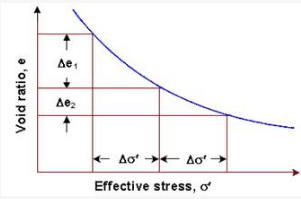
In the arithmetic plot as shown, as the soil compresses, for the same increase of effective stress Ds', the void ratio reduces by a smaller magnitude, from De1 to De2. This is on account of an increasingly denser packing of the soil particles as the pore water is forced out. In fine soils, a much longer time is required for the pore water to escape, as compared to coarse soils.
It can be said that the compressibility of a soil decreases as the effective stress increases. This can be represented by the slope of the void ratio – effective stress relation, which is called the coefficient of compressibility, av.

For a small range of effective stress, 
The -ve sign is introduced to make av a positive parameter.
If e0 is the initial void ratio of the consolidating layer, another useful parameter is the coefficient of volume compressibility, mv, which is expressed as

It represents the compression of the soil, per unit original thickness, due to a unit increase of pressure.
Normally Consolidated and Over-Consolidated Clays
The figure shows the relation of void ratio and effective stress of a clay soil as a semi-log plot.
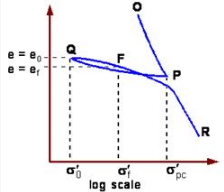
OP corresponds to initial loading of the soil. PQ corresponds to unloading of the soil. QFR corresponds to a reloading of the soil. Upon reloading beyond P, the soil continues along the path that it would have followed if loaded from O to R continuously.
The preconsolidation stress, s'pc, is defined to be the maximum effective stress experienced by the soil. This stress is identified in comparison with the effective stress in its present state. For soil at state Q or F, this would correspond to the effective stress at point P.
If the current effective stress, s', is equal (note that it cannot be greater than) to the preconsolidation stress, then the deposit is said to be normally consolidated (NC). If the current effective stress is less than the preconsolidation stress, then the soil is said to be over-consolidated (OC).
It may be seen that for the same increase in effective stress, the change in void ratio is much less for an overconsolidated soil (from e0 to ef), than it would have been for a normally consolidated soil as in path OP. In unloading, the soil swells but the increase in volume is much less than the initial decrease in volume for the same stress difference.
The distance from the normal consolidation line has an important influence on soil behaviour. This is described numerically by the overconsolidation ratio (OCR), which is defined as the ratio of the preconsolidation stress to the current effective stress.

Note that when the soil is normally consolidated, OCR = 1
Settlements will generally be much smaller for structures built on overconsolidated soils. Most soils are overconsolidated to some degree. This can be due to shrinking and swelling of the soil on drying and rewetting, changes in ground water levels, and unloading due to erosion of overlying strata.
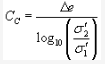
For NC clays, the plot of void ratio versus log of effective stress can be approximated to a straight line, and the slope of this line is indicated by a parameter termed as compression index, Cc.
|
30 videos|76 docs|74 tests
|
FAQs on Compression & Consolidation of Soils - Soil Mechanics - Civil Engineering (CE)
| 1. What is soil compression? |  |
| 2. How does consolidation of soil occur? | |
| 3. What factors affect soil consolidation? | |
| 4. Why is soil consolidation important in civil engineering? | |
| 5. What are some common methods used for soil consolidation? | |

|
4.73/5 Rating |

|
Dec 31, 2024 Last updated |

|
Explore Courses for Civil Engineering (CE) exam
|

|
Free
,Objective type Questions
,study material
,practice quizzes
,mock tests for examination
,past year papers
,Sample Paper
,Viva Questions
,Compression & Consolidation of Soils | Soil Mechanics - Civil Engineering (CE)
,Semester Notes
,ppt
,shortcuts and tricks
,Important questions
,MCQs
,video lectures
,Summary
,Compression & Consolidation of Soils | Soil Mechanics - Civil Engineering (CE)
,Exam
,Compression & Consolidation of Soils | Soil Mechanics - Civil Engineering (CE)
,Extra Questions
,Previous Year Questions with Solutions
;




Compression & Consolidation of Soils Free PDF Download
Importance of Compression & Consolidation of Soils
Compression & Consolidation of Soils Notes
Compression & Consolidation of Soils Civil Engineering (CE) Questions
Study Compression & Consolidation of Soils on the App
|
© EduRev
|
Education Revolution
|


|


