Design Philosophy - 1 | Design of Machine Elements - Mechanical Engineering PDF Download
| Table of contents |

|
| Introduction |
|
| Basic Concept of Machine Design |
|
| Types of design |
|
| Types of Design Based on Methods |
|

Introduction
Design is essentially a decision-making process. If we have a problem, we need to design a solution. In other words, to design is to formulate a plan to satisfy a particular need and to create something with a physical reality. Consider for an example, design of a chair. A number of factors need be considered first:
(a) The purpose for which the chair is to be designed such as whether it is to be used as an easy chair, an office chair or to accompany a dining table.
(b) Whether the chair is to be designed for a grown up person or a child.
(c) Material for the chair, its strength and cost need to be determined.
(d) Finally, the aesthetics of the designed chair.
Almost everyone is involved in design, in one way or the other, in our daily lives because problems are posed and they need to be solved.
Basic Concept of Machine Design
- Decision making comes in every stage of design. Consider two cars of different makes. They may both be reasonable cars and serve the same purpose but the designs are different. The designers consider different factors and come to certain conclusions leading to an optimum design. Market survey gives an indication of what people want. Existing norms play an important role. Once a critical decision is made, the rest of the design features follow. For example,once we decide the engine capacity, the shape and size, then the subsequent course of the design would follow. A bad decision leads to a bad design and a bad product.
- Design may be for different products and with the present specialization and knowledge bank, we have a long list of design disciplines e.g. ship design, building design, process design, bridge design, clothing or fashion design and so on.
- Here we are concerned with machine design. We now define a machine as a combination of resisting bodies with successfully constrained relative motions which is used to transform other forms of energy into mechanical energy or transmit and modify available energy to do some useful work. If it converts heat into mechanical energy we then call it a heat engine. This is illustrated in figure 1.1.2.1.
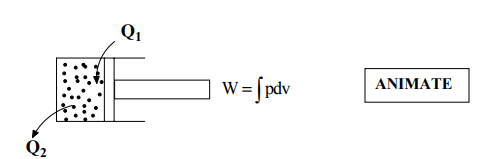 1.1.2.1A- Conversion of heat to mechanical energy in a piston cylinder arrangement.
In many cases however, the machines receive mechanical energy and modify it so that a specific task is carried out, for example a hoist, a bicycle or a handwinch.
This modification or transformation of energy requires a number of machine elements, some small and some large. Machine design involves primarily designing these elements so that they may transmit the forces safely and perform their task successfully. Consider the following simple mechanisms:
(a) Hand winch
(b) Small press operated by a power screw..
In each one of these mechanisms some useful work is being obtained with certain combinations of a number of machine parts. Designing these mechanisms would involve firstly designing these elements and then assembling them in order.
Types of design
There may be several types of design such as- Adaptive design: This is based on existing design, for example, standard products or systems adopted for a new application. Conveyor belts, control system of machines and mechanisms or haulage systems are some of the examples where existing design systems are adapted for a particular use.
- Developmental design: Here we start with an existing design but finally a modified design is obtained. A new model of a car is a typical example of a developmental design .
- New design: This type of design is an entirely new one but based on existing scientific principles. No scientific invention is involved but requires creative thinking to solve a problem. Examples of this type of design may include designing a small vehicle for transportation of men and material on board a ship or in a desert. Some research activity may be necessary.
Types of Design Based on Methods
- Rational design: This is based on determining the stresses and strains of components and thereby deciding their dimensions.
- Empirical design : This is based on empirical formulae which in turn is based on experience and experiments. For example, when we tighten a nut on a bolt the force exerted or the stresses induced cannot be determined exactly but experience shows that the tightening force may be given by P=284d where, d is the bolt diameter in mm and P is the applied force in kg. There is no mathematical backing of this equation but it is based on observations and experience.
- Industrial design : These are based on industrial considerations and norms viz. market survey, external look, production facilities, low cost, use of existing standard products.
|
49 videos|107 docs|77 tests
|
FAQs on Design Philosophy - 1 - Design of Machine Elements - Mechanical Engineering
| 1. What is the basic concept of machine design? |  |
| 2. What are the types of design in machine design? | |
| 3. What are the types of design based on methods in machine design? | |
| 4. What is the design philosophy in machine design? | |
| 5. How does mechanical engineering contribute to machine design? | |




mock tests for examination
,Objective type Questions
,shortcuts and tricks
,ppt
,Important questions
,MCQs
,Viva Questions
,Sample Paper
,Free
,Summary
,Design Philosophy - 1 | Design of Machine Elements - Mechanical Engineering
,practice quizzes
,Semester Notes
,Exam
,study material
,Design Philosophy - 1 | Design of Machine Elements - Mechanical Engineering
,video lectures
,Design Philosophy - 1 | Design of Machine Elements - Mechanical Engineering
,Extra Questions
,Previous Year Questions with Solutions
,past year papers
;



Design Philosophy - 1 Free PDF Download
Importance of Design Philosophy - 1
Design Philosophy - 1 Notes
Design Philosophy - 1 Mechanical Engineering Questions
Study Design Philosophy - 1 on the App
|
© EduRev
|
Education Revolution
|


|




within 7 days!