NCERT Solutions for Class 8 Maths - Factorisation- 1

Question: Factorise
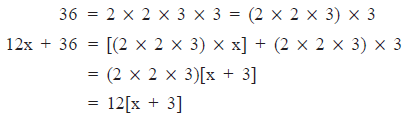
(i) 12x + 36
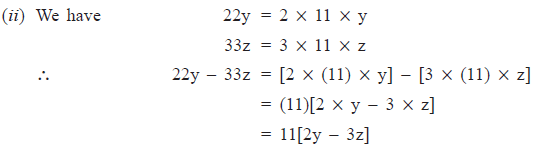
(ii) 22y – 33z
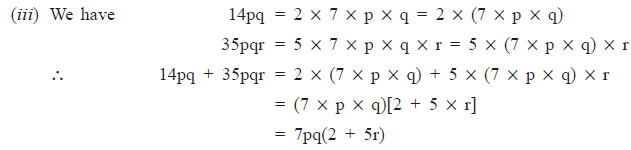
(iii) 14pq + 35pqr
Solution:
(i) We have 12x = 3 * 2 * 2 * x = (2 * 2 * 3) * x
∴
Exercise 14.1
Q1: Find the common factors of the given terms.
(i) 12x, 36
(ii) 2y, 22xy
(iii) 14pq, 28p2q2
(iv) 2x, 3x2, 4
(v) 6abc, 24ab2, 12a2b
(vi) 16x3, –4x2, 32x
(vii) 10pq, 20qr, 30rp
(viii) 3x2y3, 10x3y2, 6x2y2xz
Solution: 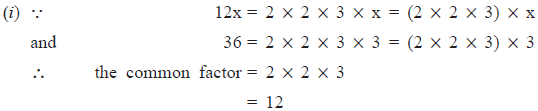
(ii) ∵ 2y = 2 * y = (2 * y)
and 22y = 2 * 11 X y = (2 X y) X 11
∴ the common factor = 2 X y
= 2y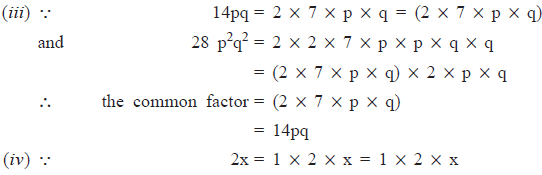
3x2 = 1 * 3 * x * x = 1 * 3 * x
and 4 = 1 * 2 * 2 = 1 * 2 * 2
∴ the common factor = 1
Note: 1 is a factor of every term.
(v) ∵ 6abc = 2 * 3 * a * b * c = (2 * 3 * a * b) * c
24 ab2 = 2 * 2 * 2 * 3 * a * b * b = (2 * 3 * a * b) * 2 * 2 * b
12 a2b = 2 * 2 * 3 * a * a * b = (2 * 3 * a * b) * 2 * a
∴ the common factor = 2 * 3 * a * b
= 6ab
(vi) ∵ 16x3 = 2 * 2 * 2 * 2 * x * x * x = (2 * x * x
–4x2 = –1 * 2 * 2 * x * x = (2 * 2 * x) * (–1) * x
32x = 2 * 2 * 2 * 2 * 2 * x = (2 * 2 * x) * 2 * 2 * 2
∴ the common factor = 2 * 2 * x
= 4x
(vii) ∵ 10pq = 2 * 5 * p * q = (2 * 5) * p * q
20qr = 2 * 2 * 5 * q * r = (2 * 5) * 2 * q * r
30rp = 2 * 3 * 5 * r * p = (2 * 5) * 3 * r * p
∴ the common factor = 2 * 5
= 10
(viii) ∵ 3x2y3 = 3 * x * x * y * y * y
= (x * x * y * y) * 3 * y
10x3y2 = 2 * 5 * x * x * x * y * y
= (x * x * y * y) * 2 * 5 * x
6x2y2z = 2 * 3 * x * x * y * y * z
= (x * x * y * y) * 2 * 3 * z
∴ the common factor = (x * x * y * y)
= x2y2
Q2: Factorise the following expressions.
(i) 7x – 42
(ii) 6p – 12q
(iii) 7a2 + 14a
(iv) –16z + 20z3 (v) 20 l2m + 30alm
(vi) 5x2y – 15xy2
(vii) 10a2 – 15 b2 + 20c2
(viii) –4a2 + 4ab – 4ca
(ix) x2yz + xy2z + xyz2
(x) ax2y + bxy2 + cxyz
Solution:
(i) ∵ 7x = 7 * x = (7) * x
42 = 2 * 7 * 3 = (7) * 2 * 3
∴ 7x – 42 = 7[(x) – (2 * 3)]
= 7[x – 6]
(ii) ∵ 6p = 2 * 3 * p = (2) * (3) * p = (2 * 3) * p
12q = 2 * 2 * 3 * q = (2) * 2 * (3) * q = (2 * 3) * 2 * q
∴ 6p – 12q = (2 * 3) [(p) – (2 * q)]
= 6[p – 2q]
(iii) ∵ 7a2 = 7 * a * a = (7 * a) * a
14a = 2 * 7 * a = (7 * a) * 2
∴ 7a2 – 14a = (7 * a)[a + 2]
= 7a(a + 2)
(iv) ∵ –16z = (–1) * 2 * 2 * 2 * 2 * z = (2 * 2 * z) * (–1) * 2
20z3 = 2 * 2 * 5 * z * z * z = (2 * 2 * z) * 5 * z * z
∴ –16z + 20z3 = (2 * 2 * z) [(–1) * 4 + 5 * z * z]
= 4z[–4 + 5z2]
(v) ∵ 20l2m = 2 * 2 * 5 * l * l * m = (2 * 5 * l * m) * 2 * l
30alm = 2 * 3 * 5 * a * l * m = (2 * 5 * l * m) * 3 * a
∴ 20l2m + 30alm = (2 * 5 * l * m)[ 2 * l + 3 * a]
= 10lm[2l + 3a]
(vi) ∵ 5x2y = 5 * x * x * y = (5 * x * y)[x]
15xy2 = 5 * 3 * x * y * y = (5 * x * y)[3 * y]
∴ 5x2y – 15xy2 = (5 * x * y)[x – 3 * y]
= 5xy(x – 3y)
(vii) ∵ 10a2 = 2 * 5 * a * a = (5)[2 * a * a]
15b2 = 3 * 5 * b * b = (5)[3 * b * b]
20c2 = 2 * 2 * 5 c * c = (5)[2 * 2 * c * c]
∴ 10a2 – 15b2 + 20c2 = (5)[2 * a * a + 3b * b + 2 * 2 * c * c]
= 5[2a2 + 3b2 + 4c2]
(viii) ∵ –4a2 = (–1) * 2 * 2 * a * a = (2 * 2 * a)[(–1) * a]
4ab = 2 * 2 * a * b = (2 * 2 * a)[b]
–4ca = (–1) * 2 * 2 * c * a = (2 * 2 * a)[(–1) * c]
∴ –4a2 + 4ab – 4ca = (2 * 2 * a)[(–1) * a + b – c]
= 4a[–a + b –c]
(ix) ∵ x2yz = x * x * y * z = (xyz)[x]
xy2z = x * y * y * z = (xyz)[y]
xyz2 = x * y * z * z = (xyz)[z]
∴ x2yz + xy2z + xyz2 = (xyz)[x + y + z]
= xyz(x + y + z)
(x) ∵ ax2y = a * x * x * y = (x * y)[a * x]
bxy2 = b * x * y * y = (x * y)[b * y]
cxyz = c * x * y * z = (x * y)[c * z]
∴ ax2y + bxy2 + cxyz = (x * y)[a * x + b * y + c * z]
= xy(ax + by + cz)
Q3: Factorise:
(i) x2 + xy + 8x + 8y
(ii) 15xy – 6x + 5y – 2
(iii) ax + bx – ay – by
(iv) 15pq + 15 + 9q + 25p
(v) z – 7 + 7xy – xyz
Solution:
(i) x2 + xy + 8x + 8y = x[x + y] + 8[x + y]
= (x + y)(x + 8)
(ii) 15xy – 6x + 5y – 2 = 3x[5y – 2] + 1[5y – 2]
= (5y – 2)(3x +1)
(iii) ax + bx – ay – by = x[a + b] + (–y)[a + b]
= (x – y)[a + b]
(iv) Regrouping the terms, we have
15pq + 15 + 9q + 25p = 15pq + 9q + 25 p + 15
= 3q[5p + 3] + 5[5p + 3]
= (5p + 3)[3q + 5]
(v) Regrouping the terms, we have
z – 7 + 7xy – xyz = z – 7 – xyz + 7xy
= 1[z – 7] – xy[z – 7]
= (z – 7)(1 – xy)
Factorisation Using Identities
We know that
(a + b)2 = a2 + 2ab + b2
(a – b)2 = a2– 2ab + b2
(a + b)(a – b) = a2 – b2
Using these identities, we can say that
a2 + 2ab + b2 = (a + b)2
= (a + b)(a + b)
a2 – 2ab + b2 = (a – b)2
= (a – b)(a – b)
a2 – b2 = (a + b)(a – b)
Note: For factorising an expression of the type x2 + px + q [where p = (a + b) and q = (ab)], we have
x2 + px + q = x2 + (a + b)x + ab
= x2 + ax + bx + ab
= x(x + a) + b(x + a)
= (x + a)(x + b)
Exercise 14.2
Q1: Factorise the following expressions.
14.2
Q1: Factorise the following expressions.
(i) a2 + 8a + 16
(ii) P2 – 10p + 25
(iii) 25m2 + 30 m + 9
(iv) 49y2 + 84yz + 36z2
(v) 4x2 – 8x + 4
(vi) 121b2 – 88bc + 16c2
(vii) (l + m)2– 4lm
(viii) a4 + 2a2b2 + b4
[Hint: Expand (l + m)2 first.]
Solution:
(i) We have a2 + 8a + 16 = (a)2 + 2(a)(4) + (4)2
= (a + 4)2 = (a + 4)(a + 4)
∴ a2 + 8a + 16 = (a + 4)2 = (a + 4)(a + 4)
(ii) We have p2 – 10p + 25 = P2 – 2(p)(5) + (5)2
= (p – 5)2 = (p – 5)(p – 5)
∴ P2 – 10p + 25 = (p – 5)2 = (p – 5)(p – 5)
(iii) We have 25m2 + 30m + 9 = (5m)2 + 2(5m)(3) + (3)2
= (5m + 3)2 = (5m + 3)(5m + 3)
∴ 25m2 + 30m + 9 = (5m + 3)2 = (5m + 3)(5m + 3)
(iv) We have 49y2 + 84yz + 36z = (7y)2 + 2(7y)(6z) + (6z)2
= (7y + 6z)2
= (7y + 6z)(7y + 6z)
∴ 49y2 + 84yx + 36 z2 = (7y + 6z)2 = (7y + 6z)(7y + 6z)
(v) We have 4x2 – 8x + 4 = (2x)2 – 2(2x)(2) + (2)2
= (2x – 2)2 = (2x – 2)(2x – 2)
= 2(x – 1)2(x – 1)
= 4(x – 1)(x – 1)
∴ 4x2 – 8x + 4 = 4(x – 1)(x – 1) = (4(x – 1)2
(vi) We have 121b2 – 88bc + 16c2 = (11b)2 – 2(11b)(4c) + (4c)2
= (11b – 4c)2 = (11b – 4c)(11b – 4c)
∴ 121b2 – 88bc + 16c2 = (11b – 4c)2 = (11b – 4c)(11b – 4c)
(vii) We have (l + m)2 – 4lm = (l2 + 2lm + m2) – 4lm
[Collecting the like terms 2lm and –4lm]
= l2 + (2lm – 4lm) + m2
= l2 + 2lm + m2
= (l)2 – 2(l)(m) + (m)2
= (l – m)2 = (l – m)(l – m)
∴ (l + m)2 – 4lm = (l – m)2 = (l – m)(l – m)
(viii) We have a4 + 2a2b2 + b4 = (a2)2 + 2(a2)(b2) + (b2)2
= (a2 + b2)2 = (a2 + b2)(a2 + b2)
∴ a4 + 2a2b2 + b4 = (a2 + b2)2 = (a2 + b2)(a2 + b2)
Q2: Factorise:
(i) 4p2 – 9q2
(ii) 63a2 – 112b2
(iii) 49x2 – 36
(iv) 16x5 – 144x3
(v) (l + m)2 – (l – m)2
(vi) 9x2y2 – 16
(vii) (x2 – 2xy + y2) – z2
(viii) 25a2 – 4b2 + 28bc – 49c2
Solution:
(i) ∵ 4p2 – 9q2 = (2p)2 – (3q)2
= (2p – 3q)(2p + 3q) [Using a2 – b2 = (a + b)(a – b)]
∴ 4p2 – 9q2 = (2p – 3q)(2p + 3q)
(ii) We have
63a2 – 112b2 = 7 * 9a2 – 7 * 16b2
= 7[9a2 – 16b2)
∵ 9a2 – 16b2 = (3a)2 – (4b)2
= (3a + 4b)(3a – 4b) [Using a2 – b2 = (a + b)(a – b)]
∴ 63a2 – 112b2 = 7[(3a + 4b)(3a – 4b)]
(iii) ∵ 49 x2 – 36 = (7x)2 – (6)2
= (7x – 6)(7x + 6) [Using a2 – b2 = (a – b)(a + b)]
∴ 49x2 – 36 = (7x – 6)(7x + 6)
(iv) We have 16x5 = 16x3 * x2 and 144x3 = 16x3 * 9
∴ 16x5 – 144x3 = (16x3) * x2 – (16x3) * 9
= 16x3[x2 – 9]
= 16x3[(x)2 – (3)2]
= 16x3[(x + 3)(x – 3)] [(Using a2 – b2 = (a – b)(a + b)]
∴ 16x5 – 144x3 = 16x3(x + 3)(x – 3)
(v) Using the identity a2 – b2 = (a + b)(a – b), we have
(l + m)2 – (l – m)2 = [(l + m) + (l – m)][(l + m) – (l – m)]
= [l + m + l – m][l + m – l + m]
= (2l)(2m) = 2 * 2(l * m)
= 4lm
(vi) We have 9x2y2 – 16 = (3xy)2 – (4)2
= (3xy + 4)(3xy – 4) [Using a2 – b2 = (a + b)(a – b)]
∴ 9x2y2 – 16 = (3xy + 4)(3xy – 4)
(vii) We have x2 – 2xy + y2= (x – y)2
∴ (x2 – 2xy + y2) – z2 = (x – y)2 – (z)2
= [(x – y) + z][(x – y) – z]
[Using a2 – b2 = (a + b)(a – b)]
= (x – y + z)(x – y – z)
∴ (x2 – 2xy + y2) – z2 = (x – y + z)(x – y – z)
(viii) We have –4b2 + 28bc – 49c2 = (–1)[4b2 – 28bc + 49c2]
= –1[(2b)2 – 2(2b)(7c) + (7c)2]
= –[2b – 7c]2
∴ 25a2 – 4b2 + 28bc – 49c2 = 25a2 – (2b – 7c)2
Now, using a2 – b2 = (a + b)(a – b), we have
[5a]2 – [2b – 7c]2 = (5a + 2b – 7c)(5a – 2b + 7c)
∴ 25a2 – 4a2 + 28bc – 49c2 = (5a + 2b – 7c)(5a – 2b + 7c)
Q3: Factorise the expressions.
(i) ax2 + bx
(ii) 7p2 + 21q2
(iii) 2x3 + 2xy2 + 2xz2
(iv) am2 + bm2 + bn2 + an2
(v) (lm + l) + m + 1
(vi) y(y + z) + 9(y + z)
(vii) 5y2 – 20y – 8z + 2yz
(viii) 10ab + 4a + 5b + 2
(ix) 6xy – 4y + 6 – 9x
Solution:
(i) ∵ ax2 = a * x * x = (x)[ax]
bx = b * x = (x)[b]
∴ ax2 + bx = x[ax + b]
(ii) We have 7p2 + 21q2 = 7 * p * p + 7 * 3 * q * q
= 7[p * p + 3 * q * q]
= 7[p2 + 3q2]
(iii) Taking out 2x as common from each term, we have
2x3 + 2xy2 + 2xz2 = 2x[x2 + y2 + z2]
(iv) We can take out m2 as common from the first two terms and n2 as common from the last two terms,
∴ am2 + bm2 + bn2 + an2 = m2(a + b) + n2(b + a)
= m2(a + b) + n2(a + b)
= (a + b)[m2 + n2]
(v) We have lm + l = l(m + 1)
∴ (lm + l) + (m + 1) = l(m + 1) + (m + 1)
= (m + 1)[l + 1]
(vi) We have (y + z) as a common factor to both terms.
∴ y(y + z) + 9(y + z) = (y + z)(y + 9)
(vii) We have 5y2 – 20y = 5y(y – 4)
and –8z + 2yz = 2z(–4 + y)
= 2z(y – 4)
∴ 5y2 – 20y – 8z + 2yz = 5y(y – 4) + 2z(y – 4)
= (y – 4)[5y + 2z]
(viii) We have, 10ab + 4a = 2a(5b + 2)
and (5b + 2) = 1(5b + 2)
∴ 10ab + 4a + 5b + 2 = 2a(5b + 2) + 1(5b + 2)
= (5b + 2)[2a + 1]
(ix) Regrouping the terms, we have
6xy – 4y + 6 – 9x = 6xy – 4y – 9x + 6
= 2y[3x – 2] – 3[3x – 2]
= (3x – 2)[2y – 3]
Q4: Factorise:
(i) a4 – b4
(ii) p4 – 81
(iii) x4 – (y + z)4
(iv) x4 – (x – z)4
(v) a4 – 2a2b2 + b4
Solution:
(i) Using a2 – b2 = (a – b)(a + b), we have
a4 – b4 = (a2)2 – (b2)2
= (a2 + b2)(a2 – b2)
= (a2 + b2)[(a + b)(a – b)]
= (a2 + b2)(a + b)(a – b)
(ii) We have P4 – 81 = (p2)2 – (92)2
Now using a2 – b2 = (a + b)(a – b), we have
(p2)2 – (9)2 = (p2 + 9)(p2 – 9)
We can factorise p2 – 9 further as
p2 – 9 = (p)2 – (3)2
= (p + 3)(p – 3)
∴ p4 – 81 = (p + 3)(p – 3)(p2 + 9)
(iii) ∵ x4 – (y + z)4 = [x2]2 – [(y + z)2]2
= [(x)2 + (y + z)2][(x2) – (y + z)2]
[Using a2 – b2 = (a + b)(a – b)]
We can factorise [x2 – (y + z)2] further as
(x)2 – (y + z)2 = [(x) + (y + z)][(x) – (y + z)]
= (x + y + z)(x – y – z)
∴ x4 – (y + z)4 = (x + y + z)(x – y – z)[x2 + (y + z)2]
(iv) We have x4 – (x – z)4 = [x2]2 – [(x – z)2]2
= [x2 + (x – z)2][x2 – (x – z)2]
Now, factorising x2 – (x – z)2 further, we have
x2 – (x – z)2 = [x + (x – z)][x – (x – z)]
= (x + x – z)(x – x + z) = (2x – z)(z)
∴ x4 – (y – z)4 = z(2x – z)[x2 + (x – z)2]
= z(2x – z)[x2 + (x2 – 2xz + z2)]
= z(2x – z)[x2 + x2 – 2xz + z2]
= z(2x – z)(2x2 – 2xz + z2)
(v) ∵ a4 – 2a2b2 + b4 = (a2)2 – 2(a2)(b2) + (b2)2
= (a2 – b2)2
= [(a2 – b2)(a2 + b2)]
= [(a – b)(a + b)(a2 + b2)]
∴ a4 – 2a2b2 + b4 = (a – b)(a + b)(a2 + b2)
Q5: Factorise the following expressions.
(i) p2 + 6p + 8
(ii) q2 – 10q + 21
(iii) p2 + 6p – 16
Solution:
(i) We have p2 + 6p + 8 = P2 + 6p + 9 – 1 [∵ 8 = 9 – 1]
= [(p)2 + 2(p)(3) + 32] – 1
= (p + 3)2 – 12 [Using a2 + 2ab + b2 = (a + b)2]
= [(p + 3) + 1][(p + 3) – 1]
= (p + 4)(p + 2)
∴ p2 + 6p + 8 = (p + 4)(p + 2)
(ii) We have q2 – 10q + 21 = q2 – 10q + 25 – 4 [∵ 21 = 25 – 4]
= [(q)2 – 2(q)(5) + (5)2] – (2)2
= [q – 5]2 – [2]2
= [(q – 5) + 2][(q – 5) – 2]
[Using a2 – b2 = (a + b) (a – b)]
= (q – 3)(q – 7)
(iii) We have p2 + 6p – 16 = p2 + 6p + 9 – 25 [∵ –16 = 9 – 25]
= [(p)2 + 2(p)(3) + (3)2] – (5)2
= [p + 3]2 – [5]2 [Using a2 + 2ab + b2 = (a + b)2]
= [p + 3] + 5][(p + 3) – 5]
[Using a2 – b2 = (a + b)(a – b)
= (p + 8)(p – 2)
Division of Algebraic Expressions
For division of algebraic expression by another expression:
- We write them in the form of a fraction, such that the divisor is the denominator.
- Factorise the numerator as well as the denominator.
- Cancel the factors common to both the numerator and denominator.
Example 1. Divide 33(p4 + 5p3 – 24p2) by 11p(p + 8).
Solution: We have 33(p4 + 5p3 – 24p2) ÷ 11p(p + 8)
[In numerator, p is taken out common from each term]
[In numerator, 5p is splitted in to 8p – 3p such that (8p)(–3p) = –24p]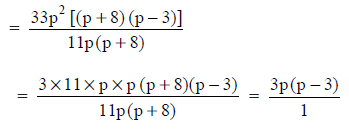
[Cancelling the factors 11p and x + 8 common to both the numerator and denominator]
Thus, 33(p4 + 5p3 – 24p2) ÷ 11p(p + 8)
= 3p(p – 3)
|
276 docs|155 tests
|
FAQs on NCERT Solutions for Class 8 Maths - Factorisation- 1
| 1. What is factorisation and why is it important in mathematics? |  |
| 2. How do you factorise a quadratic expression? | |
| 3. Can we factorise any number or expression? | |
| 4. What are the applications of factorisation in real life? | |
| 5. How can factorisation be used to solve equations? | |





Previous Year Questions with Solutions
,Extra Questions
,MCQs
,ppt
,NCERT Solutions for Class 8 Maths - Factorisation- 1
,Sample Paper
,Viva Questions
,practice quizzes
,NCERT Solutions for Class 8 Maths - Factorisation- 1
,Semester Notes
,Summary
,shortcuts and tricks
,video lectures
,Free
,NCERT Solutions for Class 8 Maths - Factorisation- 1
,mock tests for examination
,study material
,past year papers
,Exam
,Objective type Questions
,Important questions
;



NCERT Solutions: Factorisation- 1 Free PDF Download
Importance of NCERT Solutions: Factorisation- 1
NCERT Solutions: Factorisation- 1 Notes
NCERT Solutions: Factorisation- 1 Bank Exams Questions
Study NCERT Solutions: Factorisation- 1 on the App
|
© EduRev
|
Education Revolution
|


|




within 7 days!