CBSE Class 8  >  Class 8 Notes  >  Mathematics (Maths)   >  Important Questions: Exponents and Powers

Important Questions: Exponents and Powers

Q1: Evaluate
(i) 2-2
(ii) (-2)-2
(iii) (3/2)-5

Sol:
Rule: For any non-zero b and positive integer n, b-n = 1 / bn
(i) 2-2 = 1/ 22 =1/4
(ii) (-2)-2 = 1/(-2)= 1/4
(iii) (3/2)-5 = 3-5/ 2-5 =25/35 = 32/243

Q2: Find the value of.
(i) (40 + 4-1) × 22
(ii) (3-1 × 9-1) ÷ 3-2
(iii)(11-1 + 12-1 + 13-1)0

Sol:
(i) (40 + 4-1) × 22 = (1+1/4) × 4 = 4 + 1 =5
(ii) (3-1 × 9-1) ÷ 3-2 = [(1/3) × (1/9)] ÷ (1/9) =1/3
(iii) (11-1 + 12-1 + 13-1)=1 as a0= 1 

Q3: Find the value of m for which 2m ÷ 2-4 = 45

Sol:
2m ÷ 2-4 = 45
2m × (1/2-4) = 210
2m+4 =210
So, m + 4 = 10
m = 6 

Q4: Express the following numbers in usual form.
(i) 34.02 x 10⁻⁵
(ii) 9.5 x 10⁵
(iii) 9 x 10⁻⁴
(iv) 2.0001 x 10⁸

Sol:
(i) 34.02 x 10-5 = 0.0003402
(ii) 9.5 x 10= 950000
(iii) 9 x 10-4 = 0.0009
(iv) 2.0001 x 10=200010000

Q5: Find the Multiplicative inverse of
(i) 325
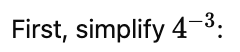
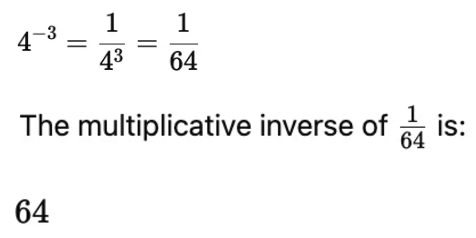
(ii) 4-3
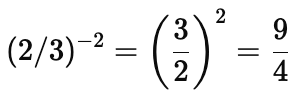
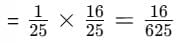
(iii) (2/3)-2

Sol:
(i) The multiplicative inverse of a number is the number that, when multiplied by the original number, equals 1.

Important Questions: Exponents and PowersImportant Questions: Exponents and Powers

(ii) 4-3
Important Questions: Exponents and PowersImportant Questions: Exponents and Powers

(iii) (2/3)2
Important Questions: Exponents and PowersImportant Questions: Exponents and PowersImportant Questions: Exponents and PowersImportant Questions: Exponents and Powers

Q6: True & False
(i) Very small numbers can be expressed in standard form using negative exponents.
(ii) ap × bq (ab)pq
(iii) .00567 5.67×10⁻³
(iv) 1/(8)-29
(v) 4= 4
(vi) (-1)3 1
(vii) The multiplicative inverse of (-2)-2 is (2)2.

Sol: 
(i) TrueImportant Questions: Exponents and Powers
(ii) FalseImportant Questions: Exponents and Powers
(iii) TrueImportant Questions: Exponents and Powers
(iv) True 

Important Questions: Exponents and PowersImportant Questions: Exponents and Powers(v) FalseImportant Questions: Exponents and Powers
(vi) FalseImportant Questions: Exponents and Powers
(vii) True  Important Questions: Exponents and PowersImportant Questions: Exponents and Powersits reciprocal is 4 = 22

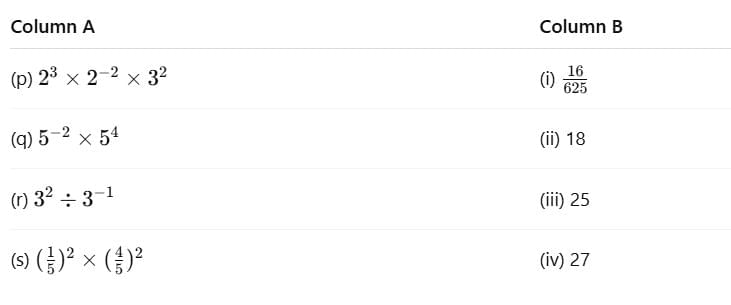
Q7: Match the columnImportant Questions: Exponents and Powers
Sol:
(p) 
23×2-2×32
= 23-2 × 3= 2× 9 = 18

(q) 5-2 × 54
= 5-2+4 =5=25

(r) 32÷3-1
= 32-(-1) =3= 27

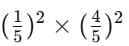
(s) Important Questions: Exponents and Powers

Important Questions: Exponents and Powers

Therefore correct match is : 
(p) → (ii)
(q) → (iii)
(r) → (iv)
(s) → (i)
Q8: The multiplicative inverse of -(7)-2 ÷ (90)-1 is
(a) -(7)2 × (90)-
(b) -(7)-2 × (90)-1
(c) -(7)2 ÷ (90)-1
(d) -(7)2 × (90)

Ans: (a)
Sol: -(7)-2 ÷ (90)-1-(1/7)2 × 901
So Multiplication inverse is -(7)2 × (90)-1
Hence correct Option is (a) 

Q9: If a be any non-zero integer, then a-1 is equal to
(a) a
(b) -a
(c) 1/a
(d) -1/a 

Ans: (c)
Sol:

Important Questions: Exponents and Powers

Q10: If 53x-1 ÷ 25 125, Then the value x is
(a) 1
(b) 2
(c) 3
(d) 4
 

Ans: (b)

Sol:

Express 25 and 125 as powers of 5

  • 25=5225 = 5^2
  • 125=53

So the equation becomes:Important Questions: Exponents and PowersApply the laws of exponents
Important Questions: Exponents and Powers

Now, equating powers (since bases are same):3x - 3 = 3

⇒ 3x = 6
⇒x=2

Hence x = 2
Option(b) is correct.

Q11: Simplify and express the result in power notation with positive exponent.
(i) (-2)5 ÷ (-2)4
(ii) (1/2)2 × (2/5)2
(iii) (-5)2 × (3/5) 

Sol:
(i) (-2)5 ÷ (-2)4
= (-2)5 / (-2)4
= (-2)5-4
=(-2)

(ii) (1/2)2 × (2/5)2
= (1/4) X (4/25)
= 1/25

(iii) (-5)2 × (3/5)
= 25 × (3/5) 
= 15 

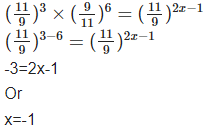
Q12: Find the value of x here

Important Questions: Exponents and Powers

Sol:
Important Questions: Exponents and Powers

Q13: Express the following numbers in standard form.
(i) 0.0000000015
(ii) 0.00000001425
(iii) 102000000000000000

Sol:
(i) 0.0000000015 = 1.5 ×10⁻⁹
(ii) 0.00000001425 = 1.425×10⁻⁸
(iii) 102000000000000000 = 1.02×10¹⁷

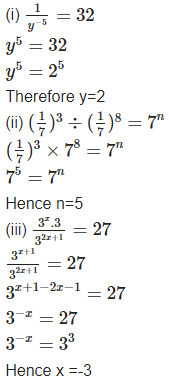
Q14: Solve for the variables
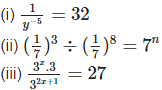
Important Questions: Exponents and Powers

Sol:
Important Questions: Exponents and Powers

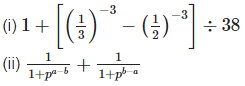
Q15: Simplify the following
Important Questions: Exponents and Powers

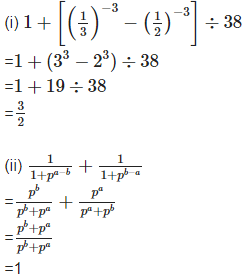
Sol:
Important Questions: Exponents and Powers

The document Important Questions: Exponents and Powers is a part of the Class 8 Course Mathematics (Maths) Class 8.
All you need of Class 8 at this link: Class 8

FAQs on Important Questions: Exponents and Powers

1. What's the difference between an exponent and a power in Class 8 maths?
Ans. An exponent is the small raised number indicating how many times to multiply a base by itself, while power refers to the complete expression (base and exponent together). For example, in 2³, the 3 is the exponent and 2³ is the power. Understanding this distinction helps students correctly interpret and solve exponential expressions and equations in CBSE mathematics.
2. How do I simplify expressions using the laws of exponents?
Ans. The laws of exponents provide shortcuts: multiply bases by adding exponents (aᵐ × aⁿ = aᵐ⁺ⁿ), divide by subtracting them (aᵐ ÷ aⁿ = aᵐ⁻ⁿ), and raise a power to a power by multiplying exponents ((aᵐ)ⁿ = aᵐⁿ). These rules apply when bases are identical. Mastering these fundamental properties makes solving complex exponential problems significantly faster during exam preparation.
3. Why do we get negative exponents and what do they actually mean?
Ans. Negative exponents indicate reciprocals: a⁻ⁿ equals 1/aⁿ. For instance, 2⁻³ means 1/2³ or 1/8. This concept extends the exponent system beyond positive integers and appears frequently in CBSE Class 8 important questions. Recognising negative exponents as fractional values prevents common calculation mistakes during assessments.
4. What happens when the base is zero or one, and how do I handle these special cases?
Ans. Any non-zero number raised to the power zero equals 1 (a⁰ = 1), while 1 raised to any power always equals 1 (1ⁿ = 1). Zero raised to any positive power equals zero (0ⁿ = 0). These special cases are critical for avoiding errors in competitive exams and worksheet problems. Refer to flashcards and mind maps to reinforce these fundamental rules quickly.
5. How do I convert between standard form and exponential notation for very large or small numbers?
Ans. Standard form expresses numbers as a × 10ⁿ, where 1 ≤ a < 10. For large numbers like 5,000,000, this becomes 5 × 10⁶; for small numbers like 0.00032, it's 3.2 × 10⁻⁴. This notation simplifies calculations and appears regularly in CBSE important questions. Using visual worksheets and MCQ tests helps reinforce conversion techniques effectively.
Explore Courses for Class 8 exam
Get EduRev Notes directly in your Google search
Related Searches
past year papers, Important Questions: Exponents and Powers, Summary, Exam, video lectures, mock tests for examination, Important questions, MCQs, Sample Paper, Objective type Questions, Semester Notes, pdf , Free, Previous Year Questions with Solutions, Important Questions: Exponents and Powers, Viva Questions, Extra Questions, study material, practice quizzes, shortcuts and tricks, ppt, Important Questions: Exponents and Powers;