Civil Engineering (CE) Exam  >  Civil Engineering (CE) Notes  >  Engineering Mechanics  >  Moment of Force on a Rigid Body

Moment of Force on a Rigid Body | Engineering Mechanics - Civil Engineering (CE) PDF Download

Introduction. The moment of a force (also called torque) describes the tendency of a force to produce rotation of a rigid body about a point or an axis. Understanding moments requires basic kinematics of rigid bodies (translation, rotation, plane motion), definitions of vectors and moments, methods to compute scalar and vector moments, and the concept of a couple and resultant of a system of forces. This chapter reviews the necessary kinematic ideas, states precise definitions and formulae for moments, and gives worked examples and problems relevant to engineering examinations.

Preliminaries: Kinematics of a Rigid Body

Types of motion. Motion of a rigid body is classified as translation, rotation about a fixed axis, general plane motion, motion about a fixed point, and general motion. These classifications are useful because the moment produced by a force is interpreted differently depending on the motion constraints of the body.

Preliminaries: Kinematics of a Rigid Body

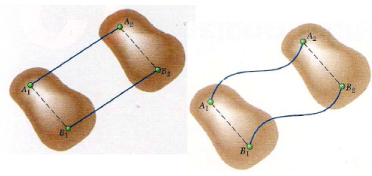
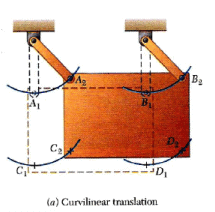
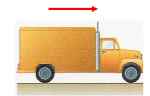
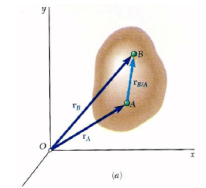
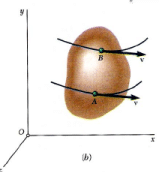
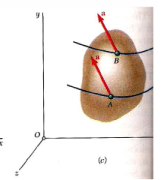
Translation. A motion is said to be a translation if any straight line in the body keeps the same direction during the movement. All particles of the body move along parallel paths. If the paths are straight lines, the motion is rectilinear translation; if the paths are curved, it is a curvilinear translation.

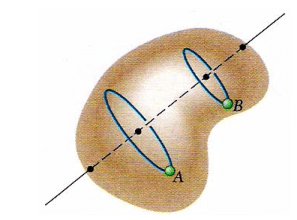
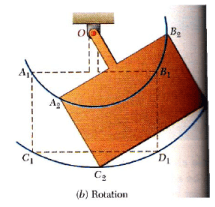
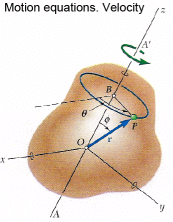
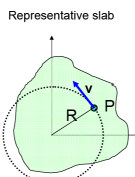
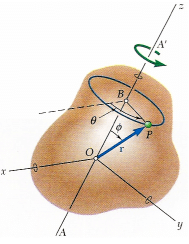
Rotation about a fixed axis. In rotation about a fixed axis all particles move in parallel planes along circles whose centres lie on the same fixed axis (the axis of rotation). Particles on the axis have zero velocity and zero acceleration.

Preliminaries: Kinematics of a Rigid Body

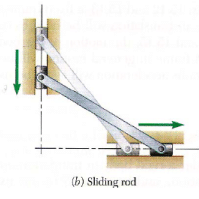
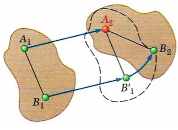
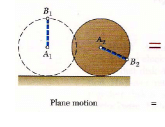
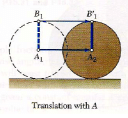
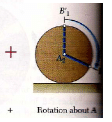
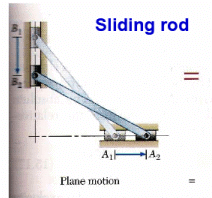
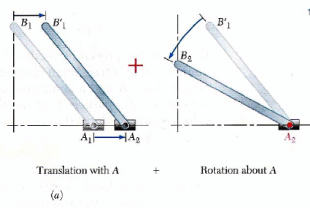
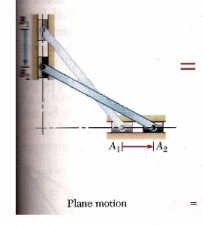
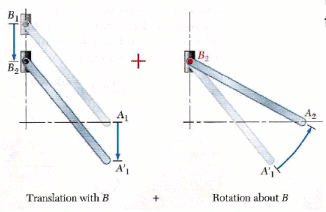
General plane motion. A motion in which all particles move in parallel planes and the overall motion is neither a pure translation nor a pure rotation is called general plane motion. Any plane motion may be represented as a translation of a reference point plus a rotation about that point.

Preliminaries: Kinematics of a Rigid Body

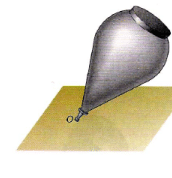
Motion about a fixed point. A rigid body attached at a fixed point (for example, a spinning top) undergoes three-dimensional motion in which all points lie on spherical surfaces about the fixed point.

General motion. Motion that does not fall into the above categories is general rigid-body motion (a combination of translation and rotation in three dimensions).

Exercise: Distinguish between curvilinear translation and rotation about a fixed axis.

Preliminaries: Kinematics of a Rigid Body

Translation: motion equations. When a rigid body undergoes pure translation, all points have the same velocity and acceleration; hence the motion of the entire body can be represented by the motion of any single reference point.

Preliminaries: Kinematics of a Rigid Body

Conclusion. A rigid body in translation can be considered as a particle for the purposes of kinematic description: its orientation does not change and a vector fixed in the body does not change direction.
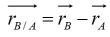
Preliminaries: Kinematics of a Rigid Body

If a vector fixed in the rigid body is constant in both magnitude (rigidity) and direction (translation), then its time derivative is zero:

Preliminaries: Kinematics of a Rigid Body

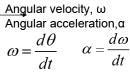
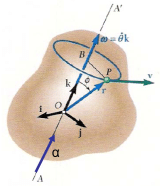
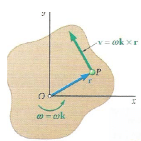
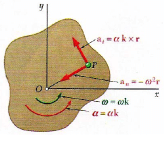
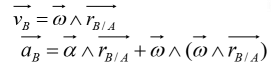
Rotation about a fixed axis: velocity and acceleration. For rotation about a fixed axis, angular velocity ω and angular acceleration α are invariants of the motion of the body; they are the same for all points of the rigid body and characterise the rotational motion. Vector expressions for velocity and acceleration of a particle at position r from the axis are given by:

Preliminaries: Kinematics of a Rigid Body

Basic relationships for curvilinear motion (arc-angle-radius). For rotation through angle θ in radians about a fixed centre with radius R:

Preliminaries: Kinematics of a Rigid Body

Note: angle must be in radians when using these relationships.

Exercise: A compact disk rotating at 500 rev/min is scanned by a laser that begins at the inner radius of about 2.4 cm and moves out to the edge at 6.0 cm. Which is the linear (tangential) velocity of the disk where the laser beam strikes: (a) at the beginning of scanning and (b) at the end? The same for acceleration.

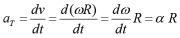
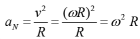
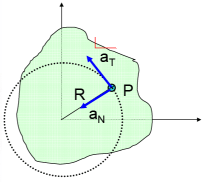
Rotation about a fixed axis: acceleration components. The acceleration of a point on a rotating rigid body has tangential and normal (centripetal) components. The normal component is ω^2 r directed toward the axis and the tangential component is α r in the direction tangent to the circular path.

Preliminaries: Kinematics of a Rigid Body

Vector motion equations for rotation about a fixed axis.

Preliminaries: Kinematics of a Rigid Body

Vector expressions for velocity and acceleration in rotation about a fixed axis can be written using cross products:
Preliminaries: Kinematics of a Rigid Body

The following kinematics problems appear in the input and are kept here for practice. Their statements are preserved exactly.

Preliminaries: Kinematics of a Rigid Body
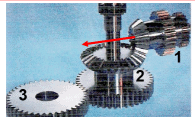
The red arrow shows the angular velocity of the horizontal gear 1. Draw the angular velocity for the other gear, 2 and 3. Solve the problem with quantitative values: ω1 = 500 rev/min; R1 = 2 cm ω2 = ? rev/min; R2 = 5 cm; R'2=10 cm ω3 = ? rev/min; R4 = 10 cm;
Preliminaries: Kinematics of a Rigid Body
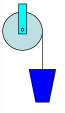
The bucket falls from rest with a constant linear acceleration of 0.3 g. (a) Estimate the speed of the bucket after 5 seconds and the fallen distance. (b) Compute the angular acceleration of the pulley. (c) How fast will it rotate after 5 s.
Preliminaries: Kinematics of a Rigid Body
Gear 1 rotates clockwise at angular velocity of 12 rad/s. How fast will gear 2 and 3 rotate. Data: R1:5 cm; R2:10 cm; R3:20 cm.

General plane motion. Any general plane motion can be represented as the superposition of a translation of a convenient reference point plus a rotation about that point. This is a practical statement of Euler's theorem for plane motion and is used when combining rotational effects (moments) with translational effects (forces).

Preliminaries: Kinematics of a Rigid Body

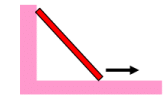
Angular velocity and angular acceleration of a rigid rod are independent of the selected reference point used to define rotation in plane motion; they are properties of the motion itself.

Preliminaries: Kinematics of a Rigid Body

Rolling Contact

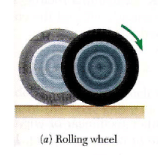
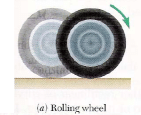
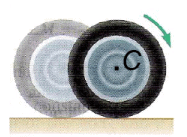
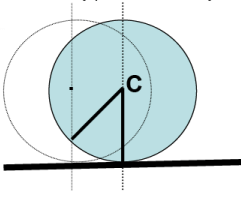
Rolling without slipping. When a wheel of radius R rolls without slipping, the distance s travelled by the centre equals the arc length described by the rotation: s = θ R. The linear velocity of the contact point relative to the ground is equal to the tangential speed due to rotation: vc = ω R. The linear acceleration of the contact point relative to the centre is ac = α R.

Rolling Contact

As the wheel rotates through angle θ, the contact point on the rim that instantaneously contacts the plane has zero velocity relative to the plane when there is no slip.

Rolling without slipping.
s = θ R
vc = ω R
ac = α R
Rolling Contact

Rolling with slipping. If slipping occurs, the equalities above do not hold: s ≠ θ R, vc ≠ ω R, ac ≠ α R.

Rolling with slipping.
s ≠ θ R
vc ≠ ω R
ac ≠ α R
Rolling Contact

Additional kinematic problems preserved from the input:

Rolling Contact

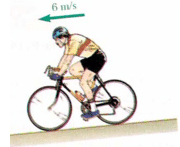
A bicycle travels with a speed of 40 km/h. How fast the cycle rider pedals in rev/min? Data: Sprocket radius: 2.5 cm; Front gear radius: 10 cm; rear wheel radius: 40 cm

Rolling Contact

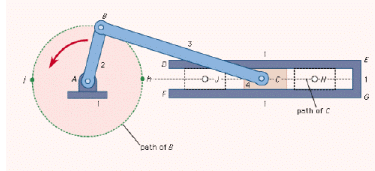
The slider-crank mechanism converts the rotational motion of a crank into linear motion of a slider. Find the relationship between the angular velocity of the crank and the linear velocity of the slider piston.

Moment of a Force: Definitions and Basic Properties

Definition. The moment of a force about a point O is defined as the measure of the tendency of the force to rotate a body about that point. For a force F acting at point P whose position vector from O is r, the vector moment (torque) about O is

MO = r × F

The magnitude of the moment is

|MO| = r F sin θ

where θ is the angle between r and F. The SI unit is newton-metre (N·m). The direction of the moment vector follows the right-hand rule and is perpendicular to the plane containing r and F.

Moment about an Axis

To compute the scalar moment of a force about a given axis with unit vector u, take the projection of the vector moment onto u:

Maxis = u · (r × F)

Alternatively, if the perpendicular distance d from the axis to the line of action of the force is known, the scalar moment about the axis is

Maxis = F d

Principle of Transmissibility

Principle. A force may be replaced by a force of the same magnitude and direction acting at any other point along its line of action without changing the external effect on a rigid body (net moment about any point and resultant force remain the same). Caution: moving a force along its line of action does not change its moment about any point if the new point lies on the same line of action; moving it off the line will change moments.

Couple (Pure Moment)

A couple consists of two equal and opposite forces whose lines of action do not coincide. The resultant force is zero and the couple produces a pure moment. The moment (magnitude) of a couple formed by forces F and -F separated by perpendicular distance d is

M = F d

The moment of a couple is free (independent of the reference point chosen) and is represented by a vector perpendicular to the plane of the forces.

Varignon's Theorem

Theorem. The moment of a force about any point is equal to the sum of the moments of its components about that point. That is, if F = Fx + Fy + Fz, then

r × F = r × Fx + r × Fy + r × Fz

This theorem simplifies computation of moments by resolving a force into convenient components.

Resultant Moment of a System of Forces

For a system of forces Fi acting at position vectors ri measured from the same origin O, the resultant moment about O is the vector sum:

MO = Σ (ri × Fi)

If required, the resultant force R = Σ Fi and the resultant moment about O together give the wrench representing the overall external effect on a rigid body.

Reduction of a Force to a Force-Couple System

A force F acting at point A can be moved to another point O by adding a couple equal to the moment of F about O. The equivalent force-couple system at O is the resultant force R = F located at O and a couple M = r × F (where r is OA).

Equilibrium Conditions for a Rigid Body

For a rigid body to be in static equilibrium under a system of forces and couples, the following vector conditions must be satisfied:

  • Σ F = 0 (resultant force is zero)
  • Σ MO = 0 for a chosen reference point O (resultant moment about O is zero)

In three dimensions, these give six scalar equations if couples are present: three for force components and three for moment components. In plane problems, the moment condition reduces to a single scalar equation: Σ M = 0 about a point perpendicular to the plane.

Computation Methods and Examples

Method 1: Using perpendicular distance. Find the perpendicular distance d from the point or axis to the line of action of the force. Then M = F d (use sign convention consistent with rotation sense).

Method 2: Using vector cross product. Express r and F in Cartesian components and compute M = r × F. This yields an exact vector moment useful for spatial problems.

Method 3: Varignon's theorem. Resolve F into convenient rectangular components; compute moments of components about the point and sum them.

Worked example: Moment of a force about a point (using components)

Problem statement (preserved exercise style): The red arrow shows the angular velocity of the horizontal gear 1. Draw the angular velocity for the other gear, 2 and 3. Solve the problem with quantitative values: ω1 = 500 rev/min; R1 = 2 cm ω2 = ? rev/min; R2 = 5 cm; R'2=10 cm ω3 = ? rev/min; R4 = 10 cm;

Sol.

Relate tangential velocities at gear contact points: the linear speed at a pitch radius is v = ω R.

Equate tangential speeds at meshing contacts; for gear1 and gear2 in mesh: ω1 R1 = ω2 R2.

Solve for ω2: ω2 = ω1 R1 / R2.

Convert ω1 = 500 rev/min to consistent units if required; plug numerical values to find ω2 and similarly ω3 using successive gear relations.

Worked example: Moment by perpendicular distance

Problem statement (preserved exercise style): The bucket falls from rest with a constant linear acceleration of 0.3 g. (a) Estimate the speed of the bucket after 5 seconds and the fallen distance. (b) Compute the angular acceleration of the pulley. (c) How fast will it rotate after 5 s.

Sol.

Use linear kinematics for the bucket with acceleration a = 0.3 g.

Linear speed after t = 5 s: v = a t.

Fallen distance after 5 s: s = (1/2) a t^2.

Relate linear acceleration of the rope to angular acceleration of the pulley: a = α R, so α = a / R.

Angular speed after 5 s: ω = α t (starting from rest).

Example: Moment about an axis (projection)

To find the scalar moment of a force about a given axis, compute the vector moment M = r × F and then project it on the axis unit vector u: Maxis = u · M. Alternatively, find the shortest distance d from the axis to the force line of action and use M = F d.

Applications of Moment of Force

  • Design and analysis of beams and bending: internal bending moment arises from external forces and must be balanced by internal stresses.
  • Machine elements: shafts, gears, and couplings transmit torques; design requires knowledge of applied moments and resulting stresses.
  • Statics and structural analysis: checking equilibrium (ΣM = 0) is essential to determine unknown forces and reactions.
  • Dynamics of rigid bodies: moment (torque) equals rate of change of angular momentum; τ = dH/dt for rotating bodies.

Summary of Key Formulae

  • Vector moment about point O: MO = r × F
  • Scalar moment magnitude: |MO| = r F sin θ
  • Moment about an axis with unit vector u: Maxis = u · (r × F)
  • Moment of a couple: M = F d (free vector; independent of reference point)
  • Resultant moment of several forces: MO = Σ (ri × Fi)
  • Rolling without slipping: s = θ R; v = ω R; a = α R

Preserved Illustrations and Problems (from reference material)

Preserved Illustrations and Problems (from reference material)
The document Moment of Force on a Rigid Body | Engineering Mechanics - Civil Engineering (CE) is a part of the Civil Engineering (CE) Course Engineering Mechanics.
All you need of Civil Engineering (CE) at this link: Civil Engineering (CE)
24 videos|67 docs|53 tests

FAQs on Moment of Force on a Rigid Body - Engineering Mechanics - Civil Engineering (CE)

1. What is the moment of force on a rigid body?
Ans. The moment of force, also known as torque, on a rigid body is the measure of the tendency of a force to rotate the body about a specific axis. It is calculated by multiplying the magnitude of the force by the perpendicular distance from the axis of rotation to the line of action of the force.
2. How is the moment of force calculated?
Ans. The moment of force is calculated by multiplying the magnitude of the force by the perpendicular distance from the axis of rotation to the line of action of the force. Mathematically, it can be expressed as M = F * d, where M is the moment of force, F is the magnitude of the force, and d is the perpendicular distance.
3. What are the units of moment of force?
Ans. The units of moment of force depend on the units used for force and distance. In the SI system, the unit of force is Newton (N) and the unit of distance is meter (m). Therefore, the unit of moment of force is Newton-meter (Nm) or Joule (J).
4. How does the moment of force affect the rotation of a rigid body?
Ans. The moment of force determines the extent to which a force can cause a rigid body to rotate. A larger moment of force will result in a greater rotational effect, while a smaller moment of force will cause a lesser rotational effect. The direction of the moment of force determines the direction of the rotation (clockwise or counterclockwise).
5. What factors can influence the moment of force on a rigid body?
Ans. The moment of force on a rigid body can be influenced by several factors, including the magnitude of the force applied, the distance from the axis of rotation to the line of action of the force, and the angle between the force and the line connecting the point of rotation to the point of application of the force. Increasing any of these factors will result in a larger moment of force.
Related Searches
study material, Important questions, ppt, shortcuts and tricks, MCQs, Extra Questions, Moment of Force on a Rigid Body | Engineering Mechanics - Civil Engineering (CE), pdf , mock tests for examination, Free, Moment of Force on a Rigid Body | Engineering Mechanics - Civil Engineering (CE), Viva Questions, Previous Year Questions with Solutions, past year papers, Semester Notes, Sample Paper, video lectures, Summary, practice quizzes, Objective type Questions, Exam, Moment of Force on a Rigid Body | Engineering Mechanics - Civil Engineering (CE);