Long Question Answers: Number System

Q1.Simplify the following expressions:
(i) (4 + √7) (3 + √2)
(ii) (√5 - √3)2
(iii) (√5 -2)( √3 - √5)
Sol.
(i) (4 + √7) (3 + √2)
= 12 + 4√2 + 3√7 + √14
(ii) (√5 - √3)2
= (√5)2 + (√3)2 - 2(√5)( √3)
= 5 + 3 - 2√15
= 8 - 2√15
(iii) (√5 -2)( √3 - √5)
= √15 - √25 - 2√3 + 2√5
= √15 - 5 - 2√3 + 2√5
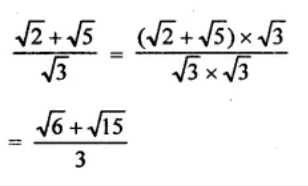
Q2. Rationalise the denominator: (√2 + √5)/ √3
Sol. Multiply both the numerator and denominator with the same number to rationalise the denominator.
Q3. If 'a' and 'b' are rational numbers and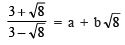 ,
,
then find the value of 'a' and 'b'.
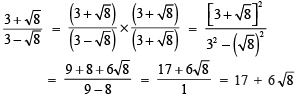
Sol.Rationalizing the fraction, we get
Now
Equating a and b both sides
⇒ a + b√8 = 17 +6√8
⇒ a = 17and b = 6
Q4:Find five rational numbers between 3/5 and 4/5.
Sol:We have to find five rational numbers between 3/5 and 4/5.
So, let us write the given numbers by multiplying with 6/6, (here 6 = 5 + 1)
Now,
3/5 = (3/5) × (6/6) = 18/30
4/5 = (4/5) × (6/6) = 24/30
Thus, the required five rational numbers will be: 19/30, 20/30, 21/30, 22/30, 23/30
Q5:
Sol:
Let x = 0.3333....
Multiply with 10,
10x = 3.3333...
Now, 3.3333... = 3 + x (as we assumed x = 0.3333...)
Thus, 10x = 3 + x
10x - x = 3
9x = 3
x = 1/3
Therefore, 0.3333... = 1/3. Here, 1/3 is in the form of p/q and q ≠ 0.
FAQs on Long Question Answers: Number System
| 1. What is the definition of a number system in mathematics? |  |
| 2. What are the different types of number systems? | |
| 3. How do number systems relate to different bases, such as binary or decimal? | |
| 4. Why is the understanding of number systems important in mathematics and computer science? | |
| 5. How can I convert numbers between different number systems, such as from decimal to binary? | |





