HOTS & Value Based Questions: Introduction to Trigonometry

HOTS
Q1: What is the maximum value of 3cosec θ ?
Ans: ∵ 3cosec θ = 3 sin θ
Since the maximum value of 'sin θ' is 1
∴ the maximum value of 3 sin θ is 3 × 1 i.e. 3
⇒ the maximum value of 3cosec θ is 3.
Q2: If sin θ = 1/3, then find the value of 9 cot2θ + 9.
Ans:
cot2 θ = cosec2 θ - 1
cosec2θ = 1sin2θ = 1(1/3)2 = 9
cot2 θ = 9 - 1 = 8
9 cot2 θ + 9 = 9(8) + 9 = 72 + 9 = 81
Thus, the value is 81.
Q3: If 4 tan θ = 3, then find the value of 4 sin θ - cos θ4sin θ + cos θ
Ans: Given 4 tanθ=3, we have: tan θ = 34
Let sinθ=3k and cosθ=4k (since tanθ = sinθ/cosθ). Using the identity sin2θ + cos2θ=1:
(3k)2 + (4k)2 =
9k2 + 16k2 = 1
25k2 = 1
⇒k= 1/5
So, sinθ = 3/5 and cosθ = 4/5. Now calculate the expression:
= 4 sin θ - cos θ4sin θ + cos θ
= 4 x 3/5 - 4/5 4 x 3/5 + 4/5
= 12/5 - 4/5 12/5 + 4/5
= 8/5 16/5
= 1/2
Q4: If sin α = 1/2 and cos β = 1/2 then find the value of (α + β).
Ans: sin 30º = 1/2 , sin α = 1/2 ⇒ α = 30º
cos 60º = 1/2 , cos β = 1/2 ⇒ β = 60º
⇒ ( α + β) = 30º + 60º = 90º
Q5: If sin θ + cos θ = √3 , find the value of tan θ + cot θ .
Ans: Given:
sin θ + cos θ = √2
Squaring both sides:
(sin θ + cos θ)² = 2
⇒ sin²θ + cos²θ + 2 sin θ cos θ = 2
Using the identity:
sin²θ + cos²θ = 1
So,
1 + 2 sin θ cos θ = 2
⇒ 2 sin θ cos θ = 1
⇒ sin θ cos θ = 1/2
Now,
tan θ + cot θ
= sin θ / cos θ + cos θ / sin θ
Taking LCM:
= (sin²θ + cos²θ) / (sin θ cos θ)
Substitute values:
= 1 / (1/2)
= 2
Q6: cos (A+B) = 1/2 and sin (A-B) = 1/2 ; 0° < (A + B) < 90° and (A - B) > 0°. What are the values of ∠A and ∠B?
Ans: We have
cos (A+B) = 1/2 ,
Also, cos 60° = 1/2 ⇒ A+B = 60° ...(1)
Also, sin (A-B) = 1/2
and sin 30° = 1/2 ⇒ A - B = 30° ...(2)
Adding (1) and (2), 2A = 90 ⇒ A = 45
From (1) 45° + B = 60° ⇒ B = 60° - 45° = 15°
Thus, ∠A = 45° and ∠B = 15°
Q7: Prove that sec2A + cosec2A = sec2A. cosec2 A
Ans: We start with the LHS:
sec2A + cosec2A = 1 cos2A + 1 sin2A
Taking a common denominator:
sin2A + cos2A sin2 A. cos2A = 1 sin2 A. cos2A
= sec2A⋅cosec2A
Thus, the equation is proved.
Q8: Prove that (sinθ + cosecθ)2 + (cosθ + secθ)2 = tan2θ + cot2θ + 7
Ans:
LHS = (sinθ + cosecθ)2 + (cosθ + secθ)2
= sin2θ + cosec2θ + 2sinθ·cosecθ + cos2θ + sec2θ + 2cosθ·secθ
= sin2θ + cos2θ + cosec2θ + sec2θ + 2(1) + 2(1)
= 1 + cosec2θ + sec2θ + 4
= 5 + cosec2θ + sec2θ
Using identities:
cosec2θ = 1 + cot2θ
sec2θ = 1 + tan2θ
= 5 + (1 + cot2θ) + (1 + tan2θ)
= 7 + tan2θ + cot2θ
RHS = tan2θ + cot2θ + 7
∴ LHS = RHS
Hence Proved.
Q9: If cos(40o + x) = sin 30o, find the value of x, provided 40o + x is an acute angle.
Ans: Given that
cos(40o + x) = sin 30o
Now RHS = sin 30o = 1/2
So, cos (40o + x) = 1/2
We know that cos60o = 1/2, therefore
40 + x = 60o
x = 20o
Q10: Prove that 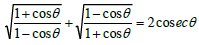 .
.
Ans:
LHS = 
 (using 1- cos2 θ = sin2θ )
= 1 + cosθ + 1 - cosθsin θ = 2 sin θ = 2 cosec θ
Value-based Questions
Q1: A group of students plan to put up a banner in favour of respect towards girls and women, against a wall. They placed a ladder against the wall such that its foot is at a distance of 2.5 m from the wall and its top reaches a window 6 m above the ground.
(i) Find the length of the ladder.
(ii) Which mathematical concept is used in this problem?
(iii) By putting up a banner in favour of respect to women, which value is depicted by the group of students?
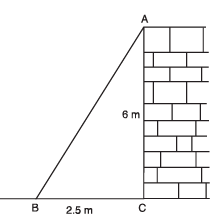
Ans: (i) Let AB be the ladder and CA be the wall with the window at A. Also,
BC = 2.5 m
CA = 6m
∴ In rt ΔACB, we have
AB2 = BC2 + CA2 [Using Pythagoras Theorem]
= (2.5)2 + (6)2
= 6.25 + 36 = 42.25
⇒ AB = √42.25 =6.5 m
Thus, the length of the ladder is 6.5 m.
(ii) Triangles (Pythagoras Theorem)
(iii) Creating positive awareness in public regarding women.
Q2: Raj is an electrician in a village. One day power was not there in entire village and villagers called Raj to repair the fault. After thorough inspection he found an electric fault in one of the electric pole of height 5 m and he has to repair it. He needs to reach a point 1.3m below the top of the pole to undertake the repair work. On the basis of above, answer the following question.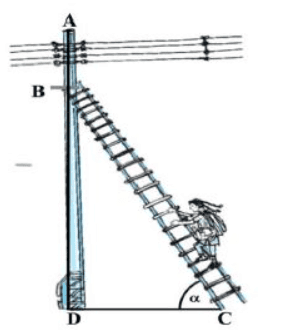
(i) When the ladder is inclined at an angle of α such that 3tan α + 2 = 5 to the horizontal, find the angle α.
(ii) How far from the foot of the pole should he place the foot of the ladder? (Use 3=1.73)
(iii) In the above situation, find the value of sin α cos α2 - cos α sin α2
(iv) In the above situation, if BD=3 cm and BC=6 cm, find α.
(v) In your opinion, how does Raj's action reflect the values of responsibility and community service?
Ans:
An electric pole is 5 m high. Raj needs to reach a point 1.3 m below the top of the pole.
Required height = 5 - 1.3 = 3.7 m
(i) Given:
3tanα + 2 = 5
3tanα = 3
tanα = 1
∴ α = 45°
(ii) Using:
tanα = height / distance
tan45° = 3.7 / x
1 = 3.7 / x
x = 3.7 m
(iii) sinα cos(α/2) - cosα sin(α/2)
Using identity:
sinA cosB - cosA sinB = sin(A - B)
= sin(α - α/2)
= sin(α/2)
For α = 45°:
sin(45°/2) = sin 22.5°
(iv) tanα = BD / BC
tanα = 3 / 6 = 1 / 2
α = tan-1(1/2) ≈ 26.6°
(v) Raj's action shows responsibility and community service. He willingly helped the villagers by repairing the electric fault, ensuring their safety and comfort. His dedication reflects concern for society and readiness to help others in need.
FAQs on HOTS & Value Based Questions: Introduction to Trigonometry
| 1. What's the difference between sine, cosine, and tangent in trigonometry for Class 10? |  |
| 2. How do I solve HOTS questions on trigonometric identities without getting confused? | |
| 3. Why do trigonometric ratios change for different angles in right triangles? | |
| 4. What are value-based questions in trigonometry and how should I approach them for exams? | |
| 5. How do angles of elevation and depression work in trigonometry word problems? | |





