NEET Exam > NEET Notes > Biology Class 12 > Energy Flow, Trophic Level & Food Chain
Energy Flow, Trophic Level & Food Chain | Biology Class 12 - NEET PDF Download
| Table of contents |

|
| Introduction |
|
| Trophic level |
|
| Energy Flow in Ecosystem |
|
| Food Chain |
|

Introduction
- The chemical energy of food is the main source of energy required by all living organisms.
- The transfer of energy from one trophic level to another trophic level is called energy flow.
- The flow of energy in an ecosystem is unidirectional.
- That is, it flows from the producer level to the consumer level and never in the reverse direction.
- Hence, energy can be used only once in the ecosystem.
- But the minerals circulate and recirculate many times in the ecosystem.
This energy flow is based on two different laws of thermodynamics:
- First law of thermodynamics, that states that energy can neither be created nor destroyed, it can only change from one form to another.
- Second law of thermodynamics, that states that as energy is transferred more and more of it is wasted.
Question for Energy Flow, Trophic Level & Food ChainTry yourself: What is the main source of energy required by all living organisms?View Solution
Trophic level
The producers and consumers in the ecosystem can be arranged into different feeding groups and are known as trophic level or the feeding level.
- The producers (plants) represent the first trophic level.
- Herbivores (primary consumers) present the second trophic level.
- Primary carnivores (secondary consumers) represent the third trophic level
- Top carnivores (tertiary consumers) represent the last level.
Energy Flow in Ecosystem
- A large amount of energy is lost at each trophic level. It is estimated that 90% of the energy is lost when it is transferred from one trophic level to another.
- Hence, the amount of energy available decreases from step to step.
- Only about 10% of the biomass is transferred from one trophic level to the next one in a food chain.
- And only about 10% chemical energy is retained at each trophic level.
- This is called 10% law of Lindeman (1942).
- When the food chain is short, the final consumers may get a large amount of energy. But when the food chain is long, the final consumer may get a lesser amount of energy.
Food Chain
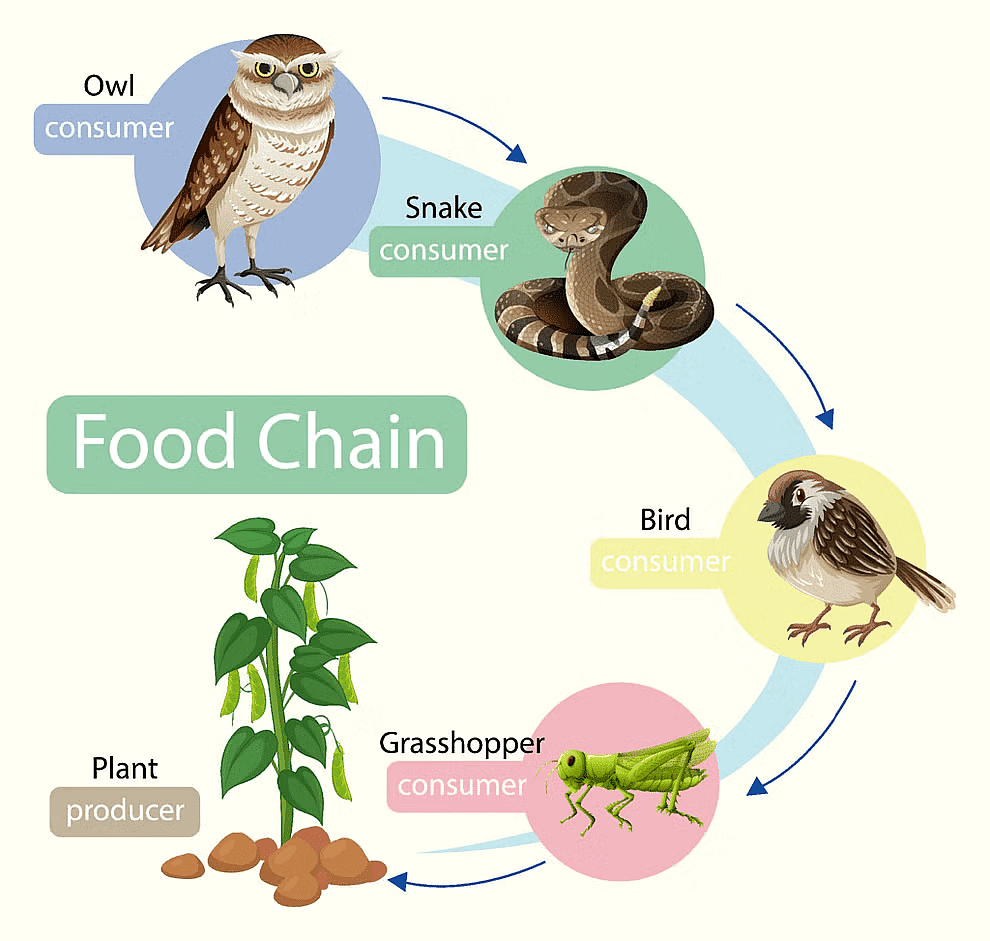
- At each step in a food chain, a portion of the energy captured by producer is lost as heat given off during the chemical breakdown of food by respiration (metabolic heat).
- Thus, energy flows through the ecosystem in a single direction and is not recycled. In contrast, nutrients cycle between organisms and the physical environment.
- The transfer of food energy from one to another organism leads to loss of energy as heat due to metabolic activity.
- The amount of solar radiation reaching the surface of the earth is 2 cals/sq.cm/min. It is more or less constant and is called solar constant or solar flux. About 95 to 99% of the energy is lost by reflection. Plants utilize only 0.02% of the energy reaching earth.
- The energy trapped by the producers (primary production) is utilized by the consumers. The producers are directly consumed by herbivores that are eaten by the primary carnivores that in turn are consumed by the secondary carnivores.
- The consumers store some amount of energy in their tissues. This energy, stored by the consumers, is called secondary production. Only about 10 to 20% of the primary production is converted into secondary production. The remaining 80 to 90% is lost by the consumers in the form of faeces.
The document Energy Flow, Trophic Level & Food Chain | Biology Class 12 - NEET is a part of the NEET Course Biology Class 12.
All you need of NEET at this link: NEET
|
59 videos|290 docs|168 tests
|
FAQs on Energy Flow, Trophic Level & Food Chain - Biology Class 12 - NEET
| 1. What is a trophic level? |  |
Ans. A trophic level refers to the position of an organism in a food chain or web. It represents the organism's feeding relationship with other organisms in the ecosystem. The primary producers, such as plants, are at the first trophic level, while herbivores that eat plants are at the second trophic level. Carnivores that feed on herbivores are at higher trophic levels.
| 2. How does energy flow in an ecosystem? | |
Ans. Energy flows through an ecosystem in a one-way direction. It starts with the primary producers, such as plants, who convert sunlight into chemical energy through photosynthesis. This energy is then passed on to herbivores when they consume the plants. The herbivores are consumed by carnivores, and this transfer of energy continues through different trophic levels. However, with each transfer, some energy is lost as heat, limiting the amount of energy available at higher trophic levels.
| 3. What is a food chain? | |
Ans. A food chain is a linear sequence that shows the transfer of energy and nutrients from one organism to another in an ecosystem. It starts with the primary producers and progresses through different trophic levels. For example, a simple food chain could be grass (producer) → rabbit (herbivore) → fox (carnivore). Food chains are important in understanding the flow of energy and the interdependence of organisms within an ecosystem.
| 4. Why is energy flow important in an ecosystem? | |
Ans. Energy flow is crucial in an ecosystem as it determines the overall functioning and stability of the system. It provides the necessary energy for organisms to carry out their life processes, such as growth, reproduction, and movement. Additionally, energy flow influences the population dynamics and interactions between different species. Understanding energy flow helps scientists comprehend the functioning and balance of ecosystems and aids in conservation efforts.
| 5. How does the concept of trophic levels relate to energy flow in an ecosystem? | |
Ans. The concept of trophic levels is closely tied to energy flow in an ecosystem. Each trophic level represents a step in the transfer of energy from one organism to another. As energy moves through the trophic levels, it gets transferred and transformed, sustaining the various organisms within the ecosystem. The higher the trophic level, the less energy is available due to energy loss at each transfer. This hierarchical structure helps in understanding the complex dynamics of energy flow and the interdependencies between different organisms.
About this Document

4.73/5
Rating

Sep 21, 2025
Last updated
Document Description: Energy Flow, Trophic Level & Food Chain for NEET 2025 is part of Biology Class 12 preparation.
The notes and questions for Energy Flow, Trophic Level & Food Chain have been prepared according to the NEET exam syllabus. Information about Energy Flow, Trophic Level & Food Chain covers topics
like Introduction, Trophic level, Energy Flow in Ecosystem, Food Chain and Energy Flow, Trophic Level & Food Chain Example, for NEET 2025 Exam. Find important definitions, questions, notes, meanings, examples, exercises and tests below for Energy Flow, Trophic Level & Food Chain.
Introduction of Energy Flow, Trophic Level & Food Chain in English is available as part of our Biology Class 12
for NEET & Energy Flow, Trophic Level & Food Chain in Hindi for Biology Class 12 course.
Download more important topics related with notes, lectures and mock test series for NEET
Exam by signing up for free. NEET: Energy Flow, Trophic Level & Food Chain | Biology Class 12 - NEET
Description
Full syllabus notes, lecture & questions for Energy Flow, Trophic Level & Food Chain | Biology Class 12 - NEET - NEET | Plus excerises question with solution to help you revise complete syllabus for Biology Class 12 | Best notes, free PDF download
Information about Energy Flow, Trophic Level & Food Chain
In this doc you can find the meaning of Energy Flow, Trophic Level & Food Chain defined & explained in the simplest way possible. Besides explaining types of
Energy Flow, Trophic Level & Food Chain theory, EduRev gives you an ample number of questions to practice Energy Flow, Trophic Level & Food Chain tests, examples and also practice NEET
tests

Related Searches
Trophic Level & Food Chain | Biology Class 12 - NEET
,Free
,Viva Questions
,Previous Year Questions with Solutions
,video lectures
,Objective type Questions
,practice quizzes
,Energy Flow
,Sample Paper
,Trophic Level & Food Chain | Biology Class 12 - NEET
,Energy Flow
,Extra Questions
,Energy Flow
,MCQs
,Semester Notes
,study material
,mock tests for examination
,Trophic Level & Food Chain | Biology Class 12 - NEET
,Summary
,shortcuts and tricks
,Important questions
,past year papers
,ppt
,Exam
;



Additional Information about Energy Flow, Trophic Level & Food Chain for NEET Preparation
Energy Flow, Trophic Level & Food Chain Free PDF Download
The Energy Flow, Trophic Level & Food Chain is an invaluable resource that delves deep into the core of the NEET exam.
These study notes are curated by experts and cover all the essential topics and concepts, making your preparation more efficient and effective.
With the help of these notes, you can grasp complex subjects quickly, revise important points easily,
and reinforce your understanding of key concepts. The study notes are presented in a concise and easy-to-understand manner,
allowing you to optimize your learning process. Whether you're looking for best-recommended books, sample papers, study material,
or toppers' notes, this PDF has got you covered. Download the Energy Flow, Trophic Level & Food Chain now and kickstart your journey towards success in the NEET exam.
Importance of Energy Flow, Trophic Level & Food Chain
The importance of Energy Flow, Trophic Level & Food Chain cannot be overstated, especially for NEET aspirants.
This document holds the key to success in the NEET exam.
It offers a detailed understanding of the concept, providing invaluable insights into the topic.
By knowing the concepts well in advance, students can plan their preparation effectively.
Utilize this indispensable guide for a well-rounded preparation and achieve your desired results.
Energy Flow, Trophic Level & Food Chain Notes
Energy Flow, Trophic Level & Food Chain Notes offer in-depth insights into the specific topic to help you master it with ease.
This comprehensive document covers all aspects related to Energy Flow, Trophic Level & Food Chain.
It includes detailed information about the exam syllabus, recommended books, and study materials for a well-rounded preparation.
Practice papers and question papers enable you to assess your progress effectively.
Additionally, the paper analysis provides valuable tips for tackling the exam strategically.
Access to Toppers' notes gives you an edge in understanding complex concepts.
Whether you're a beginner or aiming for advanced proficiency, Energy Flow, Trophic Level & Food Chain Notes on EduRev are your ultimate resource for success.
Energy Flow, Trophic Level & Food Chain NEET Questions
The "Energy Flow, Trophic Level & Food Chain NEET Questions" guide is a valuable resource for all aspiring students preparing for the
NEET exam. It focuses on providing a wide range of practice questions to help students gauge
their understanding of the exam topics. These questions cover the entire syllabus, ensuring comprehensive preparation.
The guide includes previous years' question papers for students to familiarize themselves with the exam's format and difficulty level.
Additionally, it offers subject-specific question banks, allowing students to focus on weak areas and improve their performance.
Study Energy Flow, Trophic Level & Food Chain on the App
Students of NEET can study Energy Flow, Trophic Level & Food Chain alongwith tests & analysis from the EduRev app,
which will help them while preparing for their exam. Apart from the Energy Flow, Trophic Level & Food Chain,
students can also utilize the EduRev App for other study materials such as previous year question papers, syllabus, important questions, etc.
The EduRev App will make your learning easier as you can access it from anywhere you want.
The content of Energy Flow, Trophic Level & Food Chain is prepared as per the latest NEET syllabus.
|
© EduRev
|
Education Revolution
|


|




Signup to see your scores
go up
within 7 days!
within 7 days!
Takes less than 10 seconds to signup