Fill in the Blanks: Vector Algebra and Three Dimensional Geometry - JEE Advanced

Q. 1. Let  be vectors of length 3, 4, 5 respectively. Let
  be perpendicular to
  Then the length of vector
  (1981 - 2 Marks)
Ans. 5√2
Solution.
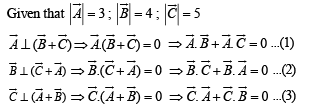
Adding (1), (2) and (3) we get
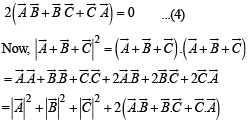
= 50 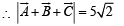
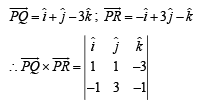
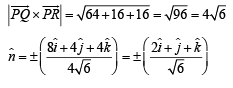
Q. 2. The unit vector perpendicular to the plane determined by P(1, -1, 2), Q (2, 0, -1) and R(0, 2, 1) is ....... (1983 - 1 Mark)
Ans. 
Solution. Required unit vector, 

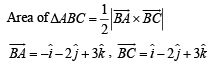
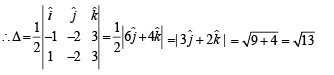
Q. 3. The area of the triangle whose vertices are A (1, -1, 2), B (2, 1, -1), C( 3, - 1, 2) is ....... (1983 - 1 Mark)
Ans. 
Solution.
Q. 4. A, B, C and D, are four points in a plane with position vectors a, b, c and d respectively such that

The point D, then, is the ................... of the triangle ABC. (1984 - 2 Marks)
Ans. orthocen tre
Solution. Given that  are position vectors of points A, B, C and D respectively, such tha

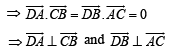
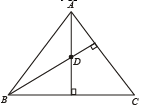
Clearly D is orthocentre of DΔABC
Q. 5. 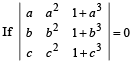 and the vectors
 are non -coplanar, then the product abc = ....... (1985 - 2 Marks)
Ans. -1
Solution. 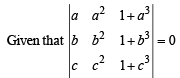
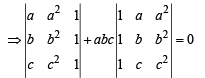
Operating  in first determinant
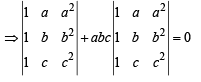
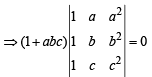
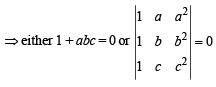
Also given that the vectors  are noncoplanar
i.e., 
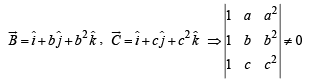
∴ We must have 1 + abc = 0 ⇒ abc = - 1
Q. 6. If  are three non-coplanar vectors, then -
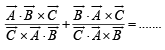 (1985 - 2 Marks)
Ans. 0
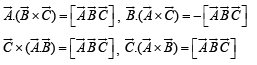
Solution. As given that  are three noncoplan ar vectors, therefore,
Also by the property of scalar triple product we have

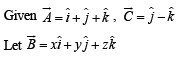
Q. 7.  are given vectors, then a vector B satisfying the equations
  and
and  (1985 - 2 Marks)
Ans. 
Solution.
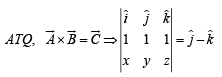

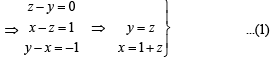

Using equations (1) and (2) we get
1 + z + z + z = 3
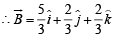
⇒ z = 2/3 ⇒ y = 2/3, x =5/3
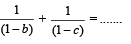
Q. 8. If the vectors  (a ≠ b ≠ c ≠ 1) are coplanar, then the value of
 (1987 - 2 Marks)
Ans. 1
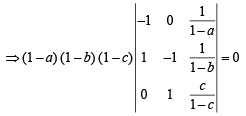
Solution. Given that the vectors  and
and  where a ≠ b ≠ c ≠ 1 are coplanar
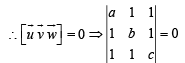
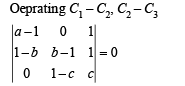
Taking (1 - a), (1 - b), (1 - c) common from R1, R2 and R3 respectively.
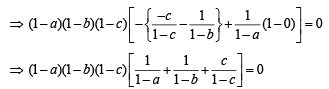
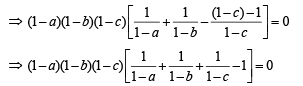
But a ≠ b ≠ c ≠ 1 (given)

Q. 9.  be two vectors perpendicular to each other in the xy-plane. All vectors in the same plane having projections 1 and 2 along
  respectively,, are given by ........ (1987 - 2 Marks)
Ans. 
Solution.
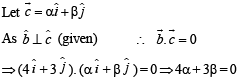
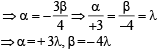 ...(1)
Now, let  be the required vectors.
Then as per question
Projection of 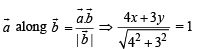
⇒ 4x + 3y = 5 ..(2)
Also, projection of 

⇒ 3λx - 4λy = 10λ
⇒ 3x - 4y = 10 ...(3)
Solving (2) and (3), we get x = 2, y = - 1
∴ The required vector is 
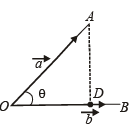
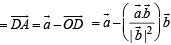
Q. 10. The components of a vector  along and perpendicular to a non-zero vector
  ..........and .......respectively.. (1988 - 2 Marks)
Ans. 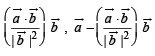
Solution. Component of 
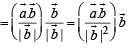
Component of 
Q. 11. Given that  and
and  (1991 - 2 Marks)
Ans. 
Solution.
Using equations (1) and (2) we get
1 + z + z + z = 3
⇒ z = 2/3 ⇒ y = 2/3, x =5/3
Q. 12. A unit vector coplanar with  and perpendicular to
  (1992 - 2 Marks)
Ans. 
Solution. Let  be a unit vector, coplanar with
  and
and  and also perpendicular to
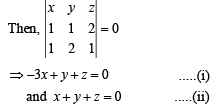
Solving the above by cross multiplication method, we get


As  is a unit vector, therefore

∴ The required vector is 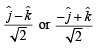
Q. 13. A unit vector perpendicular to the plane determined by the points P(1, - 1, 2) Q(2, 0, -1) and R(0, 2, 1) is ....... (1994 - 2 Marks)
Ans. 
Solution. We have position vectors of points 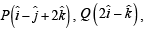
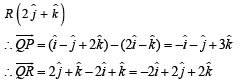
Now any vector perpendicular to the plane formed by pts
PQR is given by 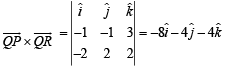
∴ Unit vector normal to plane 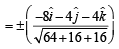

Q. 14. A nonzero vector  is parallel to the line of intersection of the plane determined by the vectors
  and the plane determined by the vectors
  The angle between
  and the vector
 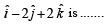 (1996 - 2 Marks)
Ans. 
Solution. Eqn of plane containing vectors 
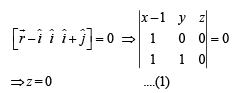
Similarly, eqn of plane containing vectors 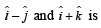
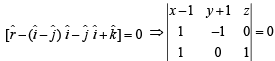
⇒ (x - 1) (-1 - 0) - (y + 1) (1 - 0) + z (0 + 1) = 0
⇒ - x + 1 - y - 1 + z = 0
⇒ x + y - z = 0 ....(2)

Since  parallel to (1) and (2)
a3 = 0 and a1 + a2 - a3 = 0 ⇒ a1 = - a2 , a3 = 0
∴ a vector in direction of 
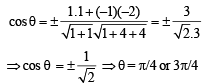
Now if θ is the angle between 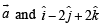 then
then
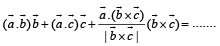
Q. 15. If  are any two non-collinear unit vectors and
  any vector, then
  (1996 - 2 Marks)
Ans.
Solution. Let us consider 
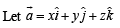

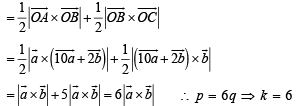
Q. 16. Let OA = a, OB = 10 a + 2b and OC = b where O, A and C are non-collinear points. Let p denote the area of the quadrilateral OABC, and let q denote the area of the parallelogram with OA and OC as adjacent sides. If p = kq, then k = ....... (1997 - 2 Marks)
Ans. 6
Solution. q = area of parallelogram with 
adjacent sides 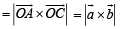
and p = area of quadrilateral OABC
FAQs on Fill in the Blanks: Vector Algebra and Three Dimensional Geometry - JEE Advanced
| 1. What are the basic operations in vector algebra? |  |
| 2. How do you find the magnitude of a vector? | |
| 3. What is the significance of the dot product of two vectors? | |
| 4. How is the cross product of two vectors calculated? | |
| 5. How is three-dimensional geometry related to vector algebra? | |




