Solution: When a number is divided by 1, the quotient is the number itself.
(d) -10
Solution: let blank be X
X x(-12)=120
X=120/-12
X=-120/12
X=-10 = -10
(e) 12
Solution: 24+12 ÷ 4-5×3
=24+3-5×3
=24+3-15
=27-15
=12
Ques 2: Find the value of P, if p × (-9) = 135
Solution:
Ans 2: P = -15
Solution:
p× (-9) = 135 is given.
We have to find the value of p.
We can simply find the value of p by solving the linear equation by transposing the terms.
p× (-9) = 135
Transposing -9 from LHS to RHS, we get
p = 135/ (-9)
Simplifying 135/(-9), we get
p = -15
∴ The value of p is (-15).
Hence, the value of p if p× (-9) = 135 is (-15).
Ques 3: The additive inverse of zero (0) is ________.
Solution:
Ans 3: 0 Solution: The additive inverse of a number is an integer that gives 0 as the sum when added. E.g. - Let the required number be 3. Then its additive inverse is -3. since, -3 + 3 = 0
The additive inverse of 0 would be 0. As, 0 + 0 = 0.
Ques 7: An elevator descends into a mine shaft at the rate of 7m/min. If the descent starts from 5m above the ground level, how long will it take to reach - 205m?
Solution:
Ans7. 30 min. Sol:
Total distance to be travelled = 5 m + 205 m = 210 m
Speed of descent = 7 m / min
Total Time = Distance / Speed
= 210 m / (7 m/min)
= 30 min
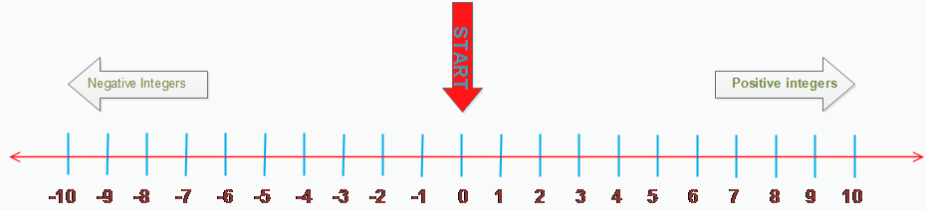
Ques 8: With the help of number line find how much greater is the number 3 than -3.
Solution:
Ans8:
Ques 9: The sum of two integers is 1500. One of the numbers is 599. Find the other number.
Solution:
Ans9: 901 Sol: Let the number be X the other number = 599 599 + X = 1500 X = 1500 - 599
X = 901
Ques 10: Write the answer in True/False : (a) When 0 is divided by an integer, the quotient is zero. (b) The product of an integer and 1 is an integer. (c) When an integer is divided by itself, the quotient is 1.
Solution:
Ans 10: (a) True (b) True (c) True
Ques 11: The product of two integers is -160. If one of them is 20, find the other.
Solution:
Ans 11: -8
Sol:
Let the number be X
X * 20=-160
X =-160/20
X=-8
Ques 12: What integers should be multiplied by (-12) to becomes -300.
Solution:
Ans 12: 25 Sol: Let the integer be "a" According to question, (-12) × a = - 300 a = - 300 / - 12 a = 300 /12 a = 25 Required number = 25
Ques 13: Pallavi got a scholarship of Rs.1000 from her school. If she gives 550 for the help of flood relief, find the balance amount with her.
Solution:
Ans 13: ₹ 450 Sol: Total Amount = 1000 Rupees given for help = 550 Remaining balance of Pallavi= 1000-550 = 450
Ques 14: A building has 21m in height. A monkey can climb 3m in one jump. In how many jumps, would the monkey reach at the top of the building?
Solution:
Ans 14: 7
Sol: If the monkey could jump 3m once then he would have to jump 7 times to reach at top of the building as 7*3 = 21
Ques 15: Find solutions for the following problems: a) Both numbers are less than 10. The distance between the two numbers on the number line is 14. b) Both numbers are greater than -15 and less than 5 One number is 6 greater than the other number. c)The numbers are opposites. The distance between the two numbers on the number line is 18. d) One number is -35. The distance between the two numbers on the number line is 20. e) The first number is the opposite of -17. The second number is less than the first number. The distance between the two numbers on the number line is 9.
Solution:
Sol: These questions can be easily solved using the number line.
a) There can be many solutions, one solution will be 7 and -7. They both are less 10 and difference is 14 Other solution could be -11 and 3.They both are less 10 and difference is 14 b) There can be many solutions, one solution will be -14 and -8. Other solution could be -13 and -7. c) This one will have unique solution. The number will be -9 and 9. Both are opposites and distance between them is 18 d) There can two solutions, one solution will be -55 and another one is -15 e) There can be one solution only. the solution is 17 and 8.
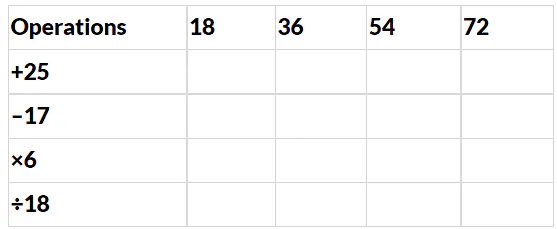
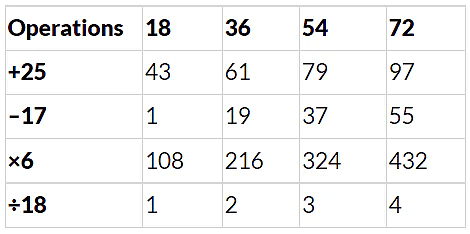
Ques 16: Fill in the blanks using different operations :
1. How do I add and subtract integers with different signs in Class 7 Maths?
Ans. When adding integers with different signs, subtract the smaller absolute value from the larger one and keep the sign of the larger number. For example, -8 + 5 = -3 (subtract 5 from 8, keep the negative sign). Similarly, 12 - (-7) becomes 12 + 7 = 19. This rule applies consistently across integer operations in CBSE Class 7 Mathematics.
2. What's the difference between multiplying negative integers and adding them?
Ans. Multiplying negative integers follows the sign rule: negative × negative equals positive, while negative × positive equals negative. Adding negative integers means moving left on the number line. For instance, -3 × -4 = 12, but -3 + (-4) = -7. Understanding this distinction prevents common errors when solving integer problems on worksheets.
3. Can I use the commutative and associative properties with negative numbers?
Ans. Yes, commutative (a + b = b + a) and associative properties (a + (b + c) = (a + b) + c) work with negative integers too. For example, -5 + 3 equals 3 + (-5), both equalling -2. These fundamental properties simplify calculations and help verify answers when working through integer worksheet questions and exam problems.
4. Why do two negatives make a positive when multiplying integers?
Ans. Multiplying negative integers produces positive results because the operation reverses direction twice on the number line. When you compute -4 × -3, you're taking the opposite of -4 three times, landing on positive 12. This concept underpins integer multiplication rules tested frequently in Class 7 CBSE assessments and worksheet exercises.
5. How do I know which integer is greater when comparing negative numbers?
Ans. On the number line, integers further right are always greater. So -2 is greater than -8, though 2 is smaller than 8 as positive numbers. Comparing integers requires visualising their positions: closer to zero means larger negative value. This skill is essential for ordering integers correctly in Class 7 Mathematics worksheet problems and exam questions.
video lectures, Summary, pdf , mock tests for examination, Worksheet Question & Answers : Integers, Semester Notes, Worksheet Question & Answers : Integers, Important questions, Free, Viva Questions, study material, ppt, Exam, Sample Paper, practice quizzes, past year papers, Worksheet Question & Answers : Integers, Objective type Questions, shortcuts and tricks, Extra Questions, Previous Year Questions with Solutions, MCQs;

 25 - 40 - 10