Dimensions: Side length = a Area: a² Perimeter: 4a (b) Rectangle Dimensions: Length = l, Width = b Area: lb Perimeter: 2(l+b) (c) Circle Dimensions: Radius = r Area: πr² Perimeter (Circumference): 2πr (d) Triangle Dimensions: Base = b, Height = h Area: (1/2) bh Perimeter: a + b + c(where a, b, and c are the lengths of the sides)
Figure with Dimension
Area
Perimeter
(a) Square
a2
4a
(b)
l × b
2(l + b)
(c)
πr2
2πr
(d) Triangle
a + b + c
Q.2. Fill up the blank : (i) 10000 m2 = .......................... hectare (ii) 1 cm2 = ......................... m2 (iii) 1 m2 = ........................... cm2 (iv) 1 km2 = .......................... m2
Solution:
(i) 10000 m² = 1 hectare
(ii) 1 cm² = 0.0001 m²
(iii) 1 m² = 10000 cm²
(iv) 1 km² = 1000000 m²
Q.3. The perimeter of a square park is 2000 m. Find its area.
Solution:
Ans.The perimeter of a square park is 2000 m. To find its area, we first need to determine the length of one side of the square.
The formula for the perimeter of a square is: P = 4 × side.
Given the perimeter (P) is 2000 m, we can rearrange the formula to find the side length:
side = P / 4 = 2000 m / 4 = 500 m.
Now, we can calculate the area of the square using the formula:
Area = side × side.
Substituting the side length:
Area = 500 m × 500 m = 250000 m².
Therefore, the area of the square park is 250000 m².
Q.4. State whether the given statements are True or False:
(i) All the triangles that are equal in the area are congruent. (ii) Al congruent triangles are equal in area. (iii) Ratio of the circumference and the diameter of a circle is more than 3.
(iv) figure (b) has greater perimeter than figure (a)
Solution:
Ans.
(i) All triangles that are equal in area are congruent: False. (ii) All congruent triangles are equal in area: True. (iii) The ratio of the circumference to the diameter of a circle is more than 3: False. (iv) Figure (b) has a greater perimeter than figure (a): True
Q.5. Fill up blanks:
(i) Perimeter of a regular polygon = length of one side × ........................ (ii) The distance around a circle is its .......................... (iii) If a wire in the shape of the square is re-bent into a rectangle, then the ................... of both shapes remain the same, but ....................... may vary.
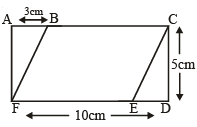
(iv)
In the figure area of the parallelogram, BCEF is .............. cm2, whereas ACDF is a rectangle.
Solution:
Ans. (i) Number of sides (ii) Circumference (iii) Perimeter, Area (iv) 35
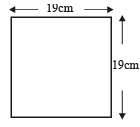
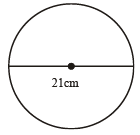
Q.6. A shopkeeper sells two kinds of 'Till Patti'. A square 'Till Patti" of side 19 cm cost ₹25 and a circular 'Till Patti' of diameter 21 cm cost ₹25 which Till Patti is a better deal and why?
Solution:
Ans. The square Till Patti is a better deal because its area is greater than that of the circular Till Patti. Let's compare the areas of both shapes:
Square Till Patti: The area is calculated using the formula Area = side × side.
For a side of 19 cm: Area = 19 cm × 19 cm = 361 cm².
Circular Till Patti: The area is calculated using the formula Area = π × (radius)².
The radius is half of the diameter (21 cm): Radius = 10.5 cm.
Thus, Area = π × (10.5 cm)² ≈ 346.36 cm².
In conclusion, since 361 cm² (square) is greater than 346.36 cm² (circular), the square Till Patti is indeed the better choice.
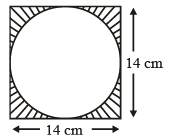
Q.7. Find the area of the shaded region in the following figure :
Solution:
Ans. Area of square = 14 x 14 = 196 cm2 Area of circle enclosed in square = πr² = 22/7 x 7 x7= 22 x 7 = 154 cm2 Area of shaded area = area of square - Area of circle = 196 cm2 - 154 cm2= 42cm2
Q.8. The Taj Mahal was created in the 17th century by Emperor Shah Jahan to honour the memory of his beloved wife, Mumtaz Mahal. The design of the Taj Mahal is based on the number four and its multiples. The garden at the Taj Mahal was laid out in four squares of the same size. Each square was divided into four flower beds, with 400 flowers in each bed. How many flowers were in the garden?
Solution:
Ans. The Taj Mahal was created in the 17th century by Emperor Shah Jahan to honour the memory of his beloved wife, Mumtaz Mahal. The design of the Taj Mahal is based on the number four and its multiples. The garden at the Taj Mahal was laid out in four squares of the same size. Each square was divided into four flower beds, with 400 flowers in each bed. To find the total number of flowers in the garden, we can calculate:
Number of squares: 4
Flower beds per square: 4
Flowers per bed: 400
The total number of flowers is calculated as follows: Total Flowers = Number of squares × Flower beds per square × Flowers per bed Total Flowers = 4 × 4 × 400 = 6400 flowers
FAQs on Worksheet Question & Answers : Perimeter & Area
1. How do I calculate the perimeter of a rectangle when only length and width are given?
Ans. Perimeter of a rectangle equals 2(length + width). Multiply the sum of length and width by 2 to get the total distance around the shape. For example, a rectangle with length 5 cm and width 3 cm has perimeter 2(5+3) = 16 cm. This formula applies to all rectangular figures regardless of size.
2. What's the difference between area and perimeter, and why do both matter in Class 7 maths?
Ans. Perimeter measures the total distance around a shape's boundary, while area measures the space enclosed inside. Perimeter uses linear units (cm, m), whereas area uses square units (cm², m²). Both are essential concepts in geometry-perimeter helps with fencing or framing problems, while area determines how much surface space a shape covers.
3. How do I find the area of a triangle if I know the base and height?
Ans. Area of a triangle = (1/2) × base × height. Multiply the base length by the perpendicular height, then divide by 2. For instance, a triangle with base 8 cm and height 6 cm has area (1/2) × 8 × 6 = 24 cm². The height must always be perpendicular to the base for accurate calculations.
4. Can two shapes have the same perimeter but different areas?
Ans. Yes, absolutely. Two different shapes can have identical perimeters yet completely different areas-this is a common misconception in CBSE Class 7 geometry. A 4×6 rectangle and a 5×5 square both have 20 cm perimeter, but their areas differ (24 cm² vs 25 cm²). Perimeter and area measure independent properties.
5. What are the formulas for calculating the perimeter and area of a circle, and what is pi?
Ans. Circle perimeter (circumference) = 2πr or πd, where r is radius and d is diameter. Area of a circle = πr². Pi (π) ≈ 3.14, a constant ratio of circumference to diameter. For a circle with radius 5 cm, circumference = 2 × 3.14 × 5 = 31.4 cm and area = 3.14 × 25 = 78.5 cm².
Worksheet Question & Answers : Perimeter & Area, Worksheet Question & Answers : Perimeter & Area, study material, mock tests for examination, Previous Year Questions with Solutions, Important questions, Exam, Semester Notes, Sample Paper, practice quizzes, Summary, past year papers, shortcuts and tricks, pdf , MCQs, Worksheet Question & Answers : Perimeter & Area, Objective type Questions, Free, Viva Questions, video lectures, ppt, Extra Questions;

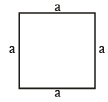
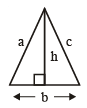


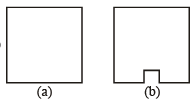 figure (b) has greater perimeter than figure (a)