Class 7 Maths Chapter 1 Question Answers - NCERT Summary
| Table of contents |

|
| Introduction |
|
| Key Points of the Story |
|
| Detailed Summary |
|
| Theme/Message |
|
| List of Difficult Words with Meanings |
|

Introduction
Three Questions by Leo Tolstoy is a story about a king seeking answers to three important questions: the right time to act, the most important people, and the most crucial task. Unsatisfied with varied responses from wise men, he turns to a hermit and learns life-changing lessons.
Leo Tolstoy (1828–1910), a renowned Russian author, is celebrated for works like War and Peace and Anna Karenina. His stories often explore moral and philosophical themes, reflecting his belief in simple living and profound thinking.
Key Points of the Story
- The king wanted answers to three questions:
When is the best time to do something?
Who is the most important person to listen to?
What is the most important thing to do? - He asked many wise people, but their answers were different and did not satisfy him.
- The king went to a wise hermit in the forest for answers.
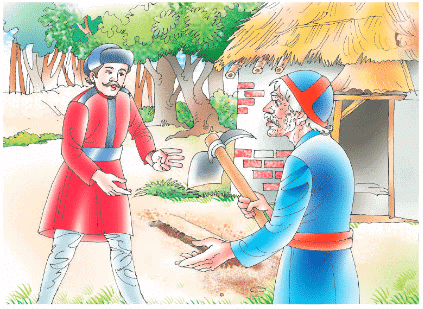
- The hermit was digging the ground and did not reply to the king’s questions.
- The king helped the hermit by digging the ground for him.
- A wounded man came running to the hut, bleeding from his stomach.
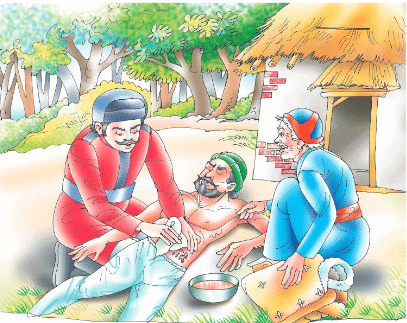
- The king helped the man by cleaning and bandaging his wound.
- The man later admitted he had planned to kill the king but was hurt by the king’s guards.
- The king forgave the man and promised to return his property.
- The hermit finally answered the king’s questions:
The best time is now.
The most important person is the one you are with.
The most important thing to do is to help others. - The king understood the importance of living in the present, helping others, and valuing people around him.
Detailed Summary
A king wanted answers to three important questions so he would never fail. The questions were:
- What is the right time to start something?
- Which people should he listen to?
- What is the most important thing to do?
The king sent messengers across his kingdom, offering a reward to anyone who could answer the questions. Many wise people came, but their answers were so different that the king was not satisfied. He decided to ask a wise hermit who lived in a forest and only met simple people.
The king wore plain clothes and went alone to meet the hermit. When he reached the hermit’s hut, the hermit was digging the ground. The king greeted him and asked his three questions. The hermit listened but did not reply and kept digging. The hermit looked old and tired, so the king took the spade and dug the ground for him. The king worked until evening and asked his questions again.
Just then, a man came running toward the hut, holding his bleeding stomach. He fell to the ground in front of the king. The king cleaned and bandaged the man’s wound with the hermit’s help. They carried the man into the hut and laid him on the bed.
The next morning, the injured man admitted that he had planned to kill the king. He wanted revenge because the king had killed his brother and taken his property. But when the king didn’t return from the hermit’s hut, the man came out of hiding and was wounded by the king’s guards. The king forgave the man and promised to return his property.
When the wounded man arrived, the most important time was the moment the king cared for him because, without help, he would have died from his injuries. At that moment, the wounded man was the most important person, and helping him was the most important thing to do.
Before leaving, the king again asked the hermit to answer his questions. The hermit, who was now planting seeds, replied:
- The most important time is now, because it is the only moment when you can act.
- The most important person is the one you are with, because the future is uncertain.
- The most important thing to do is to help others, because that is why we are here in this world.
The king understood the wisdom of living in the present, valuing people around him, and doing good for others.
Theme/Message
Theme
The story revolves around the themes of wisdom, selflessness, and living in the present. It emphasizes the importance of understanding the right time to act, valuing the people around us, and focusing on doing good for others.
Message
The story conveys that the most important time is now, the most important person is the one you are with at the moment, and the most important task is to do good for others. It teaches that living in the present and helping others brings fulfillment and peace.
List of Difficult Words with Meanings
- Certain - Specific but not clearly named or stated.
- Advance - Before something happens.
- Council - A group of people chosen to give advice or make decisions.
- Councillors - Members of a council.
- Hermit - A person who lives alone and leads a simple, quiet life.
- Woods - A small forest or area covered with trees.
- Beds - Small patches of ground prepared for planting seeds or plants.
- Fainted - Lost consciousness or passed out.
|
19 videos|254 docs|38 tests
|
FAQs on Class 7 Maths Chapter 1 Question Answers - NCERT Summary
| 1. What is the main message of the story "Three Questions"? |  |
| 2. Who are the key characters in "Three Questions"? | |
| 3. What are the three questions the king wants to answer? | |
| 4. How does the king find answers to his questions? | |
| 5. What lesson does the king learn by the end of the story? | |




Class 7 Maths Chapter 1 Question Answers - NCERT Summary
,video lectures
,Semester Notes
,Objective type Questions
,Exam
,Viva Questions
,Important questions
,Class 7 Maths Chapter 1 Question Answers - NCERT Summary
,practice quizzes
,Summary
,study material
,MCQs
,Extra Questions
,ppt
,Class 7 Maths Chapter 1 Question Answers - NCERT Summary
,Previous Year Questions with Solutions
,past year papers
,Free
,Sample Paper
,shortcuts and tricks
,mock tests for examination
;



Summary: Three Questions Free PDF Download
Importance of Summary: Three Questions
Summary: Three Questions Notes
Summary: Three Questions Class 7
Study Summary: Three Questions on the App
|
© EduRev
|
Education Revolution
|


|




