Class 12 Geography Short Questions with Answers - The World Population

Q. 1. Define the term “Density of Population”.
Ans. The ratio between the number of people to the size of land. The number of people living per unit area. The number of people living per sq. km. is called density of population.
Density of Population = Population /Area
Q. 2. How is density of population of a region calculated?
Ans. Density of population is the ratio between the number of people to the size of land or Density of Population = Population/Area.
Q. 3. Mention any two sparsely populated regions of the world with less than 1 person per sq. km.
Ans. Few sparsely populated regions of the world are :
(i) Hot and cold deserts of the world : In the deserts of Libya, Algeria, Egypt, Niger, Western Sahara, Mali, Sudan, Chad and Mauritania, the average density of population is about one person per 15 sq. kms.
(ii) High rainfall zone near the Equator : The Amazon basin, the Congo basin, and the islands of SouthEast Asia are few examples.
(iii) The regions near the North and South Pole : The Arctic Region and the Antarctica.
Q. 4. Name the most densely populated region in North America.
Ans. North-East USA.
Q. 5. Why are urbanised areas densely populated?
Ans. Urbanised areas offer better employment opportunities, educational and medical facilities, better means of transport and communication. Good civic amenities and the attraction of city life draw people to the cities. So urbanised areas are densely populated.
Q. 6. Which continent has the highest growth rate of population?
Ans. Africa has the highest growth rate of population.
Q. 7. Which country in the world has the lowest growth rate of population?
Ans. Syria has the lowest growth rate of population.
Q. 8. Which is the most populous continent?
Ans. Asia is the most populous continent.
Q. 9. Which parts of USA and Europe have density of more than 200 persons per sq km?
Ans. North-East USA and North-West Europe.
Q. 10. Explain with examples how the availability of water and landform influence the distribution of population in the world.
Ans. Water resources: Water is an essential resource for the survival of man. Water is needed for irrigation, domestic purposes, power generation, drinking and other activities. Ancient civilizations like the Indus Valley developed along river valleys. Navigable waterways also serve as major transport and trade route, e.g., the Rhine. Hence, the population distribution is high near the water resources.
Land forms: Land forms influence man’s economic activities and in turn the distribution of population. Rugged topography, harsh climate, infertile soil do not favour agriculture or development of industries. Moreover, uneven topography is not suitable for the development of transport networks. Hence distribution of population is less in the mountainous areas of Himalayas, Alps, etc.
Q. 11. Explain with examples the three economic factors influencing the population distribution in the world.
Ans. Three economic factors that influence the population distribution in the world are
(i) Minerals :
(a) Areas with mineral deposits attract industries.
(b) Mining and industrial activities generate employment. So, skilled and semi-skilled workers who move to these areas make these areas more populated. For e.g., Katanga Zambia copper belt in Africa.
(ii) Urbanization :
(a) Cities offer better employment opportunities like educational, medical facilities, better means of transport and communication.
(b) Good civil amenities and the attraction to city life draw people to the cities.
(c) It leads to rural urban migration and cities grow in size. Mega cities of the world continue to attract large number of migrants every year.
(iii) Industrialization :
(a) Industrial belts provide better job opportunities and attract large numbers of people. (b) This includes not just factory workers but also transport operators, shopkeepers, bank employees, doctors, teachers and other service providers . (c) The Kobe-Osaka region of Japan is thickly populated because of the presence of number of industries.
Q. 12. “There is a negative correlation between economic development and population growth throughout the world.” Support this statement with examples.
Ans. ”There is a negative correlation between economic development and population growth throughout the world.
(i) Population growth has impaired the productivity of renewable natural resources and their provision of environmental services.
(ii) Population growth is likely to depress wages at the bottom end of the pay scale.
(iii) High proportions of school-age children, characteristics of countries experiencing rapid population growth , undoubtedly put pressure on existing school and health care facilities.
Q. 13. Classify the world into various regions on the basis of population density.
Ans. The world is divided into various regions on the basis of population density.
(i) Areas of high density :
(a) Monsoon Asia, South and South - East Asia
(b) Europe – River valley’s coastal plains
(c) Eastern coastal region of North America
(ii) Areas of medium density :
(a) Asia
(b) Europe
(c) USA, Australia
(d) Africa, South America
(iii) Areas of low density :
(a) Hot deserts
(b) Areas around the North and South Poles
(c) Cold deserts
(d) Equatorial Region
Q. 14. Define the term ‘Population Growth’.
Ans. The population growth or population change refers to the change in number of inhabitants of a territory during a specific period of time.
OR
Change of population in a particular area between two points of time is known as growth of population.
Q. 15. Define the term ‘Positive Growth of Population’.
Ans. When the birth rate is more than the death rate between two points of time or when people from other countries migrate permanently to a region. This is known as positive growth of population
Q. 16. Give the meaning of ‘Crude Birth Rate’ (CBR).
Ans. The crude birth rate is the number of births per 1000 people per year.
Q. 17. Define the term “Natural Growth of Population”.
Ans. This is the population increased by difference between births and deaths in a particular region between two points of time. Natural Growth = Births – Deaths. (Imp)
Q. 18. Define the term ‘Migration’.
Ans. Migration refers to the movement of people from one place to another within the country or to a foreign country.
Q. 19. How is the crude birth rate expressed ?
Ans. Crude birth rate is expressed as number of live births in a year per thousand of population. CBR= (Bi/P) × 1000.
Q. 20. Name three components of population change.
Ans. The three components of population change are birth rate, death rate and migration.
Q. 21. Differentiate between Positive and Negative Growth of population.
Ans. Positive Growth of Population happens when the birth rate is more than the death rate between two points of time or when people from other countries migrate permanently to a region. Negative Growth of Population occurs when the birth rate falls below the death rate or people migrate to other countries between two points of time.
Q. 22. Distinguish between birth rate and death rate.
Ans. 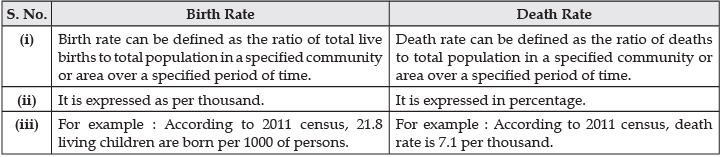
Q. 23. Describe any three characteristics of the last stage of the “Demographic Transition Theory”.
Ans. The three characteristics are :
(i) Birth and death rates are low, leading to total population being stable.
(ii) Death rates are low primarily due to lower rates of diseases and higher production of food.
(iii) The birth rate is low because people have more opportunities to choose if they want children; this is made possible by improvements in contraception or women gaining more independence and work opportunities.
Q. 24. Describe any three characteristics of the first stage of the ‘Demographic Transition Theory’.
Ans. The three characteristics of the first stage of the ‘Demographic Transition Theory’ are:
(i) High fertility and high mortality rate.
(ii) Slow rate of population growth.
(iii) High rate of illiteracy.
Q. 25. Describe any three characteristics of the second stage of ‘Demographic Transition Theory’.
Ans. The three characteristics of the second stage of ‘Demographic Transition Theory’ are:
(i) In the beginning of the second stage, the fertility rate remains high but gradually declines with time.
(ii) Morality rate is reduced due to the improved sanitation.
(iii) Mortality rate is reduced due to better health conditions due to which the net addition to population is high.
|
50 videos|353 docs|37 tests
|
FAQs on Class 12 Geography Short Questions with Answers - The World Population
| 1. What is the current world population? |  |
| 2. How has the world population changed over time? | |
| 3. What factors contribute to the growth of the world population? | |
| 4. Which countries have the highest and lowest population densities? | |
| 5. How does the world population growth impact the environment? | |




mock tests for examination
,video lectures
,Class 12 Geography Short Questions with Answers - The World Population
,past year papers
,practice quizzes
,Sample Paper
,Class 12 Geography Short Questions with Answers - The World Population
,Semester Notes
,Exam
,study material
,Important questions
,Summary
,Objective type Questions
,shortcuts and tricks
,Free
,Extra Questions
,ppt
,Viva Questions
,Previous Year Questions with Solutions
,Class 12 Geography Short Questions with Answers - The World Population
,MCQs
;



Short Questions with Answers - The World Population Free PDF Download
Importance of Short Questions with Answers - The World Population
Short Questions with Answers - The World Population Notes
Short Questions with Answers - The World Population Humanities/Arts
Study Short Questions with Answers - The World Population on the App
|
© EduRev
|
Education Revolution
|


|




within 7 days!