Q1: How did the process of liberalisation initiated in India in the 1990s promote globalisation? Explain. (2 Marks)
Solution:
Ans: Liberalisation in the 1990s removed many restrictions on foreign trade and foreign investment, allowing imports and exports to flow more freely and enabling foreign companies to set up factories and offices in India.
It reduced licensing requirements and import controls, making it easier for Indian firms to buy modern inputs and technology from abroad.
It allowed foreign firms to invest in India, bringing capital, new technology and management practices which increased competition and raised production standards.
Together these changes integrated Indian producers and markets with the world, increased trade and investment flows, and thereby promoted globalisation.
Q2: Two statements are given below. Read both the statements carefully and choose the correct option: (1 Mark) Statement I: Rapid improvement in technology has been one major factor to stimulate the globalisation process. Statement II: This has made much faster delivery of goods across long distances possible at lower costs. (a) Both statements I and II are correct and statement II is the correct explanation of statement I. (b) Both statements I and II are correct, but statement II is not the correct explanation of statement I. (c) Statement I is correct, but statement II is incorrect. (d) Statement I is incorrect, but statement II is correct.
Solution:
Ans: (a)
Explanation: Rapid technological improvements, especially in transport (like containerisation and faster ships and planes), have reduced time and cost of moving goods over long distances. This faster, cheaper movement of goods is a direct reason why technological progress has stimulated globalisation.
Q3: Two statements are given below. Read both the statements carefully and choose the correct option: (1 Mark) Statement I: Information and communication technology stimulate the process of globalisation. Statement II: It is used to contact each other, receive information instantly and communicate with remote areas. (a) Both statements I and II are correct and statement II is the correct explanation of statement I. (b) Both statements I and II are correct, but statement II is not the correct explanation of statement I. (c) Statement I is correct, but statement II is incorrect. (d) Statement I is incorrect, but statement II is correct.
Solution:
Ans: (a)
Explanation: Information and communication technology (ICT) - such as the Internet, telephones and computers - enable instant contact, fast exchange of information and reliable communication with remote areas. This instant and low-cost communication allows businesses to coordinate activities across countries and supports the spread of globalisation.
Q4: "Globalisation is the process of rapid integration and interconnection between countries." Explain the statement with examples. (2 Marks)
Solution:
Ans: Globalisation means growing interconnection and integration among countries through trade, investment and the flow of information.
Goods and services produced in one country are now sold in many others, linking national economies.
For example, Indian garments are exported to the USA, and foreign companies like Ford Motors and Coca-Cola operate in India, showing how production, markets and brands cross national boundaries.
Such flows of goods, services, capital and ideas make countries economically and technologically interdependent, which is the essence of globalisation.
Q5: Choose the correct option to fill in the blank: The process of removing barriers on foreign trade and investment by the government is known as ____________ (1 Mark) (a) Import Tax, (b) Export Tax, (c) Liberalisation, (d) Industrialisation.
Solution:
Ans: (c)
Explanation:Liberalisation refers to removing or reducing government restrictions on foreign trade and foreign investment so that goods, services and capital can move more freely between countries.
Q6: What changes did the Government of India make in its economic policies in the beginning of 1991? Explain. (2 Marks)
Solution:
Ans: In 1991 the Government of India introduced major economic reforms that opened the economy to the world.
It reduced controls on imports and exports, lowered import duties and removed many licensing requirements.
It allowed foreign companies to invest in India and set up factories and offices, thus encouraging foreign direct investment.
These changes, known as liberalisation, aimed to make Indian producers more competitive, improve efficiency and bring new technology and investment into the country.
Q7: Explain any two benefits of globalisation. (2 Marks)
Solution:
Ans: Two benefits of globalisation are:
Increased Choice for Consumers: A wider range of foreign goods and brands are available in Indian markets, giving consumers more options and often better quality at competitive prices.
Growth of Investment and Employment: Multinational companies have invested in India, creating new industries and jobs in sectors such as information technology, automobiles and services.
Q8: The growth of digital technology has greatly influenced globalization. Which of the following is its main benefit? (1 Mark) (a) Increased Communication Cost, (b) Limited Access to Information, (c) Enhanced Connectivity, (d) Slower Transaction Speed.
Solution:
Ans: (c)
Explanation: Digital technology - the Internet, mobile phones and computers - has greatly improved global connectivity, enabling instant communication, quick information exchange and easier coordination of production and trade across countries. This enhanced connectivity supports and speeds up globalisation.
Q9: How did the trade policy implemented in 1991 stimulate the globalization in India? Explain with example. (3 Marks)
Solution:
Ans: The trade policy of 1991 stimulated globalisation by introducing liberalisation - that is, by removing many barriers on foreign trade and foreign investment.
Removal of Trade Barriers: The government reduced import duties and relaxed controls on imports and exports, which encouraged competition and integration with world markets.
Attracting Foreign Investment: Foreign firms were allowed to set up operations in India, bringing capital, technology and employment.
Example: Companies like Ford Motors invested in India and set up a plant near Chennai, and Cargill Foods acquired Parakh Foods. These investments linked Indian production to global supply chains and brought new technology and jobs.
Overall, the 1991 reforms opened India to global trade and investment and integrated the Indian economy more closely with the world.
Q10: Two Statements are given below. Read both the statements and choose the correct option: (1 Mark) Statement I: In recent times technology in the areas of computer and internet has been changing rapidly. Statement II: Internet allows us to send instant electronic mail (e-mail) and talk (voice-mail) across the world at negligible costs. (a) Only I is false but II is true. (b) Only I is true but II is false. (c) Both I and II are true but II is not the correct explanation of I. (d) Both I and II are true and II is the correct explanation of I.
Solution:
Ans: (d)
Explanation: Both statements are true. Rapid changes in computer and Internet technology have made it possible to send instant e-mail and use voice communication across the world at very low cost; this capability explains how rapid technological change supports globalisation.
Q11: Explain the contribution of foreign trade as an important factor of globalization. (2 Marks)
Solution:
Ans:Foreign trade helps globalisation by connecting markets across countries.
It allows producers to sell goods beyond their domestic market, increasing sales and business opportunities.
It gives consumers access to a wider variety of goods from other countries, often at lower prices.
For example, the entry of Chinese toys into Indian markets expanded choices for buyers and often lowered prices, illustrating how trade integrates markets across countries.
Q12: Read the following statements for stimulating the process of globalization and choose the correct options: (1 Mark) I. Government reduces trade barriers. II. Government reduces competition among producers. III. Government reduces import and export taxes. IV. Government removes restrictions on foreign investment. (a) Only I, II, and III are correct. (b) Only II, III, and IV are correct. (c) Only I, III, and IV are correct. (d) Only I, II, and IV are correct.
Solution:
Ans: (c)
Explanation: Globalisation is encouraged when the government reduces trade barriers (I), lowers import and export taxes (III), and removes restrictions on foreign investment (IV). Reducing competition among producers (II) would be counterproductive to globalisation, so I, III and IV are correct.
Q13: How did information and communication technology promote the process of globalization? Explain. (2 Marks)
Solution:
Ans:Information and Communication Technology (ICT) promoted globalisation by making communication and information exchange instant, efficient and low cost.
Instant communication: Telecommunication, computers and the Internet let companies coordinate production and services across countries in real time.
Example: A magazine designed in Delhi can be sent instantly to London for printing, or customer-care services can be handled from India for customers abroad, showing how ICT connects businesses globally.
Previous Year Questions 2024
Q1: Examine the transformations observed in India's trade since 1991. (CBSE 2024)
Solution:
Ans:Indian markets have been transformed since 1991 in the following ways:
Wider choice: Consumers now enjoy a greater variety of goods and services from both domestic and foreign producers.
Access to global brands: The latest models of digital cameras, mobile phones and televisions from leading manufacturers are readily available; new automobile models are often seen on Indian roads.
Explosion of brands: There has been a marked increase in the number of brands across many products, including clothing, electronics and processed foods.
Global trade: Producers from any country can now sell their products internationally, linking markets through trade and online platforms such as Amazon and Flipkart.
Liberalisation: Firms have greater freedom to choose what to import or export, with fewer government restrictions than before.
Q2: Examine the factors that have enabled globalization in India. (CBSE 2024)
Solution:
Ans:The factors that have enabled globalisation in India include:
Information Technology (IT): IT has increased the production and export of services, especially in software and IT-enabled services.
Technological Improvements: Improvements such as containerisation have reduced costs and increased the speed of trade.
Transportation Advances: Faster and cheaper transport has made it easier to move goods across long distances.
Government Policies: Removal of many trade barriers and liberal economic policies since 1991 have facilitated easier imports, exports and foreign investment.
Previous Year Questions 2023
Q3: Which one of the following is a major benefit to an MNC when it works on joint production with a local company? (2023) (a) MNC shares its latest technology with the local company. (b) MNC decides all parameters and prices of the product. (c) MNC shares its institutional policy with local company. (d) MNC built good and familial relations with the local company
Solution:
Ans: (a)
Explanation: Joint production lets the MNC transfer its latest technology to the local partner. This improves the local firm's production techniques and product quality, making it more competitive. The other options do not capture this main advantage of technology transfer and capacity-building.
Q4:Explain any five steps taken by the developing countries to attract Foreign investment. (2023)
Solution:
Ans:Steps to attract foreign investment include:
The creation of Special Economic Zones (SEZs) that provide reliable facilities such as uninterrupted electricity, water and good transport links.
Tax exemptions or holidays for companies operating in SEZs for an initial period to lower their costs.
Flexible labour rules in some industries to allow firms to hire more easily during peak periods.
Legal and regulatory concessions such as simplified approval procedures for foreign investors.
Improvement of infrastructure (roads, ports, airports) to make investment more attractive and reduce operating costs.
Q5: Why did the Indian government liberalize trade regulations in 1991? (CBSE 2023) (a) Government wanted foreign exchange equivalent to Indian Currency. (b) Government wanted maintain good relations with Western Countries. (c) Government wanted Indian producers to compete in the World Market. (d) Government wanted to provide socio-economic justice to all.
Solution:
Ans: (c)
Explanation: The main aim of liberalisation in 1991 was to enable Indian producers to compete in the world market. By reducing restrictions on trade and investment, the government sought to improve efficiency, quality and competitiveness of Indian industries.
Q6: How is information technology connected with globalization? (CBSE 2023)
Solution:
Ans:Information technology has accelerated globalisation by transforming communication, business and trade.
People and firms can connect instantly with anyone anywhere in the world.
Many transactions, including banking, purchasing and services, can be completed online.
Without IT, globalisation of services like IT-enabled services and online retail would have been much slower.
Faster communication shortens delays and helps firms coordinate production across countries.
Q7:'Liberalization of foreign trade involves policy framework at National and International level'. Explain the statement. (2023)
Solution:
Ans:Liberalisation of foreign trade means removing government restrictions on trade and investment; this requires rules and agreements at both national and international levels.
National level: Policy changes in India since 1991 reduced import controls and encouraged competition among domestic producers.
International level: Agreements and norms under organisations such as the WTO influence how countries open their markets and treat foreign investors.
Together these national reforms and international rules make it easier for goods and capital to move across borders.
Q8:Explain the rapid transformation in the communication sector in modern times. (2023)
Solution:
Ans: Recent rapid changes in telecommunications, computing and the Internet have transformed how people communicate.
Telephones, mobile phones and the Internet allow instant contact across the world and access to information from remote areas.
Satellite communications and improved networks support reliable long-distance links.
These advances let companies spread out services internationally - for example, designing a magazine in one country and printing it in another, with text exchanged instantly over the Internet.
Previous Year Questions 2022
Q9:Examine the steps taken by the Central and State governments to attract foreign companies to invest in India. (Term-II, 2021-22)
Solution:
Ans: The Central and State governments have taken several measures to attract foreign companies to invest in India:
Simplification of rules and procedures: Approval processes for foreign investment have been streamlined to reduce delays and red tape.
Incentives and benefits: Tax holidays, subsidies and other financial incentives are offered to encourage investment.
Infrastructure development: Investment in ports, roads, power and industrial parks creates a favourable environment for companies.
Skill development: Training programmes improve the workforce skills so firms have access to qualified employees.
Sector-specific policies: Clear rules for priority sectors (for example, manufacturing or technology) give investors confidence to enter those areas.
These steps together make India more attractive for foreign direct investment.
Q10: "Technology is the vital force in the modern form of globalisation\". Explain the statement with suitable examples. (Term-II,2021-22)
Solution:
Ans:Technology and globalisation reinforce each other. Improvements in transport and communication speed up the movement of people, goods and ideas, while global links spur further technological development.
New markets: Technology enables firms to access and serve customers around the world.
Overcoming barriers: Faster transport and digital communication reduce costs, delays and difficulties in trade.
Collaboration: Software teams can work together across countries using networks and shared platforms.
Transport example: Containerisation has lowered port handling costs and sped up exports; cheaper air freight has increased the volume of goods transported by air.
Thus, technology is a vital force that makes modern globalisation possible and efficient.
Q11: "Globalisation is the process of rapid integration between countries". Examine the statements. (Term-ll, 2021-22 C)
Solution:
Ans:Globalisation refers to the growing integration of a country's economy with other countries so that goods, services and capital move more freely across borders.
Foreign trade has been a main channel linking countries by allowing goods produced in one country to be sold in another.
Historical trade routes connected regions and also carried ideas and culture, not just goods.
Producers can now compete in global markets and consumers get more choices from different countries.
Therefore, foreign trade and related exchanges lead to market integration and greater interdependence among countries.
Q12: Examine the debate that took place in the World Trade Organisation for the developing countries. (Term-11,2021-22)
Solution:
Ans:WTO agreements contain special provisions to help developing countries participate more fairly in global trade:
Longer time periods to implement certain obligations.
Measures to improve their trading opportunities and market access.
Support to build infrastructure and institutions needed for international trade.
Technical assistance to handle disputes and meet standards.
These measures aim to make the global trading system more inclusive for developing countries.
Q13: "The impact of globalisation has not been uniform". Explain the statement with suitable examples. (Term-ll, 2021-22,2020)
Solution:
Ans: The effects of globalisation vary across people, firms and regions.
Beneficiaries: Wealthy consumers and skilled workers often gain from more choices, better quality goods and lower prices, improving their standard of living.
Small producers and workers: Many small producers face stiff competition from imports and large firms, causing some units to close and workers to lose jobs.
Resource flows: Developed countries often buy raw materials cheaply from poorer countries and sell back high-value finished goods.
MNC investment: Multinational companies have created jobs in sectors such as electronics and services, though benefits are not evenly spread.
Thus, globalisation creates opportunities for some while posing challenges for others, so its impact is not uniform.
Previous Year Questions 2020
Q14: Choose the correct statement about factors regarding globalisation in India: (I) Improvement in transportation technology. (II) Liberalisation of foreign trade and foreign investment. (III) Favourable rules of WTO towards India in comparison to developed countries. Choose the correct options from the codes given below: (2020) (a) I and II only (b) I and III only (c) II and III only (d) III only
Solution:
Ans: (a)
The correct choice is (a). Improvements in transport technology (I) and liberalisation of trade and investment (II) are key factors enabling globalisation in India. Option III is not correct because WTO rules do not necessarily favour India more than developed countries.
Q15: Read the sources given below and answer the questions that follow: (2020) Source A : Production across countries Until the middle of the twentieth century, production was largely organised within countries. What crossed the boundaries of these countries were raw material, food stuff and finished products. Colonies such as India exported raw materials and food stuff and imported finished goods. Trade was the main channel connecting distant countries. This was before large companies called multinational corporations (MNCs) emerged on the scene. Source B : Foreign trade and integration of markets Foreign trade creates an opportunity for the producers to reach beyond the domestic markets, i.e., markets of their own countries. Producers can sell their produce not only in markets located within the country but can also compete in markets located in other countries of the world. Similarly, for the buyers, import of goods produced in another country is one way of expanding the choice of goods beyond what is domestically produced. Source C : Impact of globalisation in India Globalisation and greater competition among producers - both local and foreign producers - has been of advantage to consumers, particularly the well-off sections in the urban areas. There is greater choice before these consumers v/ho now enjoy improved quality and lower prices for several products. As a result, these people today, enjoy much higher standards of living than v/as possible earlier. Source A : Production across countries (i) How are MNCs a major force in connecting the countries of the world? Source B : Foreign trade and integration of markets (ii) How does foreign trade become a main channel in connecting countries? Source C : Impact of globalisation in India (iii) How is globalisation beneficial for consumers?
Solution:
Ans: (i) MNCs connect countries by establishing production, distribution and sales networks across borders. They buy raw materials from some countries, manufacture in others and sell finished goods worldwide, linking markets and production centres.
(ii) Foreign trade connects countries because producers can sell beyond domestic markets into foreign markets, and buyers can import goods from abroad. This exchange links prices, demand and production between countries.
(iii) Globalisation benefits consumers by increasing the variety of goods available, often improving quality and lowering prices, which raises living standards for many consumers.
Previous Year Questions 2019
Q16: State any one example of 'Trade Barrier'. (AI 2019)
Solution:
Ans:Tax on imports is a common example of a trade barrier.
Import tax raises the price of foreign goods, helping to protect domestic producers from foreign competition.
Governments use such barriers to control the quantity and type of goods entering the country.
Q17: Analyse any three factors that make globalisation more fair. (AI 2019)
Solution:
Ans: To make globalisation fairer, the following measures are important:
Proper enforcement of labour laws: Protecting workers' rights and ensuring safe working conditions reduces exploitation.
Support for small businesses: Assistance, credit and training help small firms compete with large multinational companies.
Use of targeted trade measures: Temporary trade protections or regulations can help emerging industries develop before facing full international competition.
Q18: Analyse the impact of globalisation on Multi-national Corporations (MNCs) in India. (AI 2019)
Solution:
Ans:Globalisation has expanded opportunities for MNCs in India:
Proximity to markets: MNCs can locate production near target markets and benefit from lower costs for land, labour and inputs.
Favourable policies: Supportive government policies and incentives can attract MNCs to invest.
Joint ventures and acquisitions: MNCs collaborate with or buy local firms to gain market access, capital and local knowledge.
Improved products: MNCs bring better technology and often introduce higher quality products at competitive prices.
Q19: How has technology stimulated the globalisation process? Explain with examples. (CBSE 2019, 12)
Solution:
Ans:Technology has stimulated globalisation in several key ways:
Transport technology: Faster and cheaper transport reduces the time and cost of moving goods internationally.
Containerisation: Using containers has reduced port handling costs and speeded up exports.
Air transport: Falling air freight costs enable rapid movement of goods over long distances.
Information and communication: The Internet and telecommunication allow instant contact and transactions across countries.
Previous Year Questions 2018
Q20: How have our markets been transformed in recent years? Explain with examples. Or What changes have taken place in the markets during the last twenty years or so? (CBSE 2018)
Solution:
Ans: Our markets have changed considerably in recent years, offering consumers many more choices.
Wider selection: Consumers now have access to a broader range of goods and services from both domestic and foreign producers.
Access to latest technology: New models of digital cameras, mobile phones and cars from global manufacturers are readily available.
Brand explosion: There is a large increase in the number of brands across product categories, from clothing to electronics and processed foods.
These changes reflect greater integration with global production and trade.
Q21: "Foreign trade integrates the markets in different countries." Support the statement with arguments. (CBSE 2018)
Solution:
Ans:Foreign trade links markets across countries by enabling producers to sell abroad and consumers to buy goods from other nations.
Producers can expand beyond domestic markets and sell in many countries.
Competition from foreign producers encourages domestic firms to improve efficiency and quality.
Consumers gain access to a wider variety of goods and services.
Producers from different countries may collaborate or form joint ventures, further integrating production.
Thus foreign trade brings markets closer and increases competition and choice.
Q22: The impact of globalisation has not been uniform." Discuss with the help of examples. Or Discuss the impact of globalisation on India. (CBSE 2018)
Solution:
Ans:(a)Positive impact:
Consumers have more choices and often better quality goods at lower prices.
Standards of living have improved for many, especially in urban areas.
Investment by MNCs has created new jobs in sectors such as electronics and services.
New technology and management practices have been introduced.
(b)Negative impact:
Creation of special economic zones and large projects has sometimes displaced people.
Flexible labour laws can reduce job security for workers.
Small producers often find it hard to compete with large firms and imports, leading to closures and job losses.
Previous Year Questions 2016
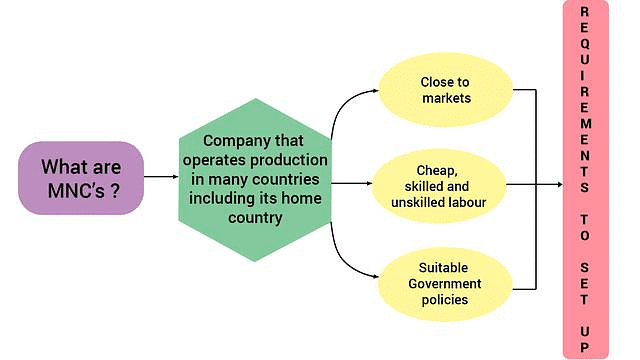
Q23: Why do MNCs set up their offices and factories in those regions where they get cheap labour and other resources? (AI 2016)
Solution:
Ans: Multinational companies (MNCs) set up offices and factories where labour, land and raw materials are cheaper to reduce production costs.
Lower input costs help MNCs stay competitive in global markets.
By saving on production costs they can increase profits and offer goods at lower prices.
Q24: Differentiate between investment and foreign investment. (AI 2016)
Solution:
Ans:Investment is money spent to buy buildings, land or other assets with the aim of earning a profit in future.
Foreign investment is investment made by a person, company or government from another country in assets within India, with the intention of earning profit from those assets.
Q25: Due to which reason the latest models of different items are available within our reach? (Foreign 2016)
Solution:
Ans:Globalisation has made the latest models of various items available by:
Improved technology: Faster production and better distribution systems.
Liberalisation: Easier import policies let companies bring new goods into the country.
Global markets: Producers sell their latest models internationally, so consumers can access them locally.
Q26: Barriers on foreign trade and investment were removed to a large extent in India since 1991." Justify the statement. (CBSE 2016) Or Why had the Indian government put barriers to foreign trade and foreign investments after independence? (CBSE 2016)
Solution:
Ans:(A)
After independence, the government imposed restrictions on imports to protect domestic industries and to build local technological capabilities.
Only essential items like machinery, fertilisers and petroleum were allowed to be imported to support industrialisation.
(B)
By 1991 India had developed enough capability and the authorities decided to remove many restrictions so domestic producers could compete internationally.
The aim was to increase efficiency, allow free exchange of capital and technology, and improve the performance of domestic firms through competition.
Q27: "Information and communication technology has played a major role in spreading out production of services across countries." Justify the statement with examples. (CBSE 2016)
Solution:
Ans:
Telecommunication facilities - telegraph, telephone (including mobile phones) and fax - help people contact one another across the world and communicate from remote areas.
Computers and the Internet allow instant electronic mail and voice communication at very low cost.
These technologies let different parts of a service be done in different countries - for example, a magazine for London readers can be designed in Delhi, the text sent by the Internet, printed and then shipped to London with payment handled through e-banking.
Previous Year Questions 2015
Q28: How are MNCs controlling and spreading their productions across the world? Explain. (CBSE 2015)
Solution:
Ans:
MNCs often set up production jointly with local companies, sharing investment and technology.
They buy local companies to expand production and gain market access.
MNCs place orders with small producers in developing countries for goods such as garments and footwear; these goods are sold under the MNC's brand name, while the MNC sets quality, price and delivery conditions.
Q29: Explain the role of technology in stimulating globalisation process. (CBSE 2015)
Solution:
Ans:Technology has been a key driver of globalisation:
Transport improvements: Faster and cheaper transport reduces the cost and time of moving goods internationally.
Containerisation: Containers lower port handling costs and speed up shipments.
Air freight: Lower air transport costs allow quicker movement of goods.
Information technology: Telecommunication and the Internet enable instant communication and coordination across countries.
Q30: Why did the Indian government remove barriers to a large extent on foreign trade and foreign investment after 1991? (CBSE 2015)
Solution:
Ans: The government removed many barriers after 1991 to:
Encourage competition among domestic producers so they would improve quality and efficiency.
Allow easier imports and exports to integrate with global markets.
Attract foreign investment to bring capital, technology and jobs into India.
These reforms, called liberalisation, gave firms more freedom to decide what to trade and helped modernise the economy.
Previous Year Questions 2014
Q31: Explain any four ways by which MNCs exercise control on production. (CBSE 2014)
Solution:
Ans:Multinational Corporations (MNCs) control production in several ways:
Factory location: They set up factories near markets to access skilled and unskilled labour and other resources at lower cost.
Local partnerships: Collaborating with local firms helps MNCs manage local operations and gain market knowledge.
Acquisition: Buying local firms lets MNCs expand production and use better technology and capital.
Outsourcing: They contract small producers in different countries to manufacture goods that are sold under the MNC's brand.
Previous Year Questions 2012
Q32: How are MNCs spreading their production across countries? Explain with an example. Multinational Corporations (MNCs) are spreading their production in different ways. Some of them are: (CBSE 2012)
Solution:
Ans: Multinational Corporations (MNCs) expand production across countries by several methods:
By buying local companies and expanding production. For example, Cargill Foods, a large American MNC, bought the Indian company Parakh Foods and became a major edible oil producer in India.
By placing production orders with small producers in developing countries for garments, footwear and other goods; these products are sold worldwide under the MNC's brand.
By producing jointly with local companies, which benefits the local partner through investment and access to modern technology.
For example, Ford Motors set up a plant near Chennai in collaboration with an Indian firm, showing how MNCs partner locally to spread production.
FAQs on Previous Year Questions: Globalisation & the Indian Economy
1. What are the main effects of globalisation on the Indian economy and job markets?
Ans. Globalisation has increased foreign investment, technology transfer, and export opportunities in India, creating jobs in IT, manufacturing, and services sectors. However, it has also displaced workers in traditional industries and widened income inequality between urban and rural regions. Competition from cheaper imports has challenged domestic small businesses, while multinational corporations have gained significant market control in consumer goods and telecommunications.
2. How did the liberalisation policies of 1991 change India's approach to trade and foreign investment?
Ans. India's 1991 economic liberalisation removed import restrictions, reduced tariffs, and allowed foreign direct investment in previously protected sectors. This marked a shift from the licence raj system towards an open-market economy. The policy enabled Indian companies to compete globally, attracted multinational corporations, and modernised infrastructure. However, it also exposed domestic industries to international competition and created economic disparities between regions benefiting from globalisation and those left behind.
3. What is the difference between globalisation and the earlier protectionist policies India followed?
Ans. Protectionist policies restricted imports and foreign investment to shield domestic industries from competition, while globalisation opens markets to international trade and capital flows. Pre-1991 India relied on self-reliance and state control through the licence raj system. Globalisation prioritises market liberalisation, private enterprise, and integration into global supply chains. This shift increased consumer choice and technological advancement but reduced job security in traditional sectors and created regional economic imbalances.
4. Which Indian industries have benefited most from globalisation and why?
Ans. Information technology, pharmaceuticals, textiles, and business process outsourcing have thrived under globalisation due to India's skilled workforce, cost advantages, and English-speaking talent pool. The IT sector emerged as a global leader, generating substantial foreign exchange. Pharmaceutical companies captured international markets with affordable medicines. Agricultural exports expanded significantly. However, labour-intensive sectors like small-scale manufacturing faced intense global competition, leading to job losses and business closures in traditional cottage industries and unorganised sectors.
5. What are the negative impacts of globalisation on Indian workers and small businesses?
Ans. Globalisation has displaced workers in traditional industries like textiles and agriculture as cheaper imports flood markets, particularly affecting unskilled and semi-skilled labourers. Small-scale industries and artisans struggle against multinational competition without adequate capital or technology access. Rural economies face agricultural distress from global price fluctuations and mechanisation. Income inequality widens as benefits concentrate in urban, skill-dependent sectors. Workers in unorganised sectors lack job security, social protection, and bargaining power against large corporate employers.
Previous Year Questions with Solutions, Previous Year Questions: Globalisation & the Indian Economy, ppt, pdf , Free, shortcuts and tricks, mock tests for examination, practice quizzes, Viva Questions, Summary, Objective type Questions, video lectures, Previous Year Questions: Globalisation & the Indian Economy, Previous Year Questions: Globalisation & the Indian Economy, Extra Questions, MCQs, Exam, study material, Important questions, Semester Notes, past year papers, Sample Paper;