Union Territories in India- 2 | Indian Polity for UPSC CSE PDF Download

Constitutional provisions for Delhi
- Art 239: Union territory shall be administered by the President through an Administrator to be appointed by the President.
- Article 239A provides for Creation of local Legislatures or Council of Ministers or both for certain Union Territories.
- Article 239AA of the Indian Constitution was added by Constitution (Sixty-ninth Amendment) Act, 1991. It says that Union Territory of Delhi shall be called the National Capital Territory of Delhi and the Administrator thereof appointed under Article 239 shall be designated as the Lieutenant Governor.
- There shall be a Legislative Assembly for the National Capital Territory (NCT)
Power of parliament to make laws
- The Parliament can make laws on any subject of the three lists (including the State List) for the union territories.
- The President can make regulations for the peace, progress and good government of the Andaman and Nicobar Islands, Lakshadweep, Dadra and Nagar Haveli, and Daman and Diu.
- A regulation made by the President has the same force and effect as an act of Parliament.
- The Parliament can establish a high court for a union territory.
Article 239AA. Special provisions concerning Delhi
(1) As from the date of commencement of the Constitution (Sixty-ninth Amendment) Act, 1991, the Union Territory of Delhi shall be called the National Capital Territory of Delhi (hereafter in this Part referred to as the National Capital Territory) and the administrator thereof appointed under article 239 shall be designated as the Lieutenant Governor.
(2) (a) There shall be a Legislative Assembly for the National Capital Territory and the seats in such Assembly shall be filled by members chosen by direct election from territorial constituencies in the National Capital Territory.
(b) The total number of seats in the Legislative Assembly, the number of seats reserved for Scheduled Castes, the division of the National Capital Territory into territorial constituencies (including the basis for such division) and all other matters relating to the functioning of the Legislative Assembly shall be regulated by law made by Parliament.
(c) The provisions of articles 324 to 327 and 329 shall apply to the National Capital Territory, the Legislative Assembly of the National Capital Territory, and the members thereof as they apply, concerning a State, the Legislative Assembly of a State and the members thereof respectively; and any reference in articles 326 and 329 to “appropriate Legislature” shall be deemed to be a reference to Parliament.
(3) (a) Subject to the provisions of this Constitution, the Legislative Assembly shall have the power to make laws for the whole or any part of the National Capital Territory concerning any of the matters enumerated in the State List or the Concurrent List in so far as any such matter applies to Union territories except matters with respect to Entries 1, 2 and 18 of the State List and Entries 64, 65 and 66 of that List in so far as they relate to the said Entries 1, 2 and 18.
(b) Nothing in sub-clause (a) shall derogate from the powers of Parliament under this Constitution to make laws with respect to any matter for a Union territory or any part thereof.
(c) If any provision of a law made by the Legislative Assembly with respect to any matter is repugnant to any provision of a law made by Parliament with respect to that matter, whether passed before or after the law made by the Legislative Assembly, or of an earlier law, other than a law made by the Legislative Assembly, then, in either case, the law made by Parliament, or, as the case may be, such earlier law, shall prevail and the law made by the Legislative Assembly shall, to the extent of the repugnancy, be void: Provided that if any such law made by the Legislative Assembly has been reserved for the consideration of the President and has received his assent, such law shall prevail in the National Capital Territory: Provided further that nothing in this sub-clause shall prevent Parliament from enacting at any time any law with respect to the same matter including a law adding to, amending, varying or repealing the law so made by the Legislative Assembly.
(4) There shall be a Council of Ministers consisting of not more than ten percent of the total number of members in the Legislative Assembly, with the Chief Minister at the head to aid and advise the Lieutenant Governor in the exercise of his functions concerning matters for which the Legislative Assembly has power to make laws, except in so far as he is, by or under any law, required to act in his discretion: Provided that in the case of difference of opinion between the Lieutenant Governor and his Ministers on any matter, the Lieutenant Governor shall refer it to the President for decision and act according to the decision given thereon by the President and pending such decision it shall be competent for the Lieutenant Governor in any case where the matter, in his opinion, is so urgent that it is necessary for him to take immediate action, to take such action or to give such direction in the matter as he deems necessary.
(5) The Chief Minister shall be appointed by the President and other Ministers shall be appointed by the President on the advice of the Chief Minister and the Ministers shall hold office during the pleasure of the President.
(6) The Council of Ministers shall be collectively responsible to the Legislative Assembly.
(7) (a) Parliament may, by law, make provisions for giving effect to or supplementing the provisions contained in the foregoing clauses and for all matters incidental or consequential thereto.
(b) Any such law as is referred to in sub-clause (a) shall not be deemed to be an amendment of this Constitution for article 368 notwithstanding that it contains any provision which amends or has the effect of amending this Constitution.
(8) The provisions of article 239B shall, so far as may be, apply to the National Capital Territory, the Lieutenant Governor, and the Legislative Assembly, as they apply to the Union territory of Pondicherry, the administrator and its Legislature, respectively; and any reference in that article to “clause (1) of article 239A” shall be deemed to be a reference to this article or article 239AB, as the case may be.
Supremacy of of Lt. governor vs state legislature
- SC was of the opinion that, Democratically elected government has more powers than the nominated Lt. governor and Governor is bound by the recommendation of the Council of Ministers.
- In the case of difference of opinion between the Lt. governor and his ministers, the Lt. governor is to refer the matter to the president for decision and act accordingly.
- Supreme Court held that governance of Delhi cannot rest upon the whims of one functionary namely the Lieutenant-Governor as he cannot refer every matter of the Delhi Government to the President. This will create work paralysis.
Way ahead
- It refers to the collaborative nature of functioning of Union along with states so as to ensure development and progress.
- The concept of collaborative federalism applies to Delhi owing to its special status under the Constitution.
Table : Administrative System of Union Territories at a Glance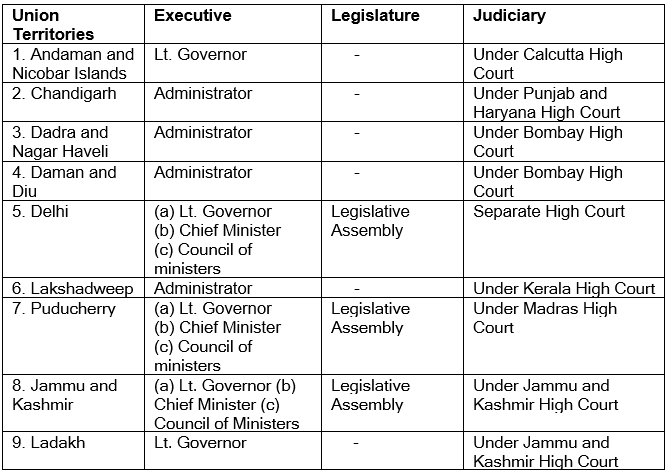
Table : Comparing States and Union Territories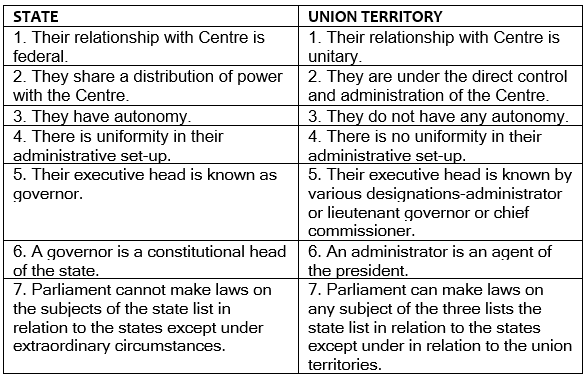
|
170 videos|999 docs|259 tests
|
FAQs on Union Territories in India- 2 - Indian Polity for UPSC CSE
| 1. What are the Union Territories in India? |  |
| 2. What is the difference between a Union Territory and a State in India? | |
| 3. How are Union Territories in India formed? | |
| 4. Which Union Territory has the highest population in India? | |
| 5. Do Union Territories have their own Chief Ministers? | |




Sample Paper
,Summary
,Free
,Viva Questions
,study material
,mock tests for examination
,past year papers
,Semester Notes
,Union Territories in India- 2 | Indian Polity for UPSC CSE
,Union Territories in India- 2 | Indian Polity for UPSC CSE
,practice quizzes
,Union Territories in India- 2 | Indian Polity for UPSC CSE
,Important questions
,Extra Questions
,Previous Year Questions with Solutions
,ppt
,shortcuts and tricks
,Exam
,MCQs
,Objective type Questions
,video lectures
;




Union Territories in India- 2 Free PDF Download
Importance of Union Territories in India- 2
Union Territories in India- 2 Notes
Union Territories in India- 2 UPSC Questions
Study Union Territories in India- 2 on the App
|
© EduRev
|
Education Revolution
|


|




