Laxmikanth Summary: Citizenship | Indian Polity for UPSC CSE PDF Download
| Table of contents |

|
| Meaning and Significance |
|
| Single Citizenship |
|
| Constitutional Provisions |
|
| Citizenship Act, 1955 |
|
| Acquisition of Citizenship |
|
| Loss of Citizenship |
|
| Overseas Citizenship of India |
|

Meaning and Significance
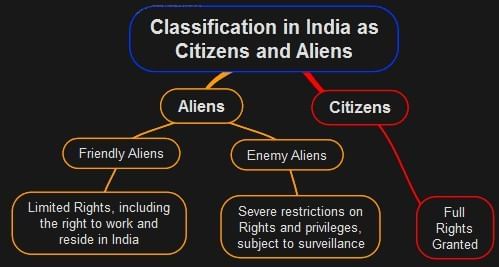
- In India, there are two categories of people: citizens and aliens, with citizens being full members of the Indian State and enjoying all civil and political rights.
- Aliens, citizens of other countries, do not have all the civil and political rights enjoyed by citizens. They are classified as friendly aliens or enemy aliens based on their country's relationship with India.
- Friendly aliens are citizens of nations with cordial relations with India, while enemy aliens are citizens of nations at war with India, enjoying lesser rights.
- Citizens in India have various rights and privileges guaranteed by the Constitution, including:
(i) Right against discrimination based on religion, race, caste, sex, or place of birth (Article 15).
(ii) Right to equality of opportunity in public employment (Article 16).
(iii) Right to freedom of speech, expression, assembly, association, movement, residence, and profession (Article 19).
(iv) Cultural and educational rights (Articles 29 and 30).
(v) Right to vote in elections to the Lok Sabha and state legislative assembly.
(vi) Right to contest for membership of Parliament and state legislature.
(vii) Eligibility to hold certain public offices such as President, Vice-President, judges of the Supreme Court and high courts, Governor of states, Attorney General, and Advocate General. - Citizens also have duties towards the Indian State, including paying taxes, respecting national symbols, and defending the country.
- Both citizens by birth and naturalizedcitizens are eligible for the office of President in India, unlike the USA where only citizens by birth are eligible for the presidency.
Single Citizenship
- The Indian Constitution is federal, with a dual polity comprising the Centre and states, but it only provides for single citizenship, which is Indian citizenship.
- In contrast to countries like the USA and Australia, where double citizenship exists, Indian citizens owe allegiance solely to the Union, with no separate state citizenship.
- Double citizenship creates issues of discrimination, as states may favor their citizens in various matters such as voting rights, holding public offices, and professional opportunities.
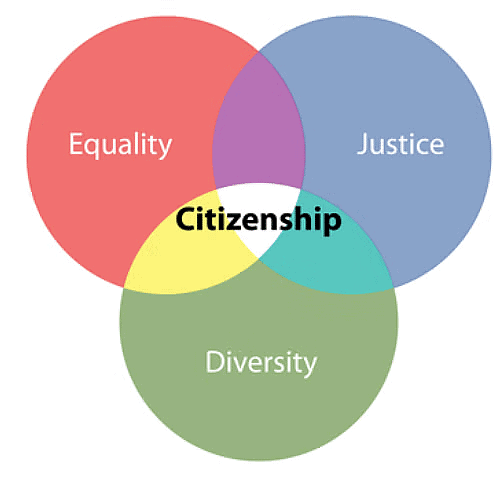
- India's system of single citizenship ensures uniform political and civil rights for all citizens across the country, without discrimination based on their state of birth or residence.
- Exceptions to the absence of discrimination include provisions allowing Parliament to prescribe residence as a condition for certain employments and states to provide benefits or preferences to their residents in matters not covered by constitutional rights.
- Article 19 protects the freedom of movement and residence but restricts outsiders' rights to settle in tribal areas to safeguard the interests of scheduled tribes and protect their culture and property.
- Until 2019, Jammu and Kashmir had special provisions defining permanent residents and conferring specific rights and privileges on them, based on Article 35-A. However, this special status was abolished in 2019.
- The Constitution aims to promote fraternity and unity among Indians by introducing single citizenship and providing uniform rights, but India continues to face communal riots, class conflicts, caste wars, linguistic clashes, and ethnic disputes, indicating that the goal of building a fully integrated Indian nation has not been fully realized.
Constitutional Provisions
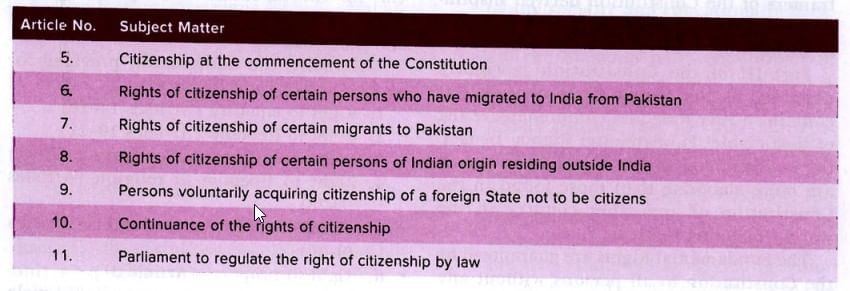
Article 5 A person who had his domicile in India and also fulfilled any one of the three conditions, viz., if he was born in India; or if either of his parents was born in India; or if he has been ordinarily resident in India for five years immediately before the commencement of the Constitution.
Article 6
- A person who migrated to India from Pakistan became an Indian citizen if he or either of his parents or any of his grandparents was born in undivided India and also fulfilled any one of the two conditions viz.,
(i) in case he migrated to India before July 19, 1948, he had been ordinarily resident in India since the date of his migration; or
(ii) in case he migrated to India on or after July 19, 1948, he had been registered as a citizen of India. But, a person could be so registered only if he had been resident in India for six months preceding the date of his application for registration.
Article 7
- A person who migrated to Pakistan from India after March 1, 1947, but later returned to India for resettlement could become an Indian citizen. For this, he had to be resident in India for six months preceding the date of his application for registration.
Article 8
- A person who, or any of whose parents or grandparents, was born in undivided India but who is ordinarily residing outside India shall become an Indian citizen if he has been registered as a citizen of India by the diplomatic or consular representative of India in the country of his residence,
Article 9
- No person shall be a citizen of India or be deemed to be a citizen of India, if he has voluntarily acquired the citizenship of any foreign state.
Article 10
- Every person who is or is deemed to be a citizen of India shall continue to be such citizen, subject to the provisions of any law made by Parliament.
Article 11
- Parliament shall have the power to make any provision with respect to the acquisition and termination of citizenship and all other matters relating to citizenship.
Citizenship Act, 1955
- The Citizenship Act (1955) governs the rules for acquiring and losing citizenship after the Constitution's commencement.
- Initially, the act included provisions for Commonwealth Citizenship, but these were repealed in 2003.
Acquisition of Citizenship
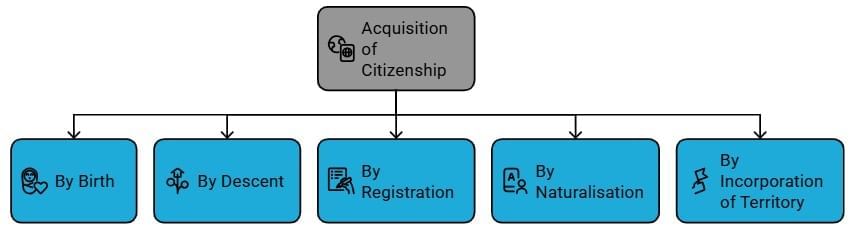
(A) By Birth
- A person born in India on or after 26th January 1950 but before 1st July 1987 is a citizen of India by birth irrespective of the nationality of his parents.
- A person born in India on or after 1st July 1987 is considered as a citizen of India only if either of his parents is a citizen of India at the time of his birth.
(B) By Descent
- A person born outside India on or after 26th January 1950 but before 10th December 1992 is a citizen of India by descent, if his father was a citizen of India at the time of his birth.
- A person born 3rd December 2004 onwards, a person born outside India shall not be a citizen of India by descent, unless his birth is registered at an Indian consulate within one year of the date of birth or with the permission of the Central Government,.
(C) By Registration
- A person of Indian origin who is ordinarily resident in India for seven years before making an application for registration;
- A person who is married to a citizen of India and is ordinarily resident in India for seven years before making an application for registration;
- A person of full age and capacity whose parents are registered as citizens of India.
(D) By Naturalisation
The Central Government may, on an application, grant a certificate of naturalisation to any person (not being an illegal migrant) if he possesses the following qualifications:
- that he is not a subject or citizen of any country where citizens of India are prevented from becoming subjects or citizens of that country by naturalisation;
- that, if he is a citizen of any country, he undertakes to renounce the citizenship of that country in the event of his application for Indian citizenship being accepted;
- that during the fourteen years immediately preceding the said period of twelve months, he has either resided in India or been in the service of a Government in India, or partly the one and partly the other, for periods amounting in the aggregate to not less than eleven years.
(E) By Incorporation of Territory
- If any foreign territory becomes a part of India, the Government of India specifies the persons who among the people of the territory shall be the citizens of India. Such persons become the citizens of India from the notified date.
- An example includes the Citizenship (Pondicherry) Order (1962) for Pondicherry's incorporation.
Special Provisions
- Assam Accord and Migrants: Special provisions apply to persons covered by the Assam Accord, granting citizenship based on residency and registration.
- Migrants from Afghanistan, Bangladesh, or Pakistan:
(i) Recent amendments allow citizenship for migrants belonging to specified communities who entered India before December 31, 2014.
(ii) Exemptions from certain penal consequences and eligibility for long-term visas were granted before the Citizenship (Amendment) Act, 2019.
Loss of Citizenship
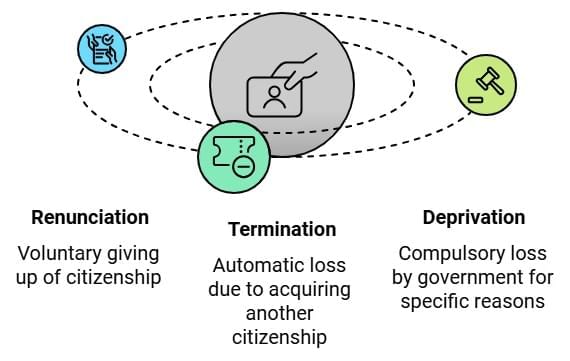
(A) By Renunciation:
- Any citizen of India of full age and capacity can make a declaration renouncing his Indian citizenship. Upon the registration of that declaration, that person ceases to be a citizen of India.
- Exceptions exist during wartime.
(B) By Termination:
- When an Indian citizen voluntarily (consciously, knowingly and without duress, undue influence or compulsion) acquires the citizenship of another country, his Indian citizenship automatically terminates.
- Exceptions exist during wartime.
(C) By Deprivation:
- It is a compulsory termination of Indian citizenship by the Central government, if: by fraud, the citizen has unlawfully traded or communicated with the enemy during a war, the citizen has been ordinarily resident out of India for seven years continuously.
Overseas Citizenship of India
- In September 2000, the Indian Government established a High-Level Committee on the Indian Diaspora chaired by L.M. Singhvi.
- The committee aimed to study the global Indian diaspora comprehensively and propose measures for a constructive relationship.
- It recommended amending the Citizenship Act (1955) to grant dual citizenship to Persons of Indian Origin (PIOs) from certain countries.
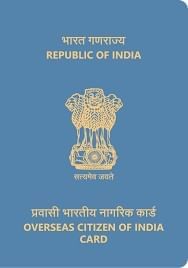
- The Citizenship (Amendment) Act, 2003, allowed PIOs from 16 specified countries (excluding Pakistan and Bangladesh) to acquire Overseas Citizenship of India (OCI).
- The act also removed provisions related to Commonwealth Citizenship from the Principal Act.
- The Citizenship (Amendment) Act, 2005, expanded OCI eligibility for PIOs from all countries allowing dual citizenship under their laws.
- The OCI is not technically dual citizenship due to constitutional restrictions.
- The Citizenship (Amendment) Act, 2015, merged the PIO card scheme and OCI card scheme into a single "Overseas Citizen of India Cardholder" scheme.
- This was done to address confusion and enhance facilities for applicants.
- The PIO scheme was terminated on January 9, 2015, and all existing PIO cardholders were considered OCI cardholders from that date.
The Citizenship (Amendment) Act of 2015 introduced a change in terminology, substituting "Overseas Citizen of India" with "Overseas Citizen of India Cardholder," and included the following provisions in the Principal Act:
Registration of Overseas Citizen of India Cardholder
The Central Government may register individuals as overseas citizens of India cardholders if they meet certain criteria:
- Individuals who were Indian citizens at the time of or after the commencement of the Constitution, or were eligible for Indian citizenship at that time.
- Individuals who were citizens of another country but belonged to a territory that became part of India after August 15, 1947.
- Minor children of eligible individuals, or individuals whose both parents are Indian citizens or one parent is an Indian citizen.
- Spouses of foreign origin of Indian citizens or overseas citizens of India cardholders, provided their marriage has been registered for at least two years.
- However, individuals or their ancestors from Pakistan, Bangladesh, or specified countries are not eligible for registration.
Conferment of Rights on Overseas Citizen of India Cardholder
- Overseas citizen of India cardholders are entitled to certain rights as specified by the Central Government.
- They are not entitled to certain rights granted to Indian citizens, such as equality of opportunity in public employment, eligibility for certain political positions, registration as a voter, or membership in legislative bodies.
Renunciation of Overseas Citizen of India Card
- Cardholders have the option to renounce their overseas citizen status by making a declaration.
- Once the declaration is registered by the Central Government, the individual ceases to be an overseascitizen of India cardholder.
- Additionally, the spouse and minor children of the cardholder also lose their overseas citizen status upon renunciation.
Cancellation of Registration as Overseas Citizen of India Cardholder:
- The Central Government has the authority to cancel the registration of a person as an overseas citizen of India cardholder under various circumstances.
- These circumstances include obtaining registration through fraudulent means, showing disaffection towards the Indian Constitution, engaging in unlawful activities during wartime, violating citizenship laws, imprisonment, or actions deemed against national security or public welfare.
- Before cancellation, the individual has the right to be heard, as per the provisions added by the Citizenship (Amendment) Act, 2019.
|
150 videos|780 docs|202 tests
|
FAQs on Laxmikanth Summary: Citizenship - Indian Polity for UPSC CSE
| 1. What are the constitutional provisions related to single citizenship in India? |  |
| 2. What is the Citizenship Act of 1955 and how does it impact Indian citizenship? | |
| 3. What is the Overseas Citizenship of India (OCI) and how does it differ from Indian citizenship? | |
| 4. How is the concept of single citizenship significant in the context of Indian federalism? | |
| 5. Can a person hold dual citizenship in India? | |




Free
,mock tests for examination
,practice quizzes
,shortcuts and tricks
,past year papers
,Exam
,Objective type Questions
,Summary
,Laxmikanth Summary: Citizenship | Indian Polity for UPSC CSE
,MCQs
,study material
,Sample Paper
,video lectures
,Extra Questions
,Previous Year Questions with Solutions
,Laxmikanth Summary: Citizenship | Indian Polity for UPSC CSE
,Important questions
,Laxmikanth Summary: Citizenship | Indian Polity for UPSC CSE
,ppt
,Semester Notes
,Viva Questions
;



Laxmikanth Summary: Citizenship Free PDF Download
Importance of Laxmikanth Summary: Citizenship
Laxmikanth Summary: Citizenship Notes
Laxmikanth Summary: Citizenship UPSC Questions
Study Laxmikanth Summary: Citizenship on the App
|
© EduRev
|
Education Revolution
|


|




within 7 days!