NEET Exam > NEET Notes > Chemistry Class 11 > Mind Map: Classification of Elements & Periodicity in Properties
Mind Map: Classification of Elements & Periodicity in Properties | Chemistry Class 11 - NEET PDF Download

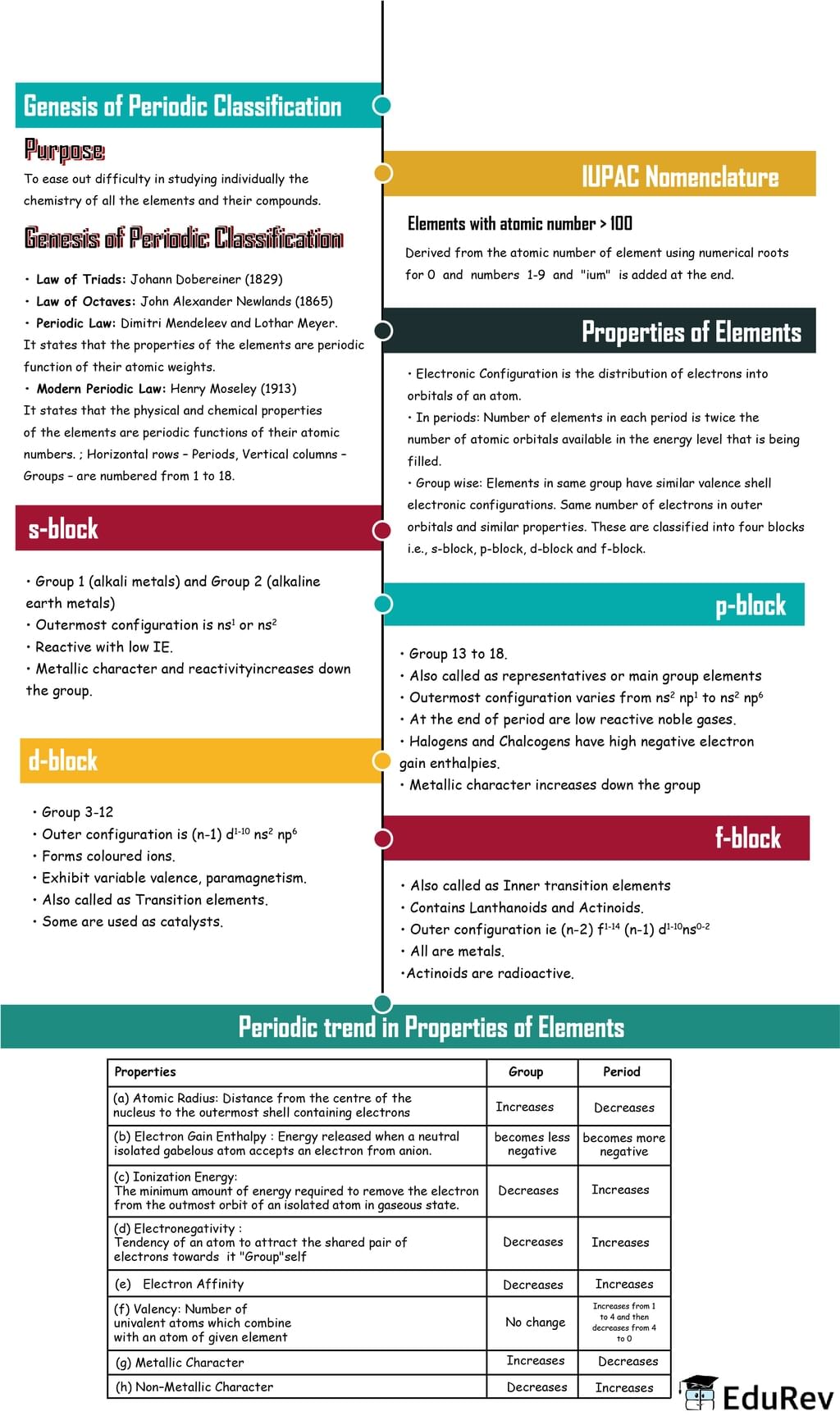
The document Mind Map: Classification of Elements & Periodicity in Properties | Chemistry Class 11 - NEET is a part of the NEET Course Chemistry Class 11.
All you need of NEET at this link: NEET
|
114 videos|263 docs|74 tests
|
FAQs on Mind Map: Classification of Elements & Periodicity in Properties - Chemistry Class 11 - NEET
| 1. What is the periodic table and why is it important? |  |
Ans. The periodic table is a tabular arrangement of chemical elements, organized based on their atomic numbers, electron configurations, and recurring chemical properties. It is important because it provides a systematic way to understand and predict the behavior of elements, their atomic structures, and their relationships with other elements.
| 2. How are elements classified in the periodic table? | |
Ans. Elements in the periodic table are classified into groups and periods. Groups represent columns and share similar properties due to the same number of valence electrons, while periods represent rows and indicate the energy level of the outermost shell. The classification is based on the electronic configuration and recurring chemical properties.
| 3. What are the trends in periodicity of properties across a period? | |
Ans. Across a period, the general trends in periodicity of properties include an increase in the number of protons, electrons, and atomic mass, as well as a decrease in atomic radius. Additionally, there is a gradual shift from metallic to non-metallic character, increasing electronegativity, and decreasing reactivity with metals becoming less reactive and non-metals becoming more reactive.
| 4. How do elements in the same group show similar properties? | |
Ans. Elements in the same group share similar properties because they have the same number of valence electrons, which determines the chemical behavior of an element. The valence electrons are located in the outermost energy level, and elements with the same number of valence electrons tend to have similar reactivity, chemical bonding, and physical properties.
| 5. What is the significance of the periodic law in understanding element properties? | |
Ans. The periodic law states that the properties of elements are periodic functions of their atomic numbers. This law provides a fundamental basis for understanding and predicting the behavior of elements. It allows scientists to organize elements in a meaningful and systematic way, revealing trends and patterns in their properties, such as atomic radius, electronegativity, ionization energy, and more.
About this Document

6.5K Views

4.88/5
Rating

Oct 19, 2025
Last updated
Document Description: Mind Map: Classification of Elements & Periodicity in Properties for NEET 2025 is part of Chemistry Class 11 preparation.
The notes and questions for Mind Map: Classification of Elements & Periodicity in Properties have been prepared according to the NEET exam syllabus. Information about Mind Map: Classification of Elements & Periodicity in Properties covers topics
like and Mind Map: Classification of Elements & Periodicity in Properties Example, for NEET 2025 Exam. Find important definitions, questions, notes, meanings, examples, exercises and tests below for Mind Map: Classification of Elements & Periodicity in Properties.
Introduction of Mind Map: Classification of Elements & Periodicity in Properties in English is available as part of our Chemistry Class 11
for NEET & Mind Map: Classification of Elements & Periodicity in Properties in Hindi for Chemistry Class 11 course.
Download more important topics related with notes, lectures and mock test series for NEET
Exam by signing up for free. NEET: Mind Map: Classification of Elements & Periodicity in Properties | Chemistry Class 11 - NEET
Description
Full syllabus notes, lecture & questions for Mind Map: Classification of Elements & Periodicity in Properties | Chemistry Class 11 - NEET - NEET | Plus excerises question with solution to help you revise complete syllabus for Chemistry Class 11 | Best notes, free PDF download
Information about Mind Map: Classification of Elements & Periodicity in Properties
In this doc you can find the meaning of Mind Map: Classification of Elements & Periodicity in Properties defined & explained in the simplest way possible. Besides explaining types of
Mind Map: Classification of Elements & Periodicity in Properties theory, EduRev gives you an ample number of questions to practice Mind Map: Classification of Elements & Periodicity in Properties tests, examples and also practice NEET
tests


Related Searches
Mind Map: Classification of Elements & Periodicity in Properties | Chemistry Class 11 - NEET
,mock tests for examination
,Important questions
,Objective type Questions
,practice quizzes
,past year papers
,Free
,video lectures
,Mind Map: Classification of Elements & Periodicity in Properties | Chemistry Class 11 - NEET
,Previous Year Questions with Solutions
,Mind Map: Classification of Elements & Periodicity in Properties | Chemistry Class 11 - NEET
,ppt
,study material
,Extra Questions
,Sample Paper
,shortcuts and tricks
,Summary
,Exam
,Semester Notes
,MCQs
,Viva Questions
;



Additional Information about Mind Map: Classification of Elements & Periodicity in Properties for NEET Preparation
Mind Map: Classification of Elements & Periodicity in Properties Free PDF Download
The Mind Map: Classification of Elements & Periodicity in Properties is an invaluable resource that delves deep into the core of the NEET exam.
These study notes are curated by experts and cover all the essential topics and concepts, making your preparation more efficient and effective.
With the help of these notes, you can grasp complex subjects quickly, revise important points easily,
and reinforce your understanding of key concepts. The study notes are presented in a concise and easy-to-understand manner,
allowing you to optimize your learning process. Whether you're looking for best-recommended books, sample papers, study material,
or toppers' notes, this PDF has got you covered. Download the Mind Map: Classification of Elements & Periodicity in Properties now and kickstart your journey towards success in the NEET exam.
Importance of Mind Map: Classification of Elements & Periodicity in Properties
The importance of Mind Map: Classification of Elements & Periodicity in Properties cannot be overstated, especially for NEET aspirants.
This document holds the key to success in the NEET exam.
It offers a detailed understanding of the concept, providing invaluable insights into the topic.
By knowing the concepts well in advance, students can plan their preparation effectively.
Utilize this indispensable guide for a well-rounded preparation and achieve your desired results.
Mind Map: Classification of Elements & Periodicity in Properties Notes
Mind Map: Classification of Elements & Periodicity in Properties Notes offer in-depth insights into the specific topic to help you master it with ease.
This comprehensive document covers all aspects related to Mind Map: Classification of Elements & Periodicity in Properties.
It includes detailed information about the exam syllabus, recommended books, and study materials for a well-rounded preparation.
Practice papers and question papers enable you to assess your progress effectively.
Additionally, the paper analysis provides valuable tips for tackling the exam strategically.
Access to Toppers' notes gives you an edge in understanding complex concepts.
Whether you're a beginner or aiming for advanced proficiency, Mind Map: Classification of Elements & Periodicity in Properties Notes on EduRev are your ultimate resource for success.
Mind Map: Classification of Elements & Periodicity in Properties NEET Questions
The "Mind Map: Classification of Elements & Periodicity in Properties NEET Questions" guide is a valuable resource for all aspiring students preparing for the
NEET exam. It focuses on providing a wide range of practice questions to help students gauge
their understanding of the exam topics. These questions cover the entire syllabus, ensuring comprehensive preparation.
The guide includes previous years' question papers for students to familiarize themselves with the exam's format and difficulty level.
Additionally, it offers subject-specific question banks, allowing students to focus on weak areas and improve their performance.
Study Mind Map: Classification of Elements & Periodicity in Properties on the App
Students of NEET can study Mind Map: Classification of Elements & Periodicity in Properties alongwith tests & analysis from the EduRev app,
which will help them while preparing for their exam. Apart from the Mind Map: Classification of Elements & Periodicity in Properties,
students can also utilize the EduRev App for other study materials such as previous year question papers, syllabus, important questions, etc.
The EduRev App will make your learning easier as you can access it from anywhere you want.
The content of Mind Map: Classification of Elements & Periodicity in Properties is prepared as per the latest NEET syllabus.
|
© EduRev
|
Education Revolution
|


|




Signup on EduRev and stay on top of your study goals
10M+ students crushing their study goals daily