Important Formula: Percentages | CSAT Preparation - UPSC PDF Download
| Table of contents |

|
| Percentage |
|
| Calculating the Percentage of a Number |
|
| How to Convert Fractions to Percentages? |
|
| Solved Examples |
|

Percentage
Percentage basically means a part per hundred. A fraction whose denominator is 100 is called a percentage .
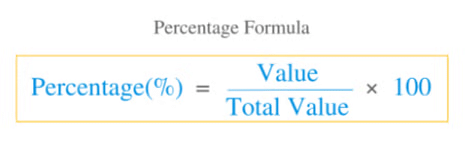
To determine the percentage, we have to divide the value by the total value and then multiply the resultant by 100.
Percentage formula = (Value/Total value) × 100 |
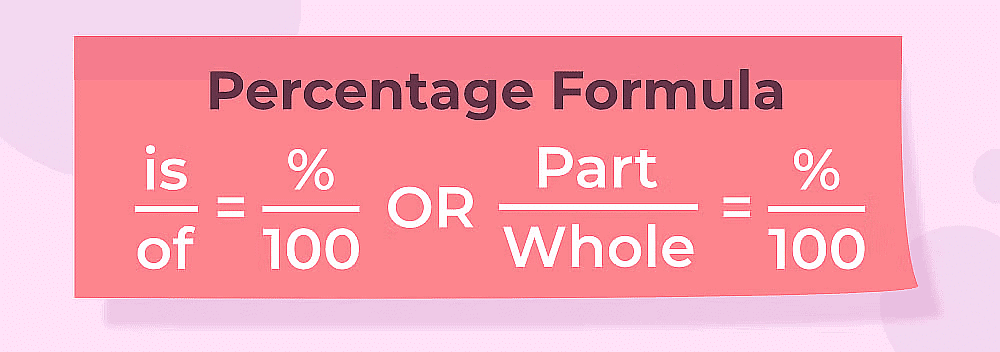
It is represented by % symbol. In all the fractions where the denominator is 100 we remove the denominator and put the % sign.
Calculating the Percentage of a Number
To calculate the percentage of a number, we need to use a different formula such as:
P% of Number = X
where X is the required percentage.
If we remove the % sign, then we need to express the above formulas as;
P/100 * Number = X
Let us understand with help of some examples.
Example: Calculate 10% of 80.
Solution:Let 10% of 80 = X10/100 * 80 = X
X = 8
Example:The number 450 is what percentage of 1200?
Solution: = (450/1200) × 100By simplifying the fraction, we get
= (3/8) × 100
= 0.375 × 100
= 37.5%
So, the number 450 is 37.5% of 1200.
Example: Convert 0.32 to percentage.
Solution:Multiplying 0.32 by 100, we get 0.32 × 100 = 32% as the answer.Example: Convert the fraction 23/25 to percentage.
Solution: Converting 23/25 to a decimal value, we get 0.92.So, 0.92 × 100 = 92% is the answer.
Percentage Forumulas
(i) Percentage Increase
The percentage increase is equal to the subtraction of the original number from a new number, divided by the original number and multiplied by 100.
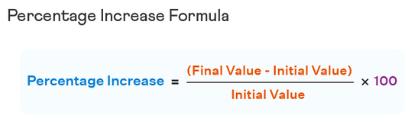
% increase = [(New number – Original number)/Original number] x 100
where, increase in number = New number – original number
(ii) Percentage Decrease
Similarly, a percentage decrease is equal to the subtraction of a new number from the original number, divided by the original number and multiplied by 100.
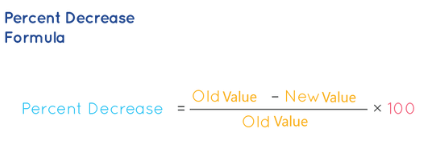
% decrease = [(Original number – New number)/Original number] x 100
Where decrease in number = Original number – New number
(iii)Percentage Formula in terms of a Fraction
To transform a fraction into a percentage divide the top/numerator number by the bottom/denominator number and lastly multiply the result by 100%.
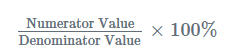
(iv)Percentage Change Formula
Sometimes when it is required to get the increase or decrease in any quantity as percentages, which is also directed to as percentage change is given by the formula:

How to Convert Fractions to Percentages?
A fraction can be represented by x/y and can be converted into percentage by the below formula: x/y * 100
Therefore by the formula, it is clear that we can convert fraction to percentage merely by multiplying the given fraction by 100.
Steps to Convert a Fraction into a Percentage
Step 1: Convert the Fraction to a Decimal
Divide the numerator (top number) by the denominator (bottom number).
Example: 3 ÷ 4 = 0.75
Step 2: Multiply the Decimal by 100
0.75 × 100 = 75
Step 3: Add the Percent Symbol
The final answer is 75%
Note: To convert percentages into fraction, divide it by 100.
Example: 25% = 25/100 = ¼
To convert a fraction into percentage, multiply in by 100.
Percentage Table
Some common fraction and their percentages equivalents are given below.
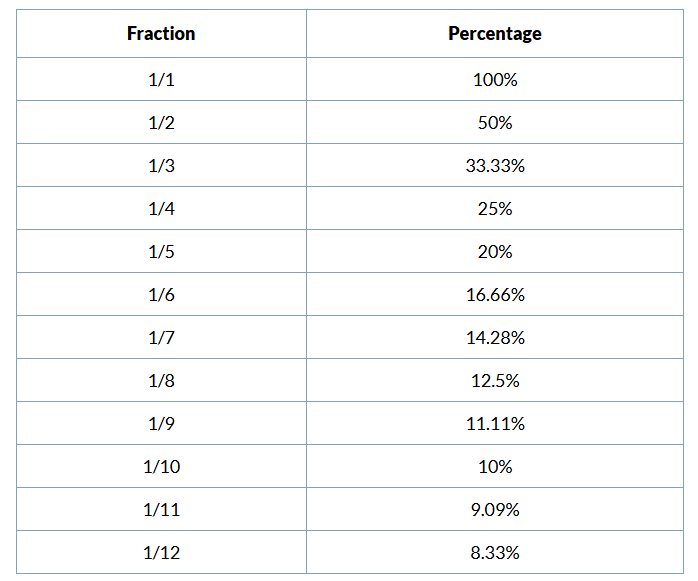
Solved Examples
Question 1: Peaches are now 50% more expensive at Reliance Smart Point. By what percentage must consumption be reduced so that total expenditure on peaches remains unchanged?
(a) 35%
(b) 35.50%
(c) 33.33%
(d) 32.50%
 View Answer
Correct option: C (33.33%)
Required reduction = [ r / (100 + r) ] × 100%
= 50 / 150 × 100 = 33⅓ %.
Question 2: Jason Statham used to save 10% of his income. Two years later his income rose by 20%, yet the rupee amount he saved stayed the same. By what percentage did his expenditure rise?
(a) 22 2⁄9%
(b) 21 5⁄7%
(c) 22 1⁄4%
(d) 23 1⁄9%
View Answer Correct option: A (22 2⁄9%)
Old income = 100 ⇒ savings = 10 ⇒ expenditure = 90.
New income = 120 ⇒ savings still = 10 ⇒ expenditure = 110.
Increase = 20; percentage increase = 20 / 90 × 100 = 22 2⁄9%.
Question 3: To pass the NDA Recruitment Test a candidate must score 290 marks in aggregate. A candidate who scored 203 marks was declared unsuccessful as he fell short by 12% of the maximum aggregate. What is the maximum aggregate?
(a) 750
(b) 725
(c) 700
(d) 675
View Answer Correct option: B (725)
Let maximum aggregate = x.
203 + 0.12 x = 290 ⇒ 0.12 x = 87 ⇒ x = 87 / 0.12 = 725.
Question 4: Robert Pattinson spends 12% of his monthly income on electricity, 25% on food, 20% on his children’s education and 30% on rent. The remaining ₹1 040 is spent on other items. What is his monthly income?
(a) ₹7 500
(b) ₹7 700
(c) ₹7 900
(d) ₹8 000
View Answer Correct option: D (₹8 000)
Percentage already allocated = 12 + 25 + 20 + 30 = 87%.
Remaining = 13% = ₹1 040.
Income = 1 040 / 0.13 = ₹8 000.
Question 5: Yasir’s income is 20% less than Xavier’s. By what percentage does Yasir’s salary fall short of Xavier’s?
(a) 16.66%
(b) 15.50%
(c) 14.45%
(d) 13.45%
View Answer Correct option: A (16.66%)
Assume Yasir = 100. For Yasir to be “20% less”, Xavier must be 120.
Shortfall = 120 − 100 = 20.
Percentage shortfall relative to Xavier = 20 / 120 × 100 ≈ 16.67%. (≈ 16.66%)
|
205 videos|264 docs|136 tests
|
FAQs on Important Formula: Percentages - CSAT Preparation - UPSC
| 1. How do you calculate the percentage of a number? |  |
| 2. What is the formula for calculating percentage increase? | |
| 3. How do you find the percentage decrease? | |
| 4. What is a simple way to express a percentage as a fraction? | |
| 5. Can you explain how to convert a decimal to a percentage? | |




Viva Questions
,Important questions
,Objective type Questions
,Exam
,Important Formula: Percentages | CSAT Preparation - UPSC
,shortcuts and tricks
,Important Formula: Percentages | CSAT Preparation - UPSC
,Important Formula: Percentages | CSAT Preparation - UPSC
,mock tests for examination
,Semester Notes
,ppt
,Previous Year Questions with Solutions
,practice quizzes
,Summary
,MCQs
,Extra Questions
,study material
,video lectures
,Sample Paper
,Free
,past year papers
;




Important Formula: Percentages Free PDF Download
Importance of Important Formula: Percentages
Important Formula: Percentages Notes
Important Formula: Percentages UPSC Questions
Study Important Formula: Percentages on the App
|
© EduRev
|
Education Revolution
|


|




