


Best Study Material for Class 9 Exam
Class 9 Exam > Class 9 Notes > Mathematics (Maths) Class 9 > RD Sharma Solutions: Number System
Number System RD Sharma Solutions | Mathematics (Maths) Class 9 PDF Download
RD Sharma Solutions: Exercise 1.1 - Number System
Q.1. Is zero a rational number? Can you write it in the form p/q, where p and q are integers and q ≠ 0?
Proof: Yes, zero is a rational number because it is either terminating or non-terminating so we can write in the form of p/q, where p and q are natural numbers and q is not equal to zero.
So,
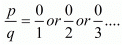
p = 0,q = 1,2,3...
Therefore,
Q.2. Find five rational numbers between 1 and 2.
Proof: We need to find 5 rational numbers between 1 and 2.
Consider,
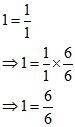
And
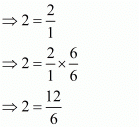
So, five rational numbers between 6/6 and 12/6 will be 7/6, 8/6, 9/6, 10/6, 11/6.
Hence 5 rational numbers between 1 and 2 are: 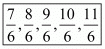 OR
OR 
Q.3. Find six rational numbers between 3 and 4.
Proof: We need to find 6 rational numbers between 3 and 4.
Consider,
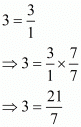
And,
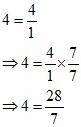
So, six rational numbers between 21/7 and 28/7 will be 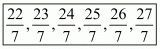
Hence 6 rational numbers between 3 and 4 are 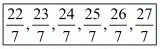
Q.4. Find five rational numbers between  and
and 
Proof: We need to find 5 rational numbers between and
Since, LCM of denominators= LCM (5,5) = 5
So, consider

And,

Hence 5 rational numbers between and are: 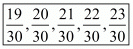 OR
OR 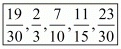
Q.5. Are the following statements true or false? Give reasons for your answer.
(i) Every whole number is a natural number.
(ii) Every integer is a rational number.
(iii) Every rational number is an integer.
(iv) Every natural number is a whole number.
(v) Every integer is a whole number.
(vi) Every rational number is a whole number.
Proof: (i) False, because whole numbers start from zero and natural numbers start from one
(ii) True, because it can be written in the form of a fraction with denominator 1
(iii) False, rational numbers are represented in the form of fractions. Integers can be represented in the form of fractions but all fractions are not integers. for example:  is a rational number but not an integer.
(iv) True, because natural numbers belong to whole numbers
(v) False, because set of whole numbers contains only zero and set of positive integers, whereas set of integers is the collection of zero and all positive and negative integers.
(vi) False, because rational numbers include fractions but set of whole number does not include fractions
RD Sharma Solutions: Exercise 1.2 - Number System
Q.1. Express the following rational numbers as decimals:
(i) 
(ii) 
(iii)
Proof: (i) Given rational number is 
Now we have to express this rational number into decimal form. So we will use long division method as below.
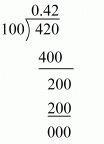
Hence, 
(ii) Given rational number is 
Now we have to express this rational number into decimal form. So we will use long division method as below.
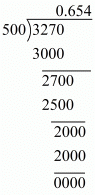
Hence,
(iii) Given rational number is 
Now we have to express this rational number into decimal form. So we will use long division method as below.
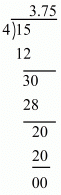
Hence,  = 3.75
Q.2. Express the following rational numbers as decimals:
(i) 
(ii) 
(iii) 
(iv) 
(v) 
(vi) 
Proof: (i) Given rational number is 
Now we have to express this rational number into decimal form. So we will use long division method
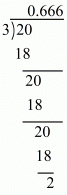
Therefore  = 0.6666

Hence, 
(ii) Given rational number is 
Now we have to express this rational number into decimal form. So we will use long division method
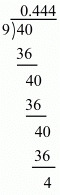
Therefore,  = 0.444
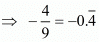
Hence, 
(iii) Given rational number is 
Now we have to express this rational number into decimal form. So we will use long division method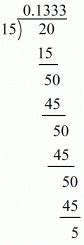
Therefore  = 0.1333

Hence, 
(iv) Given rational number is 
Now we have to express this rational number into decimal form. So we will use long division method
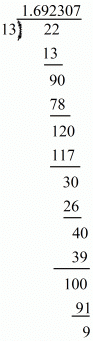
Therefore  =
= 
Hence, 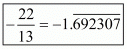
(v) Given rational number is 
Now we have to express this rational number into decimal form. So we will use long division method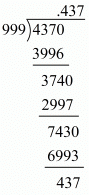
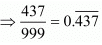
Hence, 
(vi) Given rational number is 
Now we have to express this rational number into decimal form. So we will use long division method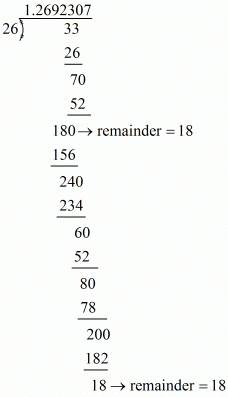
Therefor  =
= 
Hence, 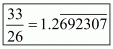
Q.3. Look at several examples of rational numbers in the form  (q ≠0), where p and q are integers with no common factors other than 1 and having terminating decimal representations. Can you guess what property q must satisfy?
Proof: Prime factorization is the process of finding which prime numbers you need to multiply together to get a certain number. So prime factorization of denominators (q) must have only the power of 2 or 5 or both.
RD Sharma Solutions: Exercise 1.3 - Number System
Q.1. Express each of the following decimals in the form  :
:
(i) 0.39
(ii) 0.750
(iii) 2.15
(iv) 7.010
(v) 9.90
(vi) 1.0001
Proof: (i) Given decimal is 0.39
Now we have to convert given decimal number into the  form
form
Let 

Hence, 
(ii) Given decimal is 0.750
Now we have to convert given decimal number into the form
Let 


Hence, 
(iii) Given decimal is 2.15
Now we have to convert given decimal number into the form
Let 


Hence, 
(iv) Given decimal is 7.010
Now we have to convert given decimal number into the form
Let 


Hence, 
(v) Given decimal is 9.90
Now we have to convert given decimal number into the form
Let 


Hence, 9.90 = 99/10
(vi) Given decimal is 1.0001
Now we have to convert given decimal number into the form


Hence, 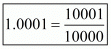
Q.2. Express each of the following decimals in the form :
(i) 
(ii) 
(iii) 
(iv) 
(v) 
(vi) 
(vii) 
Proof: (i) Let 

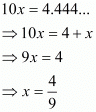
Hence, 
(ii) Let 
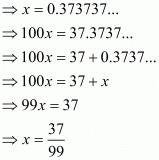
Hence, 
(iii) Let 
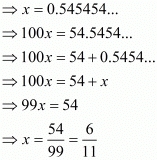
Hence, 
(iv) Let 
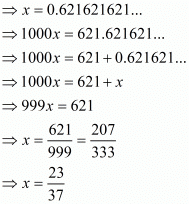
Hence, 
(v) Let 
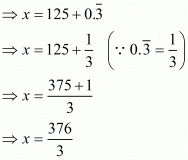
Hence, 
(vi) Let 

Let 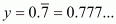
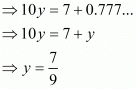
Therefore,

Hence, 
(vii) Let 

Since, 
Therefore,
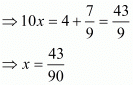
Hence, 
RD Sharma Solutions: Exercise 1.4 - Number System
Q.1. Define an irrational number.
Proof: An irrational number is a real number that cannot be reduced to any ratio between an integer p and a natural number q.
If the decimal representation of an irrational number is non-terminating and non-repeating, then it is called irrational number. For example 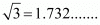
Q.2. Explain, how irrational numbers differ from rational numbers?
Proof:
Every rational number must have either terminating or non-terminating but irrational number must have non- terminating and non-repeating decimal representation.
A rational number is a number that can be written as simple fraction (ratio) and denominator is not equal to zero while an irrational is a number that cannot be written as a ratio.
Q.3. Examine, whether the following numbers are rational or irrational:
(i) √7
(ii) √4
(iii) 2 + √3
(iv)√3 + √2
(v) √3 + √5
(vi) (√ 2 – 2)2
(vii) (2−√2) (2+√2)
(viii) (√2 + √3–√)2
(ix) √5−2
(x) √23
(xi) √225
(xii) 0.3796
(xiii) 7.478478
(xiv) 1.101001000100001
Proof: (i) Let 
Therefore,

It is non-terminating and non-repeating
Hence is an irrational number
(ii) Let 
Therefore,

It is terminating.
Hence is a rational number.
(iii) Let  be the rational
Squaring on both sides
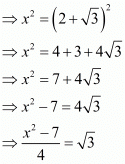
Since, x is rational
 is rational
 is rational
 is rational
 is rational
But, is irrational
So, we arrive at a contradiction.
Hence  is an irrational number
(iv) Let  be the rational number
Squaring on both sides, we get
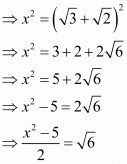
Since, x is a rational number
 is rational number
 is rational number
 is rational number
 is rational number
But  is an irrational number
So, we arrive at contradiction
Hence  is an irrational number
(v) Let  is an irrational number
Squaring on both sides, we get
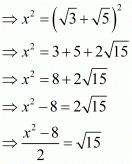
Now, x is rational number
 is rational number
 is rational number
 is rational number
 is rational number
But is an irrational number
So, we arrive at a contradiction
Hence  is an irrational number
(vi) Let  be a rational number.

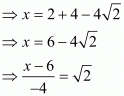
Since, x is rational number,
⇒ x – 6 is a rational number
⇒ is a rational number
⇒ is a rational number
But we know that  is an irrational number, which is a contradiction
So  is an irrational number
(vii) Let 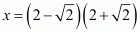
Using the formula 
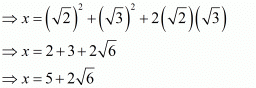

⇒ is a rational number
⇒is  a rational number
But we know that  is an irrational number
So, we arrive at a contradiction
So  is an irrational number.
(ix) Let x = √5−2 be the rational number
Squaring on both sides, we get
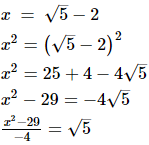
Now, x is rational
x2 is rational.
So, x2−29 is rational

But, √5 is irrational. So we arrive at contradiction
Hence x = √5−2 is an irrational number
(x) Let

It is non-terminating or non-repeating
Hence  is an irrational number
(xi) Let 

Hence  is a rational number
(xii) Given x= 0.3796.
It is terminating
Hence it is a rational number
(xiii) Given number 

It is repeating
Hence it is a rational number
(xiv) Given number is 
It is non-terminating or non-repeating
Hence it is an irrational number
Q.4. Identify the following as rational or irrational numbers. Give the decimal representation of rational numbers:
(i) (√4)
(ii) 3√18
(iii) √1.44
(iv) √927
(v) −√64
(vi) √100
Proof: (i) Given number is x =
x = 2, which is a rational number
(ii) Given number is 
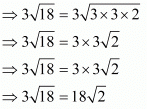
So it is an irrational number
(iii) Given number is 
Now we have to check whether it is rational or irrational
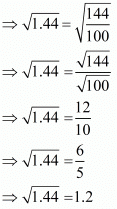
So it is a rational
(iv) Given that 
Now we have to check whether it is rational or irrational
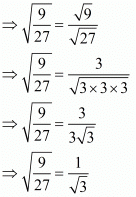
So it is an irrational number
(v) Given that 
Now we have to check whether it is rational or irrational
Since, 
So it is a rational number
(vi) Given that 
Now we have to check whether it is rational or irrational
Since, 
So it is rational number
Q.5. In the following equations, find which variables x, y, z etc. represent rational or irrational numbers:
(i) x2 = 5
(ii) y2 = 9
(iii) z2 = 0.04
(iv) u2 = 17/4
(v) v2 = 3
(vi) w2 = 27
(vii) t2 = 0.4
Proof: (i) Given that 
Now we have to find the value of x

So it x is an irrational number
(ii) Given that 
Now we have to find the value of y

So y is a rational number
(iii) Given that 
Now we have to find the value of z
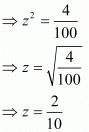

So it is rational number
(iv) Given that 
Now we have to find the value of u
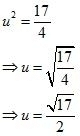
So it is an irrational number
(v) Given that 
Now we have to find the value of v


So it is an irrational number
(vi) Given that 
Now we have to find the value of w
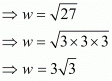
So it is an irrational number
(vii) Given that 
Now we have to find the value of t
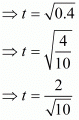
So it is an irrational number
Q.6. Give two rational numbers lying between 0.232332333233332... and 0.212112111211112.
Proof: Let a = 0.232332333233332
b = 0.212112111211112
Here the decimal representation of a and b are non-terminating and non-repeating. So we observe that in first decimal place of a and b have the same digit but digit in the second place of their decimal representation are distinct. And the number a has 3 and b has 1. So a > b.
Hence two rational numbers are  lying between 0.232332333233332... and 0.212112111211112...
Q.7. Give two rational numbers lying between 0.515115111511115...0.5353353335...
Proof: Let a = 0.515115111511115... and b = 0.535335333533335...
Here the decimal representation of a and b are non-terminating and non-repeating. So we observe that in first decimal place a and b have the same digit but digit in the second place of their decimal representation are distinct. And the number a has 1 and b has 3. So a < b.
Hence two rational numbers are  lying between 0.515115111511115.. and 0.535335333533335...
Q.8. Find one irrational number between 0.2101 and 0.222... = 0.2¯.
Proof: Let
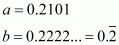
Here a and b are rational numbers .Since a has terminating and b has repeating decimal. We observe that in second decimal place a has 1 and b has 2. So a < b.
Hence one irrational number is  lying between 0.2101 and 0.2222...
Q.9. Find a rational number and also an irrational number lying between the numbers 0.3030030003 ... and 0.3010010001 ...
Proof: Let
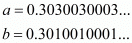
Here decimal representation of a and b are non-terminating and non-repeating. So a and b are irrational numbers. We observe that in first two decimal place of a and b have the same digit but digit in the third place of their decimal representation is distinct.
Therefore, a > b.
Hence one rational number is  lying between 0.3030030003... and 0.3010010001...
And irrational number is  lying between
  and
and 
Q.10. Find three different irrational numbers between the rational numbers  and
and  .
.
Proof: Let 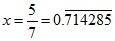 and
and 
Here we observe that in the first decimal x has digit 7 and y has 8. So x < y. In the second decimal place x has digit 1. So, if we considering irrational numbers
a = 0.72072007200072..
b = 0.73073007300073..
c = 0.74074007400074....
We find that
x<a<b<c<y
Hence are required irrational numbers.
Q.11. Give an example of each, of two irrational numbers whose:
(i) difference is a rational number.
(ii) difference is an irrational number.
(iii) sum is a rational number.
(iv) sum is an irrational number.
(v) product is an rational number.
(vi) product is an irrational number.
(vii) quotient is a rational number.
(viii) quotient is an irrational number.
Proof: (i) Let 
And, so 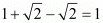
Therefore, and
and  are two irrational numbers and their difference is a rational number
(ii) Let  are two irrational numbers and their difference is an irrational number
Because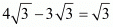 is an irrational number
(iii) Let are two irrational numbers and their sum is a rational number
That is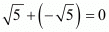
(iv) Let are two irrational numbers and their sum is an irrational number
That is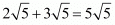
(v) Let  are two irrational numbers and their product is a rational number
That is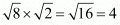
(vi) Let are two irrational numbers and their product is an irrational number
That is
(vii) Let are two irrational numbers and their quotient is a rational number
That is
(viii) Let are two irrational numbers and their quotient is an irrational number
That is 
Q.12. Find two irrational numbers between 0.5 and 0.55.
Proof: Let
a = 0.5
b = 0.55
Here a and b are rational number. So we observe that in first decimal place a and b have same digit .So a < b.
Hence two irrational numbers are and
and
lying between 0.5 and 0.55.
Q.13. Find two irrational numbers lying between 0.1 and 0.12.
Proof: Let
a = 0.1
b = 0.12
Here a and b are rational number. So we observe that in first decimal place a and b have same digit. So a < b.
Hence two irrational numbers are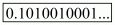 and
and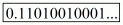 lying between 0.1 and 0.12.
Q.14. Prove that √3 + √5 is an irrational number.
Proof: Given that √3 + √5 is an irrational number
Now we have to prove √3 + √5 is an irrational number
Let x = √3 + √5 is a rational
Squaring on both sides
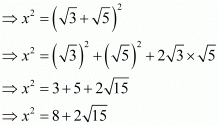
Now x is rational
 is rational
 is rational
 is rational
But, is an irrational
Thus we arrive at contradiction that is a rational which is wrong.
Hence is an irrational
 |
Download the notes
RD Sharma Solutions: Number System
|
Download as PDF |
Download as PDF
RD Sharma Solutions: Exercise 1.5 - Number System
Q.1. Complete the following sentences:
(i) Every point on the number line corresponds to a .... number which many be either ... or ...
(ii) The decimal form of an irrational number is neither ... nor ...
(iii) The decimal representation of a rational number is either ... or ...
(iv) Every real number is either ... number or ... number.
Proof: (i) Every point on the number line corresponds to a real number which may be either rational or an irrational number.
(ii) The decimal form of an irrational number is neither terminating nor repeating.
(iii) The decimal representation of rational number is either terminating, recurring.
(iv) Every real number is either rational number or an irrational number because rational or an irrational number is a family of real number.
Q.2. Find whether the following statement are true or false.
(i) Every real number is either rational or irrational.
(ii) π is an irrational number.
(iii) Irrational numbers cannot be represented by points on the number line.
Proof: (i) True, because rational or an irrational number is a family of real number. So every real number is either rational or an irrational number.
(ii) True, because the decimal representation of an irrational is always non-terminating or non-repeating. So is an irrational number.
(iii) False, because we can represent irrational numbers by points on the number line.
Q.3. Represent √6, √7, √8 on the number line.
Proof: We are asked to represent √6, √7, √8 on the number line
We will follow certain algorithm to represent these numbers on real line
We will consider point A as reference point to measure the distance
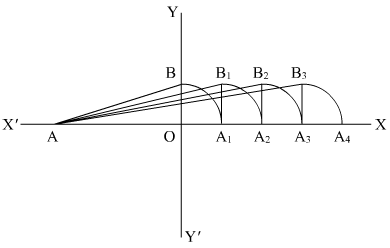
(1) First of all draw a line AX and YY’ perpendicular to AX
(2) Consider AO = 2 units and OB = 1 unit, so

(3) Take A as center and AB as radius, draw an arc which cuts line AX at A1
(4) Draw a perpendicular line A1B1 to AX such that and
and
(5) Take A as center and AB1 as radius and draw an arc which cuts the line AX at A2.
Here
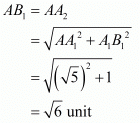
SoAA2 = √6 unit
So A2 is the representation for √6
(1) Draw line A2B2 perpendicular to AX
(2) Take A center and AB2 as radius and draw an arc which cuts the horizontal line at A3 such that
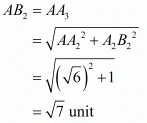
So point A3 is the representation of √7
(3) Again draw the perpendicular line A3B3 to AX
(4) Take A as center and AB3 as radius and draw an arc which cuts the horizontal line at A4
Here;
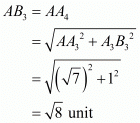
A4 is basically the representation of √8
Q.4. Represent √3.5, √9.4, √10.5 on the real number line.
Proof: We are asked to represent the real numbers √3.5, √9.4, √10.5 on the real number line
We will follow a certain algorithm to represent these numbers on real number line
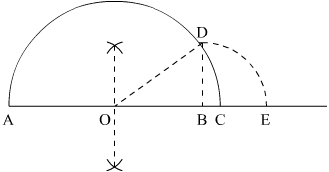
(a) √3.5
We will take A as reference point to measure the distance
(1) Draw a sufficiently large line and mark a point A on it
(2) Take a point B on the line such that AB = 3.5 cm
(3) Mark a point C on the line such that BC = 1 cm
(4) Find mid point of AB and let it be O
(5) Take O as center and OC as radius and draw a semi circle. Draw a perpendicular BD which cuts the semi circle at D
(6) Take B as the center and BD as radius, draw an arc which cuts the horizontal line at E
(7) Point E is the representation of √3.5
(b) √9.4
We will take A as reference point to measure the distance. We will follow the same figure in the part (a)
(1) Draw a sufficiently large line and mark a point A on it
(2) Take a point B on the line such that AB = 9.4 cm
(3) Mark a point C on the line such that BC = 1 cm
(4) Find mid point of AB and let it be O
(5) Take O as center and OC as radius and draw a semi circle. Draw a perpendicular BC which cuts the semi circle at D
(6) Take B as the center and BD as radius, draw an arc which cuts the horizontal line at E
(7) Point E is the representation of √9.4
(c) √10.5
We will take A as reference point to measure the distance. We will follow the same figure in the part (a)
(1) Draw a sufficiently large line and mark a point A on
(2) Take a point B on the line such that AB = 10.5 cm
(3) Mark a point C on the line such that BC = 1 cm
(4) Find mid point of AB and let it be O
(5) Take O as center and OC as radius and draw a semi circle. Draw a perpendicular BC which cuts the semi circle at D
(6) Take B as the center and BD as radius, draw an arc which cuts the horizontal line at E
(7) Point E is the representation of √10.5
 |
Take a Practice Test
Test yourself on topics from Class 9 exam
|
Practice Now |
Practice Now
RD Sharma Solutions: Exercise 1.6 - Number System
Q.1. Visualize 2.665 on the number line, using successive magnification.
Proof:
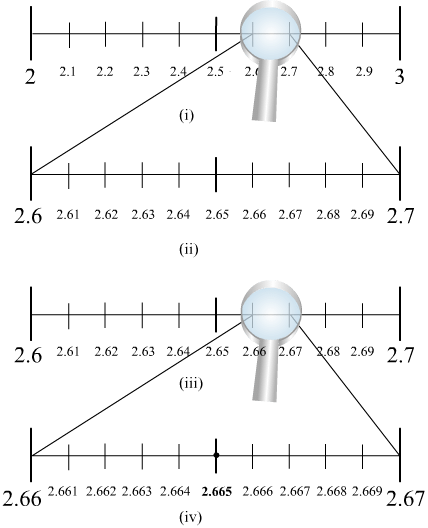
We know that 2.665 lies between 2 and 3. So, we divide the number line into 10 equal parts and mark each point of division. The first mark on the right of 2 will be 2.1 followed by 2.2 and so on. The point left of 3 will be 2.9. Now, the magnified view of this will show that 2.665 lies between 2.6 and 2.7. So, our focus will be now 2.6 and 2.7. We divide this again into 10 equal parts. The first part will be 2.61 followed by 2.62 and so on.
We now magnify this again and find that 2.665 lies between 2.66 and 2.67. So, we magnify this portion and divide it again into 10 equal parts. The first part will represent 2.661, next will be 2.662 and so on. So, 2.665 will be 5th mark in this subdivision as shown in the figure.
Q.2. Visualize the representation of 5.37¯ on the number line up to 5 decimal places, that is up to 5.37777.
Proof:
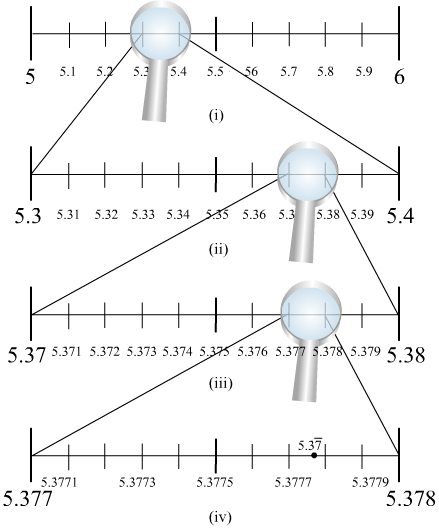
We know that 5.37¯ will lie between 5 and 6. So, we locate 5.37¯ between 5 and 6. We divide this portion of the number line between 5 and 6 into 10 equal parts and use a magnifying glass to visualize 5.37¯ .
5.37¯ lies between 5.37 and 5.38. To visualize 5.37¯ more accurately we use a magnifying glass to visualize between 5.377 and 5.378. Again, we divide the portion between 5.377 and 5.378 into 10 equal parts and visualize more closely to represent 5.37¯ as given in the figure. This is located between 5.3778 and 5.3777.
MULTIPLE CHOICE QUESTIONS(MCQs)
Q.1. Mark the correct alternative in each of the following:
1. Which one of the following is a correct statement?
(a) Decimal expansion of a rational number is terminating
(b) Decimal expansion of a rational number is non-terminating
(c) Decimal expansion of an irrational number is terminating
(d) Decimal expansion of an irrational number is non-terminating and non-repeating
Proof: The decimal expansion of an irrational number is non-terminating and non- repeating. Thus, we can say that a number, whose decimal expansion is non-terminating and non- repeating, called irrational number. And the decimal expansion of rational number is either terminating or repeating. Thus, we can say that a number, whose decimal expansion is either terminating or repeating, is called a rational number.
Hence the correct option is .
.
Q.2. Which one of the following statements is true?
(a) The sum of two irrational numbers is always an irrational number
(b) The sum of two irrational numbers is always a rational number
(c) The sum of two irrational numbers may be a rational number or an irrational number
(d) The sum of two irrational numbers is always an integer
Proof: Since, and
and are two irrational number and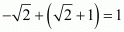
Therefore, sum of two irrational numbers may be rational
Now, let and
and be two irrational numbers and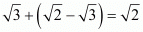
Therefore, sum of two irrational number may be irrational
Hence the correct option is .
.
Q.3. Which of the following is a correct statement?
(a) Sum of two irrational numbers is always irrational
(b) Sum of a rational and irrational number is always an irrational number
(c) Square of an irrational number is always a rational number
(d) Sum of two rational numbers can never be an integer
Proof: The sum of irrational number and rational number is always irrational number.
Let a be a rational number and b be an irrational number.
Then,
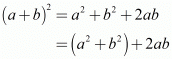
As 2ab is irrational therefore is irrational.
Hence (a + b) is irrational.
Therefore answer is .
.
Q.4. Which of the following statements is true?
(a) Product of two irrational numbers is always irrational
(b) Product of a rational and an irrational number is always irrational
(c) Sum of two irrational numbers can never be irrational
(d) Sum of an integer and a rational number can never be an integer
Proof: Since we know that the product of rational and irrational number is always an irrational. For example: Let are rational and irrational numbers respectively and their product is
Hence the correct option is .
.
Q.5. Which of the following is irrational?
(a) √4 / 9
(b) √4 / 5
(c) √7
(d) √81
Proof: Given that
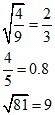
And 7 is not a perfect square.
Hence the correct option is .
.
Q.6. Which of the following is irrational?
(i) 0.14
(ii) 
(iii) 
(iv) 0.1014001400014...
Proof: Given that
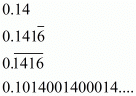
Here 0.1014001400014...is non-terminating or non-repeating. So it is an irrational number.
Hence the correct option is .
.
Q.7. Which of the following is rational?
(a) √3
(b) π
(c) 4/0
(d) 0/4
Proof: Given that
Here, , this is the form of
 So this is a rational number
Hence the correct option is .
.
Q.8. The number 0.318564318564318564 ........ is:
(a) a natural number
(b) an integer
(c) a rational number
(d) an irrational number
Proof: Since the given number is repeating, so it is rational number because rational number is always either terminating or repeating
Hence the correct option is .
.
Q.9. If n is a natural number, then √n is
(a) always a natural number
(b) always an irrational number
(c) always an irrational number
(d) sometimes a natural number and sometimes an irrational number
Proof: The term “natural number” refers either to a member of the set of positive integer 1,2,3.
And natural number starts from one of counting digit .Thus, if n is a natural number then sometimes n is a perfect square and sometimes it is not.
Therefore, sometimes √n is a natural number and sometimes it is an irrational number
Hence the correct option is .
.
Q.10. Which of the following numbers can be represented as non-terminating, repeating decimals?
(a) 39/24
(b) 3/16
(c) 3/11
(d) 137/25
Proof: Given that
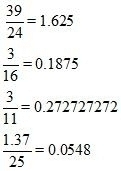
Here is repeating but non-terminating.
Hence the correct option is .
.
Q.11. Every point on a number line represents
(a) a unique real number
(b) a natural number
(c) a rational number
(d) an irrational number
Proof:
In basic mathematics, number line is a picture of straight line on which every point is assumed to correspond to real number.
Hence the correct option is .
.
Q.12. Which of the following is irrational?
(a) 0.15
(b) 0.01516
(c) 
(d) 0.5015001500015.
Proof: Given decimal numbers are

Here the number 0.5015001500015... is non terminating or non-repeating.
Hence the correct option is .
.
Q.13. The number 0.3¯ in the form p/q, where p and q are integers and q ≠ 0, is
(a) 33/100
(b) 3/10
(c) 1/3
(d) 3/100
Proof: Given number is 0.3¯
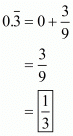
The correct option is
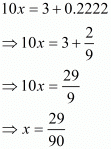
Q.14. 0.32¯ when expressed in the form p/q (p, q are integers q ≠ 0), is
(a) 8/25
(b) 29/90
(c) 32/99
(d) 32/199
Proof: Given that 0.32¯
Now we have to express this number into p/q form
Let X =0.32¯
The correct option is
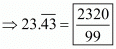
Q.15. 23.43¯ when expressed in the form p/q (p, q are integers q ≠ 0), is
(a) 
(b) 
(c) 
(d) 
Proof: Given that
Now we have to express this number into the form of
Let
x = 23.43
x = 23+0.4343...
x = 23+43 / 99
x=2277+43 / 99
=2320 / 99
The correct option is
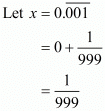
Q.16.  when expressed in the form p/q (p, q are integers, q ≠ 0), is
(a) 
(b) 
(c) 
(d) 
Proof: Given that
Now we have to express this number into from
from
The correct option is
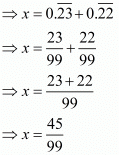
Q.17. The value of is
is
(a) 
(b)
(c)
(d) 0.45
Proof: Given that
Let
Now we have to find the value of x
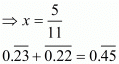
The correct option is
Q.18. An irrational number between 2 and 2.5 is
(a) √11
(b) √5
(c) √22.5
(d) √12.5
Proof: Let
a = 2
b = 2.5
Here a and b are rational numbers. So we observe that in first decimal place a and b have distinct. According to question a < b.so an irrational number between 2 and 2.5 is 2.236067978 OR √5.
Hence the correct answer is
Q.19. The number of consecutive zeros in 23 ×34 ×54 ×7, is
(a) 3
(b) 2
(c) 4
(d) 5
Proof: We are given the following expression and asked to find out the number of consecutive zeros
23 ×34 ×54 ×7
We basically, will focus on the powers of 2 and 5 because the multiplication of these two number gives one zero. So
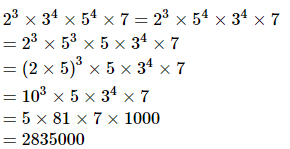
Therefore the consecutive zeros at the last is 3
So the option (a) is correct
Q.20. The smallest rational number by which 1/3 should be multiplied so that its decimal expansion terminates after one place of decimal, is
(a) 1/10
(b) 3/10
(c) 3
(d) 30
Proof: Give number is Now multiplying by
 in the given number, we have
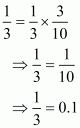
Hence the correct option is
Fill in the Blanks Types Questions(FBQs)
Q.1. The decimal expansion of a rational number is either ______ or _______.
Proof: The decimal expansion of a rational number either terminates after finitely many digits or ends with a repeating sequence.
Hence, the decimal expansion of a rational number is either terminating or recurring.
Q.2. The decimal expansion of an irrational number is non-terminating and _______.
Proof: The decimal expansion of a rational number either terminates after finitely many digits or ends with a repeating sequence.
In case of irrational number, the decimal expansion neither terminates nor repeats after finitely many digits.
Hence, the decimal expansion of an irrational number is non-terminating and non-repeating.
Q.3. The decimal expansion of √2 is _______ and _________.
Proof: √2 is an irrational number.
The decimal expansion of an irrational number neither terminates nor repeats after finitely many digits.
Hence, the decimal expansion of √2 is non-terminating and non-repeating.
Q.4. The value of 1.999. in the form of m/n, where m and n are integers and n ≠ 0, is _______.
Proof: Let x=1.999..... ...(1)
Multiply (1) by 10 on both sides, we get
10x=19.999..... ...(2)
Subtracting (1) from (2), we get
10x−x=19.999....−1.999....
⇒9x=18
⇒x=18/9
⇒x=2/1
Hence, the value of 1.999... in the form of m/n, where m and n are integers and n ≠ 0, is 2/1.
Q.5. Every recurring decimal is a _________ number.
Proof: The decimal expansion of a rational number either terminates after finitely many digits or ends with a repeating sequence.
Hence, every recurring decimal is a rational number.
Q.6. π is an _______ number.
Proof: The decimal expansion of π neither terminates nor repeats after finitely many digits.
Therefore, it is an irrational number.
Hence, π is an irrational number.
Q.7. The product of a non-zero rational number with an irrational number is always an ________ number.
Proof: The product of a non-zero rational number with an irrational number always results in an irrational number.
Hence, the product of a non-zero rational number with an irrational number is always an irrational number.
Q.8. The simplest form of  is _______.
Proof: Let x=1.6666..... ...(1)
Multiply (1) by 10 on both sides, we get
10x=16.6666..... ...(2)
Subtracting (1) from (2), we get
10x−x=16.6666....−1.6666....
⇒9x=15
⇒x=15/9
⇒x=5/3
Hence, the simplest form of is
is 
Q.9.  +
+ is equal to _________.
Proof: Let x=0.3333..... ...(1)
Multiply (1) by 10 on both sides, we get
10x=3.3333..... ...(2)
Subtracting (1) from (2), we get
10x−x=3.333....−0.333....
⇒9x=3
⇒x=3/9 ...(3)
Let y=0.4444..... ...(4)
Multiply (1) by 10 on both sides, we get
10y=4.4444..... ...(5)
Subtracting (4) from (5), we get
10y−y=4.4444....−0.4444....
⇒9y=4
⇒y=4/9 ...(6)
Now, 0.3+0.4 = x+y
=3/9+4/9 (From (3) and (6))
=
Hence, +
+  is equal to
Q.10. The sum of a rational number and an irrational number is ________ number.
Proof: The sum of a rational number and an irrational number always results in an irrational number.
Hence, the sum of a rational number and an irrational number is an irrational number.
Q.11. Every real number is either ________ or _______ number.
Proof: The real number includes all the rational as well as irrational numbers.
Hence, every real number is either rational or irrational number.
The document Number System RD Sharma Solutions | Mathematics (Maths) Class 9 is a part of the Class 9 Course Mathematics (Maths) Class 9.
All you need of Class 9 at this link: Class 9
|
40 videos|420 docs|51 tests
|




FAQs on Number System RD Sharma Solutions - Mathematics (Maths) Class 9
| 1. What is the RD Sharma Solutions: Exercise 1.1 - Number System? |  |
| 2. How can I access the RD Sharma Solutions: Exercise 1.1 - Number System? | |
Ans. You can access the RD Sharma Solutions: Exercise 1.1 - Number System by either purchasing the RD Sharma textbook and referring to the solutions provided at the end of the book or by searching for online platforms or websites that offer the solutions for free or for a fee.
| 3. Are the RD Sharma Solutions: Exercise 1.1 - Number System helpful for exam preparation? | |
Ans. Yes, the RD Sharma Solutions: Exercise 1.1 - Number System can be highly useful for exam preparation. They provide step-by-step solutions to the exercises in the textbook, helping students understand the concepts and practice solving problems. By using these solutions, students can improve their problem-solving skills and become more confident for exams.
| 4. Can I rely solely on the RD Sharma Solutions: Exercise 1.1 - Number System for my exam preparation? | |
Ans. While the RD Sharma Solutions: Exercise 1.1 - Number System can be a valuable resource for exam preparation, it is recommended to use them in conjunction with other study materials. It is essential to understand the concepts thoroughly and practice solving a variety of problems from different sources to ensure a comprehensive preparation for the exam.
| 5. Are there solutions available for all the exercises in the RD Sharma textbook? | |
Ans. Yes, solutions are available for almost all the exercises in the RD Sharma textbook. However, it is advisable to check the specific edition or version of the textbook you are using to ensure that the solutions provided match the exercises in your book. Additionally, some advanced or optional exercises may not have solutions provided.
About this Document

1.9K Views

4.88/5
Rating

Mar 29, 2025
Last updated
Document Description: RD Sharma Solutions: Number System for Class 9 2025 is part of Mathematics (Maths) Class 9 preparation.
The notes and questions for RD Sharma Solutions: Number System have been prepared according to the Class 9 exam syllabus. Information about RD Sharma Solutions: Number System covers topics
like RD Sharma Solutions: Exercise 1.1 - Number System, RD Sharma Solutions: Exercise 1.2 - Number System, RD Sharma Solutions: Exercise 1.3 - Number System, RD Sharma Solutions: Exercise 1.4 - Number System, RD Sharma Solutions: Exercise 1.5 - Number System, RD Sharma Solutions: Exercise 1.6 - Number System, and RD Sharma Solutions: Number System Example, for Class 9 2025 Exam. Find important definitions, questions, notes, meanings, examples, exercises and tests below for RD Sharma Solutions: Number System.
Introduction of RD Sharma Solutions: Number System in English is available as part of our Mathematics (Maths) Class 9
for Class 9 & RD Sharma Solutions: Number System in Hindi for Mathematics (Maths) Class 9 course.
Download more important topics related with notes, lectures and mock test series for Class 9
Exam by signing up for free. Class 9: Number System RD Sharma Solutions | Mathematics (Maths) Class 9
Description
Full syllabus notes, lecture & questions for Number System RD Sharma Solutions | Mathematics (Maths) Class 9 - Class 9 | Plus excerises question with solution to help you revise complete syllabus for Mathematics (Maths) Class 9 | Best notes, free PDF download
Information about RD Sharma Solutions: Number System
In this doc you can find the meaning of RD Sharma Solutions: Number System defined & explained in the simplest way possible. Besides explaining types of
RD Sharma Solutions: Number System theory, EduRev gives you an ample number of questions to practice RD Sharma Solutions: Number System tests, examples and also practice Class 9
tests


Related Searches
Viva Questions
,Summary
,Exam
,study material
,mock tests for examination
,Number System RD Sharma Solutions | Mathematics (Maths) Class 9
,Important questions
,Sample Paper
,practice quizzes
,Number System RD Sharma Solutions | Mathematics (Maths) Class 9
,Extra Questions
,Objective type Questions
,ppt
,shortcuts and tricks
,Number System RD Sharma Solutions | Mathematics (Maths) Class 9
,Free
,Semester Notes
,past year papers
,video lectures
,Previous Year Questions with Solutions
,MCQs
;





Additional Information about RD Sharma Solutions: Number System for Class 9 Preparation
RD Sharma Solutions: Number System Free PDF Download
The RD Sharma Solutions: Number System is an invaluable resource that delves deep into the core of the Class 9 exam.
These study notes are curated by experts and cover all the essential topics and concepts, making your preparation more efficient and effective.
With the help of these notes, you can grasp complex subjects quickly, revise important points easily,
and reinforce your understanding of key concepts. The study notes are presented in a concise and easy-to-understand manner,
allowing you to optimize your learning process. Whether you're looking for best-recommended books, sample papers, study material,
or toppers' notes, this PDF has got you covered. Download the RD Sharma Solutions: Number System now and kickstart your journey towards success in the Class 9 exam.
Importance of RD Sharma Solutions: Number System
The importance of RD Sharma Solutions: Number System cannot be overstated, especially for Class 9 aspirants.
This document holds the key to success in the Class 9 exam.
It offers a detailed understanding of the concept, providing invaluable insights into the topic.
By knowing the concepts well in advance, students can plan their preparation effectively.
Utilize this indispensable guide for a well-rounded preparation and achieve your desired results.
RD Sharma Solutions: Number System Notes
RD Sharma Solutions: Number System Notes offer in-depth insights into the specific topic to help you master it with ease.
This comprehensive document covers all aspects related to RD Sharma Solutions: Number System.
It includes detailed information about the exam syllabus, recommended books, and study materials for a well-rounded preparation.
Practice papers and question papers enable you to assess your progress effectively.
Additionally, the paper analysis provides valuable tips for tackling the exam strategically.
Access to Toppers' notes gives you an edge in understanding complex concepts.
Whether you're a beginner or aiming for advanced proficiency, RD Sharma Solutions: Number System Notes on EduRev are your ultimate resource for success.
RD Sharma Solutions: Number System Class 9 Questions
The "RD Sharma Solutions: Number System Class 9 Questions" guide is a valuable resource for all aspiring students preparing for the
Class 9 exam. It focuses on providing a wide range of practice questions to help students gauge
their understanding of the exam topics. These questions cover the entire syllabus, ensuring comprehensive preparation.
The guide includes previous years' question papers for students to familiarize themselves with the exam's format and difficulty level.
Additionally, it offers subject-specific question banks, allowing students to focus on weak areas and improve their performance.
Study RD Sharma Solutions: Number System on the App
Students of Class 9 can study RD Sharma Solutions: Number System alongwith tests & analysis from the EduRev app,
which will help them while preparing for their exam. Apart from the RD Sharma Solutions: Number System,
students can also utilize the EduRev App for other study materials such as previous year question papers, syllabus, important questions, etc.
The EduRev App will make your learning easier as you can access it from anywhere you want.
The content of RD Sharma Solutions: Number System is prepared as per the latest Class 9 syllabus.
|
© EduRev
|
Education Revolution
|


|








Signup to see your scores
go up within 7 days!
Access 1000+ FREE Docs, Videos and Tests
Takes less than 10 seconds to signup