System Calls | Question Bank for GATE Computer Science Engineering - Computer Science Engineering (CSE) PDF Download
| Table of contents |

|
| Introduction |
|
| How are system calls made? |
|
| How System Calls Work |
|
| Types of System Calls |
|

Introduction
A system call is a way for a user program to interface with the operating system. The program requests several services, and the OS responds by invoking a series of system calls to satisfy the request. A system call can be written in assembly language or a high-level language like C or Pascal. System calls are predefined functions that the operating system may directly invoke if a high-level language is used.
In this article, you will learn about the system calls in the operating system and discuss their types and many other things.
What is a System Call?
- A system call is a method for a computer program to request a service from the kernel of the operating system on which it is running. A system call is a method of interacting with the operating system via programs. A system call is a request from computer software to an operating system's kernel.
- The Application Program Interface (API) connects the operating system's functions to user programs. It acts as a link between the operating system and a process, allowing user-level programs to request operating system services. The kernel system can only be accessed using system calls. System calls are required for any programs that use resources.
How are system calls made?
When a computer software needs to access the operating system's kernel, it makes a system call. The system call uses an API to expose the operating system's services to user programs. It is the only method to access the kernel system. All programs or processes that require resources for execution must use system calls, as they serve as an interface between the operating system and user programs.
Below are some examples of how a system call varies from a user function.
- A system call function may create and use kernel processes to execute the asynchronous processing.
- A system call has greater authority than a standard subroutine. A system call with kernel-mode privilege executes in the kernel protection domain.
- System calls are not permitted to use shared libraries or any symbols that are not present in the kernel protection domain.
- The code and data for system calls are stored in global kernel memory.
Why do you need system calls in Operating System?
There are various situations where you must require system calls in the operating system. Following of the situations are as follows:
- It is must require when a file system wants to create or delete a file.
- Network connections require the system calls to sending and receiving data packets.
- If you want to read or write a file, you need to system calls.
- If you want to access hardware devices, including a printer, scanner, you need a system call.
- System calls are used to create and manage new processes.
How System Calls Work
- The Applications run in an area of memory known as user space. A system call connects to the operating system's kernel, which executes in kernel space. When an application creates a system call, it must first obtain permission from the kernel. It achieves this using an interrupt request, which pauses the current process and transfers control to the kernel.
- If the request is permitted, the kernel performs the requested action, like creating or deleting a file. As input, the application receives the kernel's output. The application resumes the procedure after the input is received. When the operation is finished, the kernel returns the results to the application and then moves data from kernel space to user space in memory.
- A simple system call may take few nanoseconds to provide the result, like retrieving the system date and time. A more complicated system call, such as connecting to a network device, may take a few seconds. Most operating systems launch a distinct kernel thread for each system call to avoid bottlenecks. Modern operating systems are multi-threaded, which means they can handle various system calls at the same time.
Types of System Calls
There are commonly five types of system calls. These are as follows:- Process Control
- File Management
- Device Management
- Information Maintenance
- Communication
Now, you will learn about all the different types of system calls one-by-one.
- Process Control
Process control is the system call that is used to direct the processes. Some process control examples include creating, load, abort, end, execute, process, terminate the process, etc. - File Management
File management is a system call that is used to handle the files. Some file management examples include creating files, delete files, open, close, read, write, etc. - Device Management
Device management is a system call that is used to deal with devices. Some examples of device management include read, device, write, get device attributes, release device, etc. - Information Maintenance
Information maintenance is a system call that is used to maintain information. There are some examples of information maintenance, including getting system data, set time or date, get time or date, set system data, etc. - Communication
Communication is a system call that is used for communication. There are some examples of communication, including create, delete communication connections, send, receive messages, etc.
Examples of Windows and Unix system calls
There are various examples of Windows and Unix system calls. These are as listed below in the table: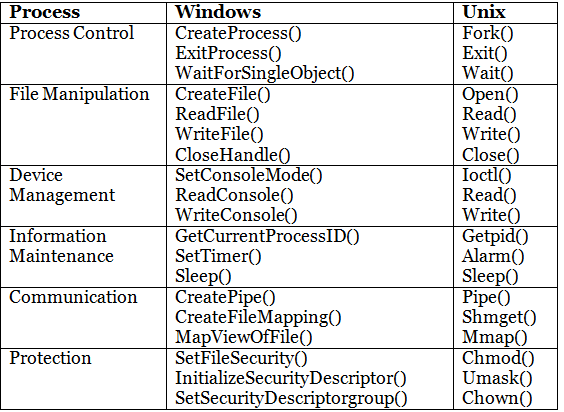
Here, you will learn about some methods briefly:
open()
The open() system call allows you to access a file on a file system. It allocates resources to the file and provides a handle that the process may refer to. Many processes can open a file at once or by a single process only. It's all based on the file system and structure.
read()
It is used to obtain data from a file on the file system. It accepts three arguments in general:
- A file descriptor.
- A buffer to store read data.
- The number of bytes to read from the file.
The file descriptor of the file to be read could be used to identify it and open it using open() before reading.
wait()
In some systems, a process may have to wait for another process to complete its execution before proceeding. When a parent process makes a child process, the parent process execution is suspended until the child process is finished. The wait() system call is used to suspend the parent process. Once the child process has completed its execution, control is returned to the parent process.
write()
It is used to write data from a user buffer to a device like a file. This system call is one way for a program to generate data. It takes three arguments in general:
- A file descriptor.
- A pointer to the buffer in which data is saved.
- The number of bytes to be written from the buffer.
fork()
Processes generate clones of themselves using the fork() system call. It is one of the most common ways to create processes in operating systems. When a parent process spawns a child process, execution of the parent process is interrupted until the child process completes. Once the child process has completed its execution, control is returned to the parent process.
close()
It is used to end file system access. When this system call is invoked, it signifies that the program no longer requires the file, and the buffers are flushed, the file information is altered, and the file resources are de-allocated as a result.
exec()
When an executable file replaces an earlier executable file in an already executing process, this system function is invoked. As a new process is not built, the old process identification stays, but the new process replaces data, stack, data, head, etc.
exit()
The exit() is a system call that is used to end program execution. This call indicates that the thread execution is complete, which is especially useful in multi-threaded environments. The operating system reclaims resources spent by the process following the use of the exit() system function.
|
63 videos|8 docs|165 tests
|
FAQs on System Calls - Question Bank for GATE Computer Science Engineering - Computer Science Engineering (CSE)
| 1. How are system calls made? |  |
| 2. How do system calls work? | |
| 3. What are some common types of system calls? | |
| 4. Why are system calls important in computer science engineering (CSE)? | |
| 5. Can system calls be directly accessed by user programs? | |



|
63 videos|8 docs|165 tests
|
|
Explore Courses for Computer Science Engineering (CSE) exam
|
|
System Calls | Question Bank for GATE Computer Science Engineering - Computer Science Engineering (CSE)
,System Calls | Question Bank for GATE Computer Science Engineering - Computer Science Engineering (CSE)
,Previous Year Questions with Solutions
,ppt
,System Calls | Question Bank for GATE Computer Science Engineering - Computer Science Engineering (CSE)
,Extra Questions
,shortcuts and tricks
,Free
,Important questions
,practice quizzes
,mock tests for examination
,Semester Notes
,Exam
,Objective type Questions
,MCQs
,past year papers
,video lectures
,Sample Paper
,study material
,Summary
,Viva Questions
;




System Calls Free PDF Download
Importance of System Calls
System Calls Notes
System Calls Computer Science Engineering (CSE) Questions
Study System Calls on the App
|
© EduRev
|
Education Revolution
|


|




