
























Best Study Material for Physics Exam
Physics Exam > Physics Notes > Mechanics & General Properties of Matter > Newton's Laws of Motion: Assignment
Newton's Laws of Motion: Assignment | Mechanics & General Properties of Matter - Physics PDF Download
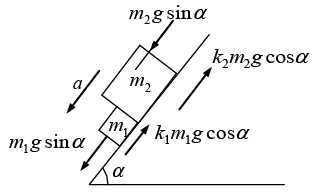
Q.1. Two touching bars 1 and 2 are placed on an inclined plane forming an angle α with the horizontal (Fig). The masses of the bars are equal to m1 and m2, and the coefficients of friction between the inclined plane and these bars are equal to k1 and k2 respectively, with k1 > k2. Find: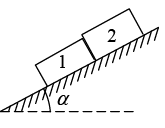 (a) the force of interaction of the bars in the process of motion;
(b) the minimum value of the angle a at which the bars start sliding down.
(a) Pulling force F = m1g sin α + m2g sin α - k1m1g cos α k2m2g cos α
Then acceleration α is:…(i)
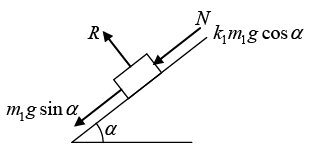
F.B.D of m1:
R is the reaction from the incline and N is the force of interaction between the blocks. Since m1 is sliding, frictional force on it is k1m1g cos α
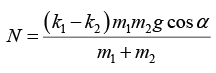
m1g sin α + N - k1m1g cos α = m1α ...(ii)
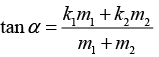
(b) For minimum value of a acceleration will be zero and friction force will be at maximum value then⇒
Q.2. A particle of mass m during its motion in the plane xy according to the law x = a sin ωt, y = b cos ωt, where a, b and ω are constants.
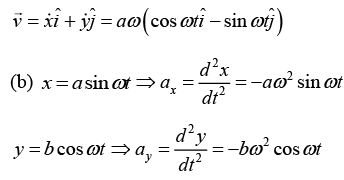
(a) Find the velocity vector
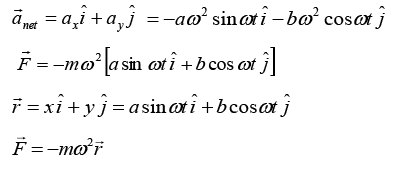
(b) Find the magnitude and direction of the force acting on the particle
(c) Prove that angular motion of the system is conserve
(a)
whereposition vector of particle.
(c) Hence the force is central then angular momentum of system is conserve.
Q.3. A bar of mass m is pulled by means of a thread up an inclined plane forming an angle α with the horizontal (Figure).
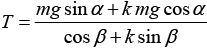
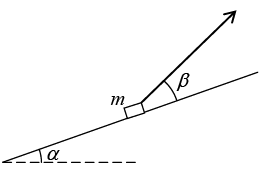 The coefficient of friction is equal to k. Find the angle β which the thread must form with the inclined plane for the tension of the thread to be minimum. What is it equal to?
When block pull up. Direction of friction will be downward.
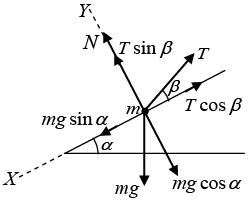
F.B.D. of block:
N = mg cos α - T sin β
fr = k (mg cos α - T sin β)
At just sliding:
T cos β = mg sin α + k(mg cos α - T sin β)
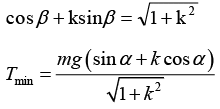
For the minimum value of T, cos β + k sin β should be maximum.
Let f (β) = (cos β + k sin β)
Now, for equilibrium point
∂f(β)/∂β = 0 ⇒ sin β + k cos β = 0 ⇒ tan β = k
Hence maximum value of f (b)
Q.4. In planar polar co-ordinates, an object’s position at time t is given as
(r, θ) = (etm, √8t rad)
(a) Find radial velocity tangential velocity and speed of particle at t = 0
(b) Find radial acceleration tangential acceleration and magnitude of acceleration at t = 0
(r, θ) = (etm, √8t rad)
Speed of particle is given by= √9 = 3m/sec
(b) Magnitude of acceleration- 8 x et at t = 0, 1 - 8 x 1 = -7m/sec2
Magnitude of acceleration is
Q.5. The coefficient of static friction between the two blocks of M of 6 kg and m of 2 kg as shown in figure, is 0.2 and table is smooth. Then maximum horizontal force F that can be applied to the block of mass M so that the two blocks move together.
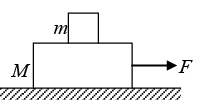
It is given M = 6kg m = 2kg.
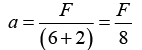
For the two blocks to move together there acceleration should be equal. Let the acceleration of ( M + m ) be a . Then
Using Newton’s law for mass m
f = ma = 2F/8 = F/4
Now f ≤ μN∴ F/4 ≤ 0.2 x 2 x 10 ⇒ F/4 ≤ 4 N ⇒ F ≤ 16 N
Q.6. A particle P of mass m is constrained to move on the surface of cylinder under a force  as shown in figure (k is the positive constant). Which of the following statements is/are correct? (Neglect friction.)
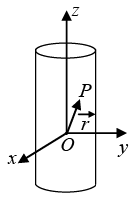 (a) Prove that the force is conservative.
(b) Write the equation of motion along 
(c) Prove that motion along is oscillatory with frequency
(d) Prove that angular momentum of the particle about O is conserved.
(e) Write down expression of the total energy.
(a)
(b) Fr = -kr, Fz = -kz Fθ = 0 so angular momentum conserve
(c) Fz = -kz ⇒= -kz the motion along z is simple harmonic motion with angular
frequency
(d) Fθ = 0, so angular momentum is conserved
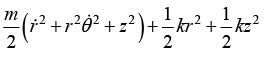
(e) The total energy is given by
Q.7. A book of mass M is positioned against a vertical wall. The coefficient of friction between the book and the wall is μ. You wish to keep the book from falling by pushing on it with a force F applied at an angle θ with respect to the horizontal (-π/2 < θ < π/2), as shown in figure.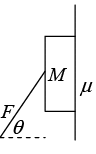 (a) For a given θ, what is the minimum F required.
(b) For what θ is this minimum F the smallest? What is the corresponding minimum F?
(c) What is the limiting value of θ, below which there does not exist an F that keeps the book up?
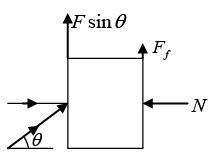
(a) The normal force from the wall is F cos θ, so the friction force Ff holding the book up is at most μF cos θ. Gravitational force, which is Mg , and the vertical component of F , which is F sin θ. If the book is to stay at rest, we must have F sin θ + Ff - Mg = 0.
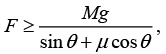
F (sin θ + μ cos θ) ≥ Mg .
Therefore, F must satisfy
assuming that sin θ + μ cos θ is positive. If it is negative then there is no solution for F .
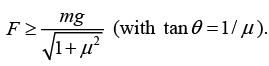
(b) To minimize this lower bound, we must maximize the denominator. Talking the derivative gives cos θ - μ sin θ = 0 ⇒ tan θ = 1/μ. Plugging this value of θ back intoEquation, gives
This is the smallest possible F that keeps the book up, and the angle must be θ = tan-1 (1-μ) for it work. We see that if μ is very small, then to minimize your F , you should push essentially vertically with a force m mg . But if μ is very large, you should push essentially horizontally with a force mg/μ.
(c) There is no possible F that satisfies the condition (if the right-hand side is infinite if the coefficient of F is zero or negative). This occurs when
tan θ = - μ
If θ is more negative than this, then it is impossible to keep the book up, no matter how hard you push.
Q.8. A projectile is fired from the origin O at an angle of 45º from the horizontal as shown in figure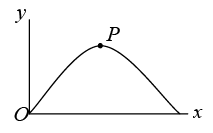 (a) Find the maximum height and range of projectile
(b) At the highest point P of its trajectory find the radial and transverse components of its acceleration in terms of the gravitational acceleration g.
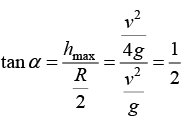
(a) Maximum hmax
where θ = π/4
(b)
From the figure αr = g cos (90 - α) = - g sin α = -g/√5
αθ = - g cos α = -2g/√5
Q.9. A block of mass M rests on a fixed plane inclined at an angle θ. You apply a horizontal force of Mg on the block, as shown in figure. Assume that the friction force between the block and the plane is large enough to keep the block at rest.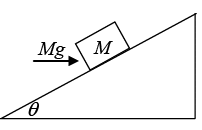 (a) What are the normal and friction forces (call them N and Ff) that the plane exerts on the block?
(b) If the coefficient of static friction is μ, for what range of angles θ will the block in fact remain at rest?
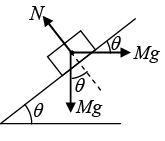
(a) The free body diagram of the block is shown below: The normal force on the block can be calculated using Newton’s second law in the direction perpendicular to the incline.
N - Mg cos θ - Mg sin θ = 0
⇒ N = Mg (sin θ + cos θ)
Maximum value of static frictional force
fs = μMg(sin θ + cos θ)
(b) The coefficient m tells us that |Ff| ≤ μN. Using Eq this inequality becomes
Mg |sin θ - cos θ| ≤ μMg(cos θ + sin θ) ....(1)
The absolute value here signifies that we must consider two cases:
If tan θ ≥ 1, then Eq. (1) becomes
sin θ cos θ ≤ μ(cos θ + sinθ) ⇒ tan θ ≤ 1 + μ/1 - μ.
Q.10. A bead moves along the spoke of a wheel at constant speed u meters per second. The wheel rotates with uniform angular velocity  = ω radians per second about an axis fixed in space. At t = 0, the spoke is along the x-axis and the bead is at the origin.
(a) Find the velocity at time t in polar coordinates
(b) Find the velocity at time t in Cartesian coordinates
(c) Find the acceleration at time t in polar coordinates
(a)
Hence
To specify the velocity completely, we need to know the direction ofThis is obtained from r = (r,θ) = (ut, ωt).
(b) In Cartesian coordinates, we have vx = vr cosθ - vθ cos θ - vθ sin θ and vy = vr + cos θ + vθ cos θ
Since vr = u, vθ = rω = utω, θ = ωt, we obtain
v = (u cos ωt - utω sinωt)+ (u sin ωt - utω cos ωt)
Note how much simpler the result is in plane polar coordinates.
(c) The acceleration is α =
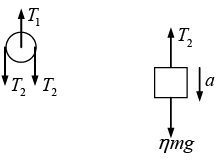
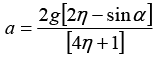
Q.11. Find the acceleration w of body 2 in the arrangement shown in figure, if its mass is η times as great as the mass of 1 and the angle that the inclined plane forms with the horizontal is equal to α. The masses of the pulley and threads, as well as the friction, are assumed to be negligible.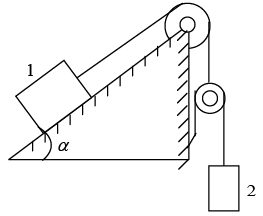
Let acceleration of mass 1 is α1 and acceleration of mass 2 is α2. If mass 1 moves x distance then mass 2 moves 2x distance then 2α1 = α2.
Let α2 = α then α1 = α/2
Force on mass 1:
Using Newton’s second law to the pulley gives T1 = 2T2
Let T1 = T then T2 = T/2
Motion of body (1): T - mg sin α = m(α/2) ...(i)
The force on pulley and mass 2:
Motion of body (2): ηmg - T/2 = ηma ⇒ 2η mg - T = 2η mα ...(ii)
from (i) and (ii):
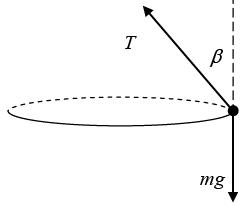
Q.12. A mass hangs from a massless string of length of l. Conditions have been set up so that the mass swings around in a horizontal circle, with the string making a constant angle β with the vertical (see figure). What is the angular frequency, w, of this motion?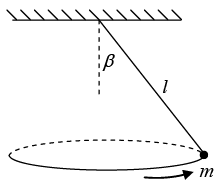
The mass travels in a circle, so the horizontal radial force must be Fr =
≡ mrω2 (with r = ℓ sin β), directed radially inward. The forces on the mass are the tension in the string, T , and gravity, mg (see figure). There is no acceleration in the vertical direction, so F = mα in the vertical and radial directions give, respectively,
T cos β - mg = 0,
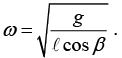
T sin β = m(ℓ sin β)ω2.Solving for ω gives
If β ≈ 90º, then ω ⇢ ∞, which makes sense. And if β ≈ 0, then ω ≈which happens to equal the frequency of a plane pendulum of length ℓ.
Q.13. Find the acceleration of the blocks as shown in figure.
If m1 = 1kg , m2 = 2kg , m3 = 0.5, m4 = 4kg , take g = 10 m/s2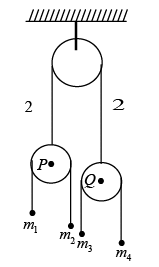
Let a1, a2, a3 and a4 be the downward accelerations of
m1, m2, m3 and m4 respectively.
From Newton’s second law the on masses:1g - T = 1α1 ....(i)
2 g - T= 2α2 .... (ii)
0.5g - T = 0.5α3 ...(iii)
4g - T = 4α4 ...(iv)
From equation of constrain
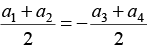
a1 + a2 + a3 + a4 = 0
Where a1 + a2 + a3 + a4 are downward acceleration of respective masses.
Solving these five equations, we get:down
down.
Q.14. A mass, which is free to move on a horizontal frictionless surface, is attached to one end of a massless string that wraps partially around a frictionless vertical pole of radius a (see the top view in figure).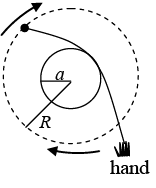
You hold on to the other end of the string. At t = 0, the mass has speed v0 in the tangential direction along the dotted circle of radius R shown. Your task is to pull on the string so that the mass keeps moving along the dotted circle. You are required to do this in such a way that the string remains in contact with the pole at all times. (You will have to move your hand around the pole, of course). What is the speed of the mass as a function time?
Let F be the string. At the mass, the angle between the string and the radius of the dotted circle is θ = sin-1 (α/R). In terms of θ,
the radial and tangential F = mα equations are
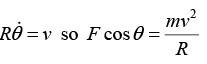
For circular motion
For circular motionDividing these two equations gives tan θ = dv/dt R/v2. Separating variables and integrating gives
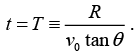
The speed v becomes infinite when
This means that you can keep the mass moving in the desired circle only up to time T . After that, it is impossible, for all practical purpose, long before v becomes infinite). The total distance
d = ∫vdt, is infinite because this integral diverges(barely, like a log) as t approaches T.
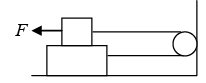
Q.15. The friction coefficient between the two block shown in figure is μ but the floor is smooth.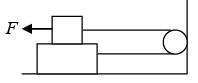 (a) What maximum horizontal force F can be applied without disturbing the equilibrium of the system?
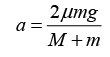
(b) Suppose the horizontal force applied is double that found in part (a). Find the acceleration of the two masses.
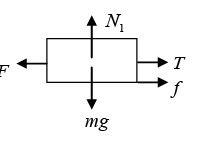
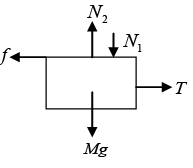
F. B. D at Block m
F - T - f = 0
F = T + fT = f For limiting case f = μmg
F = 2f
F = 2 μmg
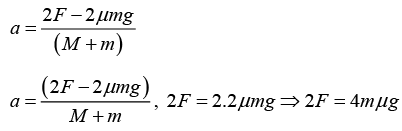
(b) 2F - f - T = mα
T - f = Mα
T - μmg = MαT = Mα + μmg
2F - μmg - Ma - μmg = mα
Q.16. Consider a particle that feels an angular force only, of the form  Show that
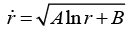
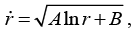 where A and B are constant of integration, determined by the initial condition. (There's nothing all that physical about this force. It simply makes the F = mα equations solvable).
With the given force, equation becomes
The second of these equations gives. Therefore,
where D = eC is a constant of integration, determined by the initial conditions. Substituting this value ofinto the first of equations and then multiplying through by
and integrating, gives
Therefore,
where A ≡ 2D2 and B ≡ 2E.
Q.17. Two blocks A and B of equal mass m are connected through a massless string as shown in figure. Friction is absent everywhere. Now the system is released from the rest,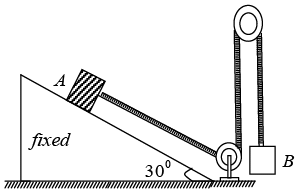 (i) Find the tension in string
(ii) Find acceleration of A
T + mg sin θ = ma ; N = mg cos θ; mg - T = ma
3 equations can be solved for T, N and α
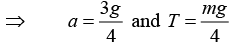
Q.18. A bead slides without friction on a rigid wire rotating at constant angular speed ω. Assume there is not any gravitational field. Find the force exerted by the wire on the bead.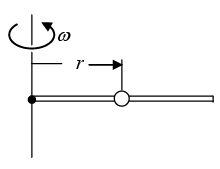
In a coordinate system rotating with the wire the motion is purely radial. The sketch shows the force diagram in the rotating system.
Fcent is the centrifugal force and Fcor is the coriolis force.
Since the wire frictionless, the contact force N is normal to the wire.
(We neglect gravity).
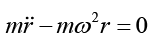
In the rotating system the equations of motion areFcent =
N - Fcor = 0
Using Fcent = mω2r, the first equation gives
which has the solution
r = Aeωt + Be-ωt
where A and B are constants depending on the initial conditions.
The tangential equation of motion, which expresses the fact that there is no tangential acceleration in the rotating system gives
N = Fcor == 2mω2 (Aeωt - Be-ωt
To complete the problem, we must be given the initial conditions which specify A and B.
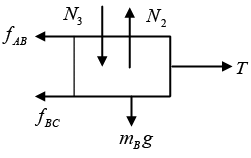
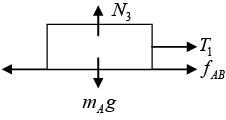
Q.19. In the figure, the blocks A, B and C have masses of 3 kg and 4 kg and 8 kg respectively. The coefficient of friction between any two surfaces is 0.25. A is at rest by a massless rigid rod fixed to the wall, B and C are connected by a light flexible cord around a fixed frictionless pulley. Find the force necessary to drag C along the horizontal surface to the left at a constant speed. Assume that the arrangement is shown in the figure. i.e., B on C and A on B, is maintained throughout.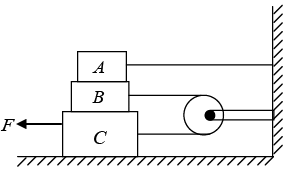
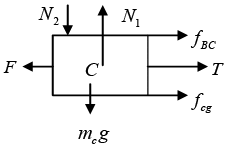
For Block C
N1 Normal force on block C due to ground.
N2 Normal force on block C due to block B.
Fcg is frictional force on block C due to interaction between the ground and block C.
fBC is frictional force on block C due to interaction between surface of block B and C.
N2 + mcg - N1 = 0 (i)
F - fBC - T - fcg = 0 (ii)
For Block B
fBC is frictional force on Block B due to interaction between the surface of blocks B and C.
fAB is frictional force on Block B due to interaction between surface of Block A and B.
N3 is normal force on Block B due to Block A.
- N3 + N2 - mBg = 0 (iii)
fAB + fBC - T = 0 (iv)
N3 = mAg
f AB = μmAg
N2 = N3 + mBg ⇒ N2 = mAg + mBg from (iii)
fBC = μN2 = μ(mAg + mBg
N1 = N2 + Mcg ⇒ N1 = (mA + mB + mC) g from (i)
fcg = μN1 = μ(mA + mB + mc) g
T = fAB + fBC = μ(2mA + mB)g
F = T + fcg + fBC = μ(2mA + mB) g + μ(mA + mB + mC) g + μ(mA + mB)g
F = μ(4mA + 3mB + 2mC) g = 0.25(4.3 + 3.4 + 2.8) (9.8) = 98 N.
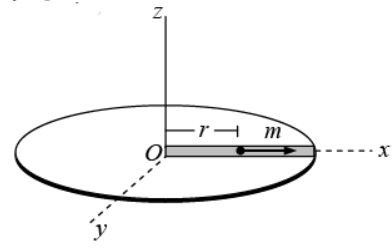
Q.20. A table with smooth horizontal surface is turning at an angular speed ω about its axis. A groove is made on the surface along a radius and a particle is gently placed inside the groove at a distance a from, the centre. Find the speed of the particle with respect to the table as its distance from the centre becomes L.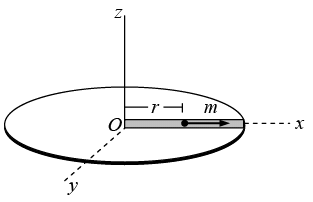
The radial part of acceleration at distance r is given by αr =
Hence there is not any external force in radial direction so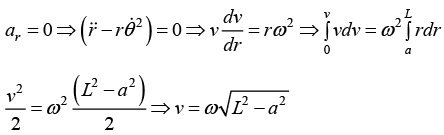
The document Newton's Laws of Motion: Assignment | Mechanics & General Properties of Matter - Physics is a part of the Physics Course Mechanics & General Properties of Matter.
All you need of Physics at this link: Physics
|
61 videos|23 docs|25 tests
|





FAQs on Newton's Laws of Motion: Assignment - Mechanics & General Properties of Matter - Physics
| 1. What are Newton's Laws of Motion? |  |
| 2. What is the significance of Newton's Laws of Motion? | |
Ans. Newton's Laws of Motion have significant importance in understanding and explaining the fundamental principles of motion. They provide a framework to analyze and predict the behavior of objects under the influence of forces. These laws are widely applicable in various fields, including engineering, physics, and everyday life. They form the basis for the study of mechanics and have been instrumental in the development of technologies like spacecraft, automobiles, and bridges.
| 3. How can Newton's Laws of Motion be applied in everyday life? | |
Ans. Newton's Laws of Motion can be observed and applied in various everyday life situations. For example, when a person pushes a shopping cart, the cart moves forward (First Law). When playing sports like soccer, the harder a player kicks the ball, the farther it will travel (Second Law). Similarly, when a person jumps off a diving board, the force exerted downward propels them upward (Third Law). Understanding these laws can help in understanding and improving our interactions with the physical world.
| 4. What are some common misconceptions about Newton's Laws of Motion? | |
Ans. There are several common misconceptions about Newton's Laws of Motion. One misconception is that the laws only apply to objects on Earth, whereas they are universally applicable. Another misconception is that an object can only be in motion if a force is continuously applied to it, whereas an object will remain in motion unless acted upon by an external force (First Law). Additionally, people often confuse mass with weight, assuming that heavier objects will always have more acceleration, ignoring the influence of mass (Second Law).
| 5. Can Newton's Laws of Motion be used to explain phenomena beyond classical mechanics? | |
Ans. Newton's Laws of Motion are primarily applicable to classical mechanics, which deals with macroscopic objects and speeds much slower than the speed of light. However, they are not sufficient to explain phenomena at extreme speeds or at the quantum level. In these cases, more advanced theories like Einstein's theory of relativity or quantum mechanics are required. While Newton's Laws of Motion form a foundation for understanding motion, they have limitations in explaining phenomena beyond the classical realm.
Related Exams
About this Document

1.2K Views

4.76/5
Rating

Apr 05, 2025
Last updated
Document Description: Newton's Laws of Motion: Assignment for Physics 2025 is part of Mechanics & General Properties of Matter preparation.
The notes and questions for Newton's Laws of Motion: Assignment have been prepared according to the Physics exam syllabus. Information about Newton's Laws of Motion: Assignment covers topics
like and Newton's Laws of Motion: Assignment Example, for Physics 2025 Exam. Find important definitions, questions, notes, meanings, examples, exercises and tests below for Newton's Laws of Motion: Assignment.
Introduction of Newton's Laws of Motion: Assignment in English is available as part of our Mechanics & General Properties of Matter
for Physics & Newton's Laws of Motion: Assignment in Hindi for Mechanics & General Properties of Matter course.
Download more important topics related with notes, lectures and mock test series for Physics
Exam by signing up for free. Physics: Newton's Laws of Motion: Assignment | Mechanics & General Properties of Matter - Physics
Description
Full syllabus notes, lecture & questions for Newton's Laws of Motion: Assignment | Mechanics & General Properties of Matter - Physics - Physics | Plus excerises question with solution to help you revise complete syllabus for Mechanics & General Properties of Matter | Best notes, free PDF download
Information about Newton's Laws of Motion: Assignment
In this doc you can find the meaning of Newton's Laws of Motion: Assignment defined & explained in the simplest way possible. Besides explaining types of
Newton's Laws of Motion: Assignment theory, EduRev gives you an ample number of questions to practice Newton's Laws of Motion: Assignment tests, examples and also practice Physics
tests


Related Searches
Sample Paper
,MCQs
,video lectures
,mock tests for examination
,Important questions
,past year papers
,Previous Year Questions with Solutions
,practice quizzes
,Newton's Laws of Motion: Assignment | Mechanics & General Properties of Matter - Physics
,Exam
,shortcuts and tricks
,Extra Questions
,Summary
,Objective type Questions
,Viva Questions
,Newton's Laws of Motion: Assignment | Mechanics & General Properties of Matter - Physics
,study material
,Semester Notes
,Newton's Laws of Motion: Assignment | Mechanics & General Properties of Matter - Physics
,Free
,ppt
;



Additional Information about Newton's Laws of Motion: Assignment for Physics Preparation
Newton's Laws of Motion: Assignment Free PDF Download
The Newton's Laws of Motion: Assignment is an invaluable resource that delves deep into the core of the Physics exam.
These study notes are curated by experts and cover all the essential topics and concepts, making your preparation more efficient and effective.
With the help of these notes, you can grasp complex subjects quickly, revise important points easily,
and reinforce your understanding of key concepts. The study notes are presented in a concise and easy-to-understand manner,
allowing you to optimize your learning process. Whether you're looking for best-recommended books, sample papers, study material,
or toppers' notes, this PDF has got you covered. Download the Newton's Laws of Motion: Assignment now and kickstart your journey towards success in the Physics exam.
Importance of Newton's Laws of Motion: Assignment
The importance of Newton's Laws of Motion: Assignment cannot be overstated, especially for Physics aspirants.
This document holds the key to success in the Physics exam.
It offers a detailed understanding of the concept, providing invaluable insights into the topic.
By knowing the concepts well in advance, students can plan their preparation effectively.
Utilize this indispensable guide for a well-rounded preparation and achieve your desired results.
Newton's Laws of Motion: Assignment Notes
Newton's Laws of Motion: Assignment Notes offer in-depth insights into the specific topic to help you master it with ease.
This comprehensive document covers all aspects related to Newton's Laws of Motion: Assignment.
It includes detailed information about the exam syllabus, recommended books, and study materials for a well-rounded preparation.
Practice papers and question papers enable you to assess your progress effectively.
Additionally, the paper analysis provides valuable tips for tackling the exam strategically.
Access to Toppers' notes gives you an edge in understanding complex concepts.
Whether you're a beginner or aiming for advanced proficiency, Newton's Laws of Motion: Assignment Notes on EduRev are your ultimate resource for success.
Newton's Laws of Motion: Assignment Physics Questions
The "Newton's Laws of Motion: Assignment Physics Questions" guide is a valuable resource for all aspiring students preparing for the
Physics exam. It focuses on providing a wide range of practice questions to help students gauge
their understanding of the exam topics. These questions cover the entire syllabus, ensuring comprehensive preparation.
The guide includes previous years' question papers for students to familiarize themselves with the exam's format and difficulty level.
Additionally, it offers subject-specific question banks, allowing students to focus on weak areas and improve their performance.
Study Newton's Laws of Motion: Assignment on the App
Students of Physics can study Newton's Laws of Motion: Assignment alongwith tests & analysis from the EduRev app,
which will help them while preparing for their exam. Apart from the Newton's Laws of Motion: Assignment,
students can also utilize the EduRev App for other study materials such as previous year question papers, syllabus, important questions, etc.
The EduRev App will make your learning easier as you can access it from anywhere you want.
The content of Newton's Laws of Motion: Assignment is prepared as per the latest Physics syllabus.
|
© EduRev
|
Education Revolution
|


|








Signup on EduRev and stay on top of your study goals
10M+ students crushing their study goals daily