Chapter Notes: Roman Numerals


What are Roman Numerals?
- Romans developed a different system of numeration about 2000 years ago, known as Roman numerals.
- The ancient Romans explained that when a number reaches 10 it is not easy to count on one's fingers. Therefore, there was a need to create a proper number system that could be used for trade and communications.
- Roman numerals are denoted using a different combination of symbols that include the English alphabet.
- There are seven basic Roman Numerals: I, V, X, L, C, D, M.
- These numerals and their corresponding Hindu-Arabic numerals are given below.
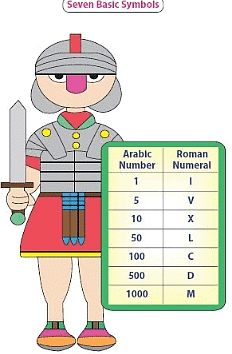 Seven Basic Roman Numerals
Did You Know
In the Roman numeral , system there is no symbol for zero.
Large Roman Numerals
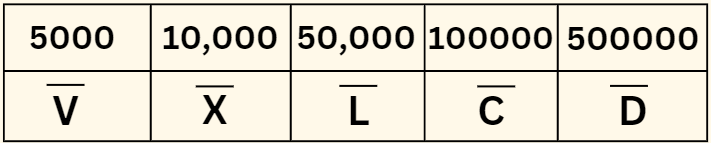
With the help of the chart given below, you can write large numbers in Roman numerals.
 Large numbers in Roman numerals
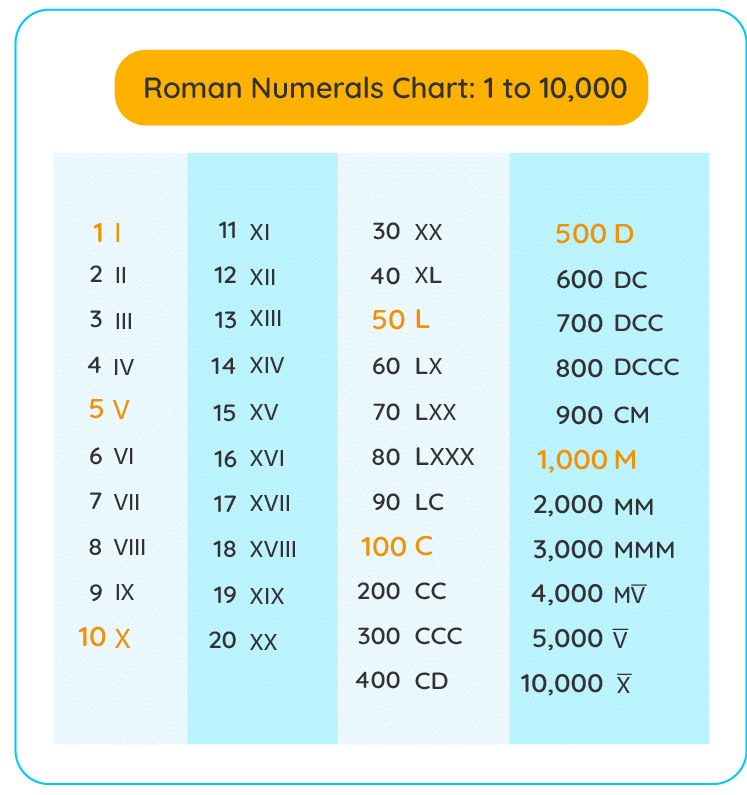
 Chart of Roman Numerals from 1 to 10,000
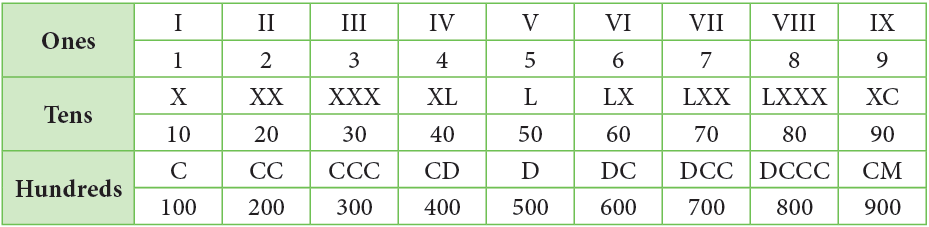
Rules to Write Roman Numerals
We can convert any Roman Numeral into a Hindu-Arabic number, also Hindu-Arabic number can be written in the form of a Roman Numeral. Roman Numerals Chart
Rule 1: Repetition Rule
When a letter is used more than once, we add its value each time to get the number.
Did You Know:
1. The same roman numeral cannot be repeated more than 3 times together.
Example: We represent 3 as III in Roman numerals but we cannot represent 4 as IIII; it is written as IV.
2. The symbols V, L and D are never repeated.

Examples:
II = 1 + 1 = 2
XXX = 10 + 10 + 10 = 30
CCC = 100 + 100 + 100 = 300
MM = 1000 + 1000 = 2000
MMM = 1000 + 1000 + 1000 = 3000
Rule 2: Addition Rule
When a smaller number comes after a larger one, you add both of the numbers.

Examples:
VII = 5 + 1 + 1 = 7
XII = 10 + 1 + 1 = 12
XXVII = 10 + 10 + 5 + 1 + 1 = 27
LVII = 50 + 5 + 1 + 1= 57
LXVI = 50 + 10 + 5 + 1 = 66
CVII = 100 + 5 + 1 + 1 = 107
CLXV = 100 + 50 + 10 + 5 = 165
DC = 500 + 100 = 600
MDCXVIII = 1000 + 500 + 100 + 10 + 5 + 1 + 1 + 1 = 1618
Rule 3: Subtraction Rule
When a smaller number comes before a larger one, you subtract.

Examples:
IV = 5 - 1 = 4
IX = 10 - 1 = 9
XL = 50 - 10 = 40
XC = 100 - 10 = 90
CD = 500 - 100 = 400
CM = 1000 - 100 = 900
Tips:
- V, L, and D are never subtracted.
- I can be subtracted from V and X only once.
- X can be subtracted from L and C only once.
- C can be subtracted from D and M only once.
- Thus, I or V is never written to the left of L or C. L is never written to the left of C.
Rule 4: Bar Rule
1000 can be represented by a line on the letter, which is called a bar.
Example:
Roman Numbers 1 to 100
Following is the list of Roman numerals from 1 to 100.
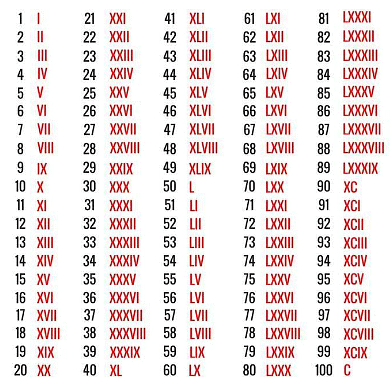
Conversion
We will follow the following steps to convert from Roman Numerals to Arabic Numerals or vice versa.

I. Convert Hindu Arabic to Roman Numeral
Suppose , we have to convert 72 into Roman Numerals.
Step 1: Break down 72 into largest possible tens and ones according to roman numerals:
72 = 50 + 20 + 2Step 2: Convert each part to Roman numerals:
50 = L
20 = XX
2 = IIStep 3: Combine the parts:
72 = LXXII
II. Convert Roman Numeral to Hindu-Arabic Numeral
Suppose, We have to convert XII into a number.Step 1: Write values of the given Roman Numerals
X = 10
II = 2Step 2: Add the Values
10 + 2 = 12Answer: XII = 12
Solved Examples
Example 1: Convert 45 to Roman Numerals
Sol: Step 1: Break down the number into largest tens and ones according to roman numerals that fits into that number:
45 can be broken down into:
45 = 40+5
Step 2: Write Each Part as Roman Numerals
40 = XL(Subtraction Rule used, 40 = 50-10)
5= V
Step 3: Combine the Roman Numerals
After combining, we get : XL+V = XLV
Example 2: Convert 789 to Roman Numerals
Sol: Step 1: Break Down the Number789 can be broken down into:789 = 700+ 80 +9Step 2: Write Each Part as Roman Numerals700 = DCC (Addition rule used, 700 = 500+200)80 = LXXX (Addition rule used,80=50+30)9 = IX (Subtraction Rule used,9=10-1)Step 3: Combine the Roman NumeralsAfter combining, we get: DCC + LXXX + IX = DCCLXXXIX
Example 3: Convert XLII to Hindu-Arabic Numerals
Sol: Step 1: Break Down the Roman Numerals
XL = 40 (This uses the subtraction rule: X before L means 50 - 10 = 40)
II = 2
Step 2: Add the Values
40 + 2 = 42
Answer: XLII = 42
Example 4: Convert CDXLIV to Hindu-Arabic Numerals
Sol: Step 1: Break Down the Roman Numerals
CD = 400 (C before D means 500 - 100 = 400)XL = 40 (X before L means 50 - 10 = 40)
IV = 4 (I before V means 5 - 1 = 4)
Step 2: Add the Values
400 + 40 + 4 = 444
Answer: CDXLIV = 444
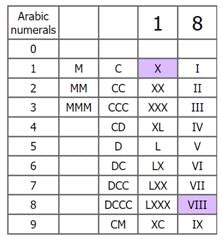
Try yourself: Choose the Roman representation for 18
FAQs on Chapter Notes: Roman Numerals
| 1. How do I write 49 in Roman numerals? |  |
| 2. What's the difference between IV and VI in Roman numerals? | |
| 3. Why can't you write 99 as IC in Roman numerals? | |
| 4. How do I convert large numbers like 2024 into Roman numerals? | |
| 5. What are the seven basic Roman numeral symbols I need to memorize? | |