Chapter Notes: Adaptation in Animals


What do we need to survive?
Food, water and shelter are the basic needs for us to survive.
- Animals also need the same things and they live in places where they can get these.
- The place that provides the basic things for an organism to survive is called its habitat.
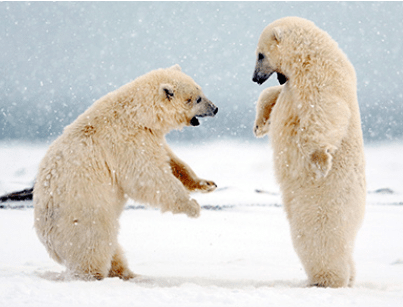 Polar Bear's habitat is on top of the ice that covers Arctic seas
 - A habitat is a place where an organism makes its home. A habitat meets all the environmental conditions an organism needs to survive.
What is an Adaptation?
"Adaptation is the physical or behavioural characteristic of an organism that helps an organism to survive better in the surrounding environment."
- Animals live in many different habitats. Some habitats, such as deserts, are very hot and dry; others, such as the Polar Regions, are very cold. Some places have lots of water, others have very little.
- Not all animals can survive in all habitats. For example, camels can live in deserts but cannot survive in very cold regions. Fish can live only in water and not on land.
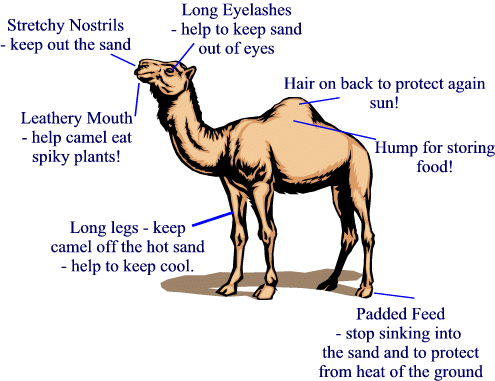 Camels can survive easily in the deserts but they can not survive in cold regions.
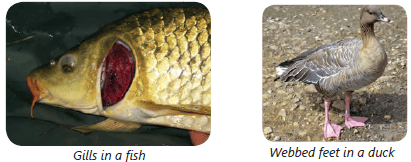
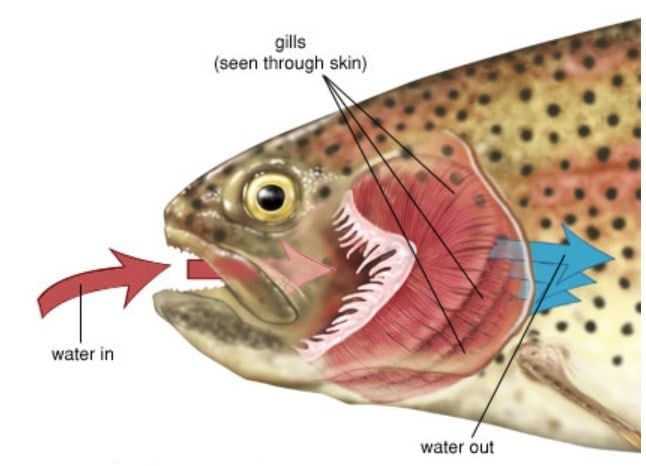 Fish have gills for breathing in water.
 - Animals can live in many different places because they have special features called adaptations to survive in the area they live. Polar bears have thick fur to protect them from cold surroundings.
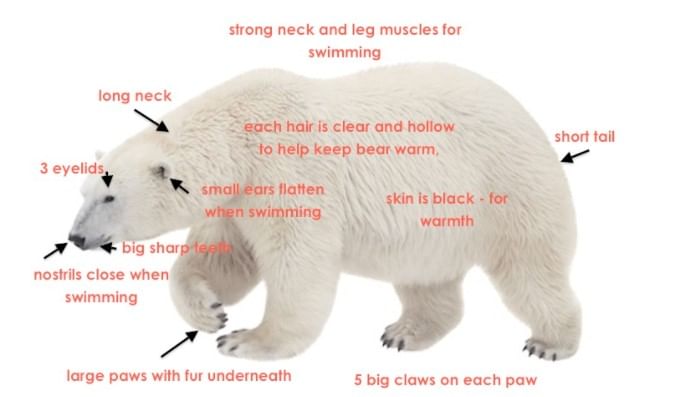 Adaptation Features of Polar Bear
 - Adaptations may be structural (body parts such as fur, scales, beaks) or behavioural (actions such as huddling, migration, hibernation).
- Such changes usually develop slowly over very long periods (many generations). When groups of animals cannot adapt, they may become extinct.
- Thus, in order to survive, animals have to adapt themselves to the changing conditions.
Animals adapt themselves in the following ways:
- For habitat
- For food habit
- For protecting themselves
- For surviving extreme heat and cold
- Special adaptations such as camouflage, migration and hibernation
Adaptation for Habitat
Animals can be grouped according to the habitat in which they live. Each group shows special adaptations that help them survive in that habitat.
Terrestrial Animals
Animals that live on land - either on the surface of the ground or in burrows below the surface - are called terrestrial animals.
- Some animals, such as snakes, rabbits, mice and foxes, live in burrows.
- Many others, such as dogs, cats, tigers, lions, zebras, cheetahs, elephants, camels, horses and cows, live on open land.
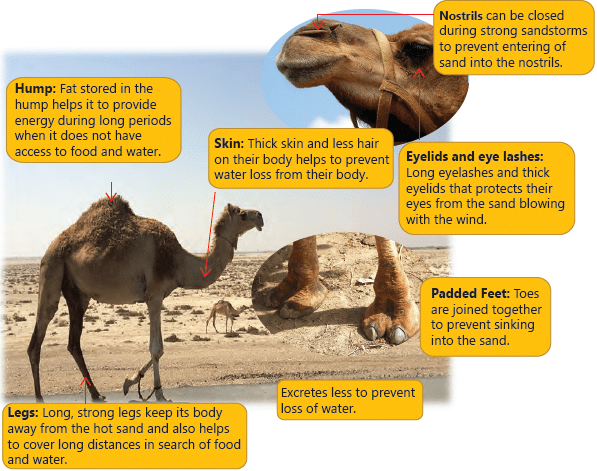
- Strong legs help many terrestrial animals to cover long distances in search of food and water.
- Snakes do not have legs; they have scales and muscles that help them to crawl.
- Terrestrial animals have digestive systems suited to their diets and well-developed sense organs - keen smell, sharp eyesight, teeth, claws and body colour help them to hunt or avoid predators.
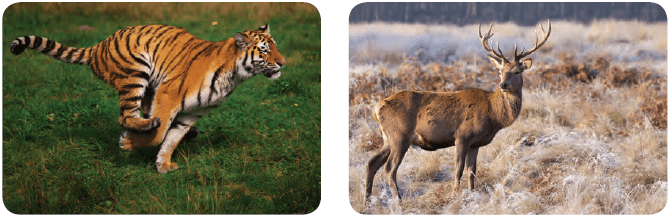 Animals found on Land
Try yourself: Tigers and leopards have stripes on their bodies. How does this adaptation help them?
Adaptation for Surviving Extreme Cold / Polar Regions
- Animals living in very cold regions have fur to protect them from cold.
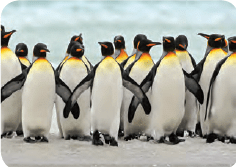
- Many cold-region animals, such as penguins and polar bears, have a thick layer of fat called blubber under their skin to keep them warm.
- Some species show behavioural adaptations for warmth. For example, emperor penguins and their chicks huddle together; birds take turns occupying the colder outer positions to keep the group warm.
Adaptation for Surviving Extreme Heat
- Deserts are very hot during the day and often very cold at night. There is little rainfall, so food and water are scarce.
- Animals living in deserts often have thick or tough skin that protects them from the sun and reduces water loss from the body.
- Examples of desert animals include scorpion, bandicoot, hedgehog, desert tortoise, kangaroo rat and rattlesnake.
- The camel, often called the "ship of the desert", shows many useful adaptations for desert life.
Aquatic Animals
Animals that live in water are called aquatic animals. Examples include crabs, turtles, ducks, fishes, whales and dolphins.
- Most aquatic animals breathe through gills. Exceptions such as whales and dolphins breathe with lungs and come to the water surface to breathe.
- Many aquatic animals have fins or specialised limbs that help them swim.
- Aquatic birds such as ducks and geese have webbed feet which help push water during swimming.
- Fish have streamlined bodies to cut through water more easily.
- Fish have scaly skin; their scales are waterproof and protect them.
Amphibians
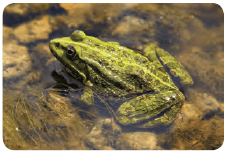
Amphibians are animals that can live both on land and in water. Frogs, toads and newts are amphibians.
- Many amphibians have limbs for swimming; some have webbed feet and tails that help in swimming.
- They can breathe through moist skin when in water; on land they use lungs.
Aerial Animals
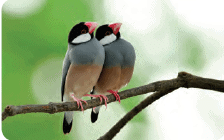
Aerial animals are those that can fly. Birds, many insects and bats are aerial animals.
- Their forelimbs are modified into wings for flight.
- They have feathers that keep them warm and help during flight.
- Many birds have light bodies with hollow bones to reduce weight.
- The body shape is often streamlined - narrow at the front and back and broad in the middle - helping them cut through air easily.
- Some birds, such as ostrich, kiwi and penguin, are flightless and cannot fly.
Arboreal Animals
Arboreal animals spend most of their lives on trees. They eat, sleep and play in the tree canopy. Examples include monkeys, koalas, opossums, sloths and many lizards.
➤ Limbs and Tails
- Many arboreal animals have long limbs that allow them to swing efficiently from branch to branch.
- Some have long, grasping tails that act like an extra limb for holding branches and balancing.
- Animals such as spider monkeys, opossums and chameleons use their tails to move and balance in the canopy.
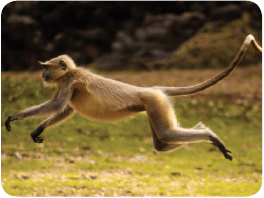
Try yourself: Which of the following body parts maintain balance in a monkey?
➤ Feet and Claws
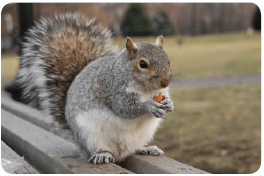
- Tree-living animals, like squirrels, require a strong grip so they do not fall from branches; they have strong feet and claws for this purpose.
- Their feet and claws are adapted for seizing, grasping or holding objects by wrapping around them.
- Their fingers and thumb are shaped in such a way that they can hold the branches firmly.
Adaptation for Food Habit
The type of teeth, beak or feeding structure that an animal has is often an adaptation to its food habit.
- Herbivores have strong, broad, flat teeth for biting and grinding leaves and grass. They allow them to easily bite and chew the grass and leaves.
- Carnivores have sharp teeth to tear flesh easily.
- Omnivores have a combination of teeth for tearing, biting and grinding.
- Birds do not have teeth; they have different kinds of beaks suited to their diets - sharp beaks for tearing, long beaks for probing, strong beaks for cracking seeds.
- Snakes have powerful muscles and special jaws that help them swallow and move food down the throat.
Parasites
- Parasites are small animals that depend on other living animals (hosts) for their food.
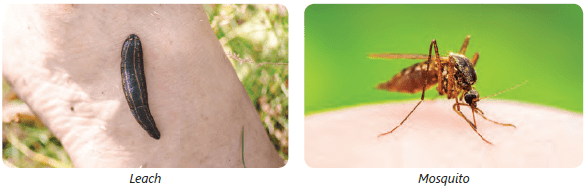
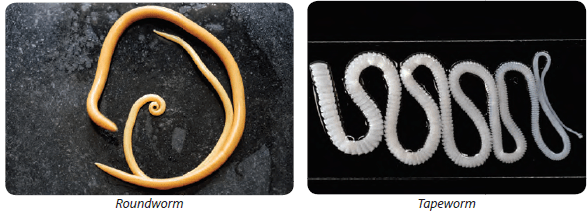
- Mosquitoes, which suck the blood of humans and other animals, are parasites. They do not have teeth but have a long sharp tube-like mouthpart (a proboscis) to pierce and suck blood like we drink cold drinks with a straw.
- Fleas, leeches and some bugs also live on the bodies of animals and feed on blood.
- Some parasites, such as hookworm, roundworm and tapeworm, live inside the bodies of animals and humans and absorb nutrients from the host's digested food.
Adaptation for Protecting Themselves
Animals have many physical features and behaviours to protect themselves from predators.
Horns
- Animals such as rhinoceros use their horns to push, threaten and defend themselves. Horns are also used by animals for defence.
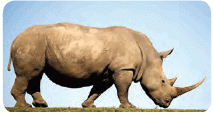 Rhinoceros
Scales
- Animals such as lizards, chameleons and snakes have scales on their bodies. Scales protect the skin and help prevent drying.
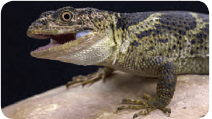 Scales on a chameleon
Shells
- Garden snails, clams, crabs and tortoises have hard shells that protect them from enemies. The shells help them to stay protected from enemy attacks.
- Garden snails and tortoises can pull their heads and legs inside their shells for protection.
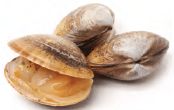 Clams with hard shell
Spines and Other Defences
- Porcupines have spines that can injure predators that come too close.
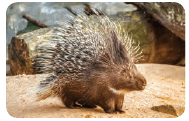 Porcupine with spines
 - Animals develop various adaptations to protect themselves from being eaten by other animals.
- The ocean has many kinds of fish. Big fish such as sharks eat the smaller fish. A small fish called puff fish protects itself by puffing up like a balloon.
- This makes the sharp spines on its body poke out. The shark cannot eat it.
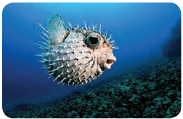 Puff fish with spines
Good to Know
Octopuses, when threatened, release an inky fluid that darkens the water and confuses predators. Cuttlefish and squid do this too.
Special Adaptations
Camouflage
Camouflage is the ability of an animal to blend into its surroundings, helping it avoid detection by predators or sneak up on prey.. It is an useful self-defence method.
- Chameleons and some leaf frogs can change colour to match their surroundings.
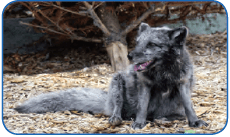 Arctic fox in spring and summer
 - The arctic fox changes fur colour with seasons: grey in spring and summer, white in autumn and winter, helping it remain hidden from predators and prey.
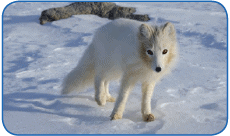 Arctic fox in autumn and winter
 - The stick insect looks like a twig and is hard to see when sitting on plants.
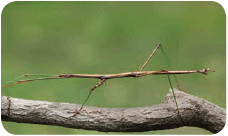 Stick insect on the branch of a tree
 - Zebras, tigers and leopards have stripes or spots that help break up their body outline among grass and trees, making them harder to spot.
Hibernation
- In very cold seasons some animals sleep for several months; this deep sleep is called hibernation.
- During hibernation the animal's heart rate and breathing slow down and it survives on the fat stored in its body. Bears, chipmunks, hedgehogs and some bats hibernate.
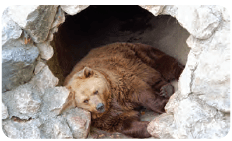 Hibernating bear
Migration
- Migration is the mass movement of animals or birds from one place to another for breeding, feeding or to escape harsh weather conditions.
- Animals migrate to habitats with more favourable climate or food. For example, in freezing winters the Arctic tern flies to warmer areas and returns when weather improves.
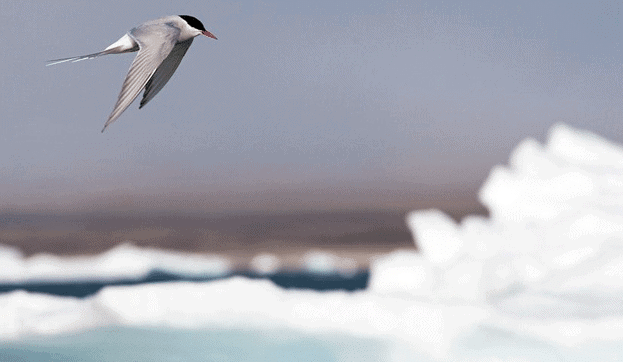 Arctic tern
 - Salmon, whales and many birds such as swallows migrate to far-off places during certain seasons and return later.
Good to Know
The Monarch butterfly migrates from Mexico to Canada each year; however, only their babies complete the return journey. Human activities such as building construction, dams and factories can destroy natural habitats and force animals to lose shelter and food.Many animals die due to loss of habitat.
Important Points
- The place that provides the basic things for an organism to survive is called its habitat.
- An adaptation is a modification or change in the organism's body or behaviour that helps it to survive.
- Animals can be divided into five groups according to their habitat-terrestrial, aquatic, amphibian, arboreal and aerial.
- Animals in terrestrial habitat generally have strong legs, well-developed digestive system and sense organs.
- Animals living in cold regions, such as polar bears, have fur on their bodies to protect them from cold.
- Animals living in deserts like camels have thick skin which protects them from the sun.
- Most of the aquatic animals, including fish, live and breathe in water.
- Arboreal animals spend most part of their lives on trees.
- Forelimbs modified as wings, feathers, lightweight bones help aerial animals to fly.
- Parasites are small animals that depend on other living animals for their food.
- Some animals protect themselves through physical features like horn, scale, shell, spine, etc.
- Camouflage is the ability to blend into the surrounding environment.
- During hibernation the animal survives on the stored fat in its body.
- Migration is when animals leave their habitat for another one that has better climatic conditions.
Summary
Every animal shows adaptations that help it obtain food, water and shelter and protect itself. Adaptations may be parts of the body (like fur, scales, beaks and shell) or behaviours (like huddling, hibernation and migration). Learning how animals are adapted to their habitats helps us understand how they live and why protecting natural habitats is important.
FAQs on Chapter Notes: Adaptation in Animals
| 1. What are the main types of animal adaptations and how do they help animals survive? |  |
| 2. Why do animals need different adaptations for different habitats like deserts and forests? | |
| 3. How do animals use camouflage and colour adaptation to survive in nature? | |
| 4. What's the difference between hibernation and migration as survival adaptations? | |
| 5. How do Class 4 students identify and explain animal adaptations in exam questions? | |