Question 1: Write the following in Roman numerals : (a) 258 (b) 410 (c) 285 (d) 335 (e) 444 (f) 247 (g) 438 (h) 365 (i) 495 (j) 466
(a) 258 = 200 + 50 + 8 = CC + L + VIII = CCLVIII
Solution:
Break down 258 into its parts: 200 + 50 + 8.
Roman numeral for 200 is CC.
Roman numeral for 50 is L.
Roman numeral for 8 is VIII.
Combine them: CC + L + VIII = CCLVIII.
(b) 410 = 400 + 10 = CD + X = CDX
Solution:
Break down 410 into its parts: 400 + 10.
Roman numeral for 400 is CD.
Roman numeral for 10 is X.
Combine them: CD + X = CDX.
(c) 285 = 200 + 80 + 5 = CC + LXXX + V = CCLXXXV
Solution:
Break down 285 into its parts: 200 + 80 + 5.
Roman numeral for 200 is CC.
Roman numeral for 80 is LXXX.
Roman numeral for 5 is V.
Combine them: CC + LXXX + V = CCLXXXV.
(d) 335 = 300 + 30 + 5 = CCC + X X X + V = CCCXXXV
Solution:
Break down 335 into its parts: 300 + 30 + 5.
Roman numeral for 300 is CCC.
Roman numeral for 30 is XXX.
Roman numeral for 5 is V.
Combine them: CCC + XXX + V = CCCXXXV.
(e) 444 = 400 + 40 + 4 = CD + XL + IV = CDXLIV
Solution:
Break down 444 into its parts: 400 + 40 + 4.
Roman numeral for 400 is CD.
Roman numeral for 40 is XL.
Roman numeral for 4 is IV.
Combine them: CD + XL + IV = CDXLIV.
(f) 247 = 200 + 40 + 7 = CC + X L + VII = CCXLVII
Solution:
Break down 247 into its parts: 200 + 40 + 7.
Roman numeral for 200 is CC.
Roman numeral for 40 is XL.
Roman numeral for 7 is VII.
Combine them: CC + XL + VII = CCXLVII.
(g) 438 = 400 + 30 + 8 = CD + X X X + VIII = CDXXXVIII
Solution:
Break down 438 into its parts: 400 + 30 + 8.
Roman numeral for 400 is CD.
Roman numeral for 30 is XXX.
Roman numeral for 8 is VIII.
Combine them: CD + XXX + VIII = CDXXXVIII.
(h) 365 = 300 + 60 + 5 = CCC + LX + V = CCCLXV
Solution:
Break down 365 into its parts: 300 + 60 + 5.
Roman numeral for 300 is CCC.
Roman numeral for 60 is LX.
Roman numeral for 5 is V.
Combine them: CCC + LX + V = CCCLXV.
(i) 495 = 400 + 90 + 5 = CD + X C + V = CDXCV
Solution:
Break down 495 into its parts: 400 + 90 + 5.
Roman numeral for 400 is CD.
Roman numeral for 90 is XC.
Roman numeral for 5 is V.
Combine them: CD + XC + V = CDXCV.
(j) 466 = 400 + 60 + 6 = CD +LX + VI = CDLXVI
Solution:
Break down 466 into its parts: 400 + 60 + 6.
Roman numeral for 400 is CD.
Roman numeral for 60 is LX.
Roman numeral for 6 is VI.
Combine them: CD + LX + VI = CDLXVI.
Question 2: Write the following in Roman numerals : (a) 42 (b) 63 (c) 85 (d) 99 (e) 105 (f) 109 (g) 115 (h) 136 (i) 171 (j) 184 (k) 197 (l) 200
(a) 42 = 40 + 2 = X L + II = XLII
Solution:
Break down 42 into its parts: 40 + 2.
Roman numeral for 40 is XL.
Roman numeral for 2 is II.
Combine them: XL + II = XLII.
(b) 63 = 60 + 3 = LX + III = LXIII
Solution:
Break down 63 into its parts: 60 + 3.
Roman numeral for 60 is LX.
Roman numeral for 3 is III.
Combine them: LX + III = LXIII.
(c) 85 = 80 + 5 = LXXX + V = LXXXV
Solution:
Break down 85 into its parts: 80 + 5.
Roman numeral for 80 is LXXX.
Roman numeral for 5 is V.
Combine them: LXXX + V = LXXXV.
(d) 99 = 90 + 9 = X C + IX = XCIX
Solution:
Break down 99 into its parts: 90 + 9.
Roman numeral for 90 is XC.
Roman numeral for 9 is IX.
Combine them: XC + IX = XCIX.
(e) 105 = 100 + 5 = C + V = CV
Solution:
Break down 105 into its parts: 100 + 5.
Roman numeral for 100 is C.
Roman numeral for 5 is V.
Combine them: C + V = CV.
(f) 109 = 100 + 9 = C + IX = CIX
Solution:
Break down 109 into its parts: 100 + 9.
Roman numeral for 100 is C.
Roman numeral for 9 is IX.
Combine them: C + IX = CIX.
(g) 115 = 100 + 10 + 5 = C + X + V = CXV
Solution:
Break down 115 into its parts: 100 + 10 + 5.
Roman numeral for 100 is C.
Roman numeral for 10 is X.
Roman numeral for 5 is V.
Combine them: C + X + V = CXV.
(h) 136 = 100 + 30 + 6 = C + XXX + VI = CXXXVI
Solution:
Break down 136 into its parts: 100 + 30 + 6.
Roman numeral for 100 is C.
Roman numeral for 30 is XXX.
Roman numeral for 6 is VI.
Combine them: C + XXX + VI = CXXXVI.
(i) 171 = 100 + 70 + 1 = C + LXX + I = CLXXI
Solution:
Break down 171 into its parts: 100 + 70 + 1.
Roman numeral for 100 is C.
Roman numeral for 70 is LXX.
Roman numeral for 1 is I.
Combine them: C + LXX + I = CLXXI.
(j) 184 = 100 + 80 + 4 = C + LXXX + IV = CLXXXIV
Solution:
Break down 184 into its parts: 100 + 80 + 4.
Roman numeral for 100 is C.
Roman numeral for 80 is LXXX.
Roman numeral for 4 is IV.
Combine them: C + LXXX + IV = CLXXXIV.
(k) 197 = 100 + 90 + 7 = C + XC + VII = CXCVII
Solution:
Break down 197 into its parts: 100 + 90 + 7.
Roman numeral for 100 is C.
Roman numeral for 90 is XC.
Roman numeral for 7 is VII.
Combine them: C + XC + VII = CXCVII.
(l) 200 = 100 + 100 = C + C = CC
Solution:
Break down 200 into its parts: 100 + 100.
Roman numeral for 100 is C.
Combine them: C + C = CC.
Question 3: Write the Hindu-Arabic numerals for each of the following : (a) CCCXIV (b) CDXL (c) DCI (d) CCCLXXVI (e) DXVIII (f) CCCXX XVIII (g) CDXXXVIII
(a) CCCXIV = CCC + X + IV = 300 + 10 + 4 = 314
Solution:
Roman numerals: CCC + X + IV.
CCC = 300, X = 10, IV = 4.
Combine them: 300 + 10 + 4 = 314.
(b) CDXL = CD + XL = 400 + 40 = 440
Solution:
Roman numerals: CD + XL.
CD = 400, XL = 40.
Combine them: 400 + 40 = 440.
(c) DCI = D + C + 1 = 500 + 100 + 1 = 601
Solution:
Roman numerals: D + C + I.
D = 500, C = 100, I = 1.
Combine them: 500 + 100 + 1 = 601.
(d) CCCLXX VI = CCC + L + XX + VI = 300 + 70 + 6 = 376
FAQs on Practice Questions with Solutions: Roman Numerals
1. How do I convert normal numbers into Roman numerals for Class 5 exams?
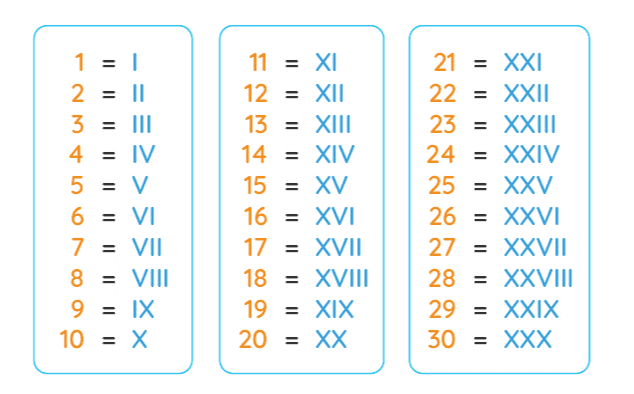
Ans. Convert numbers by breaking them into place values and using Roman numeral symbols: I (1), V (5), X (10), L (50), C (100). For example, 24 becomes XX + IV = XXIV. Subtraction rule applies when a smaller numeral precedes a larger one. Practice with flashcards or mind maps on EduRev to master conversion patterns quickly before your test.
2. What's the difference between how you write 9 and 90 in Roman numerals?
Ans. The number 9 is written as IX (10 minus 1), while 90 is written as XC (100 minus 10). Both follow the subtraction principle, but the place value differs. Understanding this distinction helps prevent common errors in Roman numeral representation across different digit positions and strengthens your grasp of the numbering system's logic.
3. Can I use Roman numerals bigger than 100 for Class 5 practice questions?
Ans. Yes, Roman numerals extend beyond 100 using the symbols C (100), D (500), and M (1000). Numbers like 150 (CL) and 250 (CCL) appear regularly in practice questions with solutions. Most CBSE Class 5 syllabi include converting three-digit numerals, so familiarise yourself with these higher-value symbols and their combinations for comprehensive exam preparation.
4. Why do Roman numerals have rules about repeating the same symbol?
Ans. Repeating symbols follows strict conventions: I, X, C, and M can repeat up to three times consecutively, but V, L, and D cannot repeat. This rule prevents confusion and maintains clarity in ancient numeral representation. For instance, 3 is III (allowed), but 4 is IV (not IIII). Grasping these restrictions eliminates mistakes in both reading and writing Roman numerals accurately.
5. How do I know when to use subtraction in Roman numerals instead of addition?
Ans. Use subtraction when a smaller numeral appears directly before a larger one: IV (4), IX (9), XL (40), XC (90), CD (400), CM (900). Only these pairs follow subtraction rules in standard notation. Memorising these specific combinations through repeated practice with solutions helps students avoid incorrectly subtracting symbols like IL or IC, which violate proper Roman numeral conventions.
mock tests for examination, pdf , Summary, Objective type Questions, Important questions, MCQs, Sample Paper, study material, Practice Questions with Solutions: Roman Numerals, shortcuts and tricks, Previous Year Questions with Solutions, ppt, Practice Questions with Solutions: Roman Numerals, practice quizzes, Free, Extra Questions, video lectures, Practice Questions with Solutions: Roman Numerals, Semester Notes, Viva Questions, past year papers, Exam;

 Roman Numerals 1 to 30