Chapter Notes: Birds: Food and More


Introduction
One day, Riya saw a little bird picking up seeds. She asked, "Do all birds eat the same food?" Grandpa smiled and said, "No! Some birds eat seeds, some eat insects, and some even eat fish. Their beaks help them eat different foods." Riya was surprised and started watching birds closely. She saw a parrot eating fruits, a duck searching for food in water, and a crow picking up grains. "Birds are so special!" she thought. Let's learn more about these birds and their wonderful world!
What are Birds?
Birds are animals that have feathers, wings, and beaks. They use their wings to fly and their beaks to eat different types of food, like seeds, insects, or fish.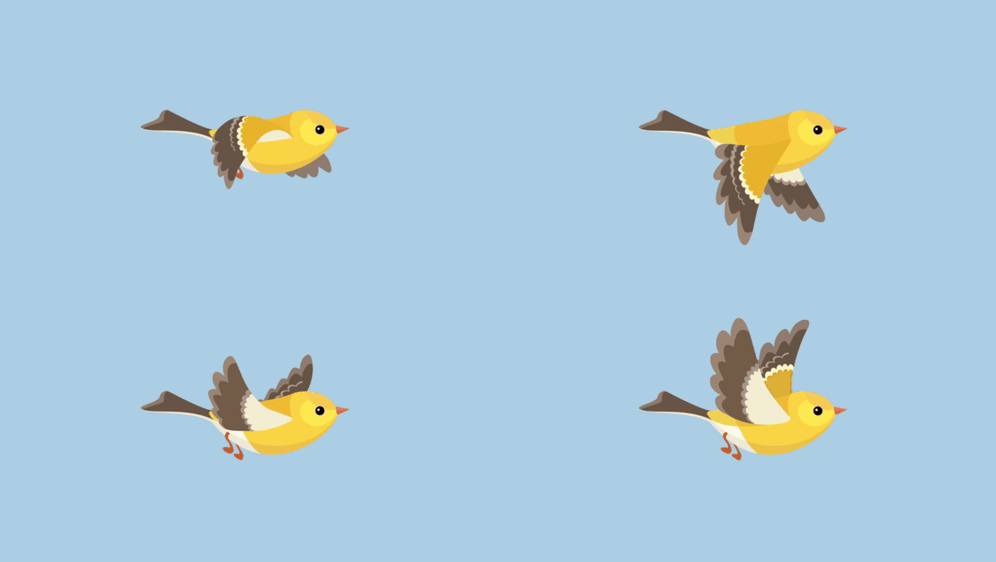
Special Features of Birds
Let us discuss some special features that help birds in flying.
- Light Body - Their bodies are very light, so they can stay in the air for a long time.
- Hollow Bones - Their bones are filled with air, making them strong yet light.
- Boat-shaped Body - Their body shape helps them move smoothly through the air.
- Strong Wings - Their wings help them fly by catching air.
- Flight Muscles - These help birds move their wings up, down, forward, and backward while flying.
- Tail for Balance - Their tails help them turn and balance in the air.
These features make birds great flyers!
Flying Abilities of Different Birds
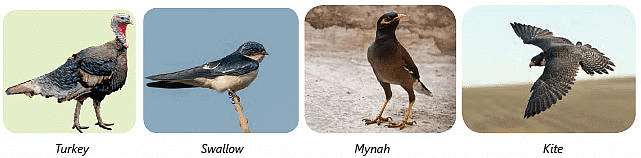
- Short-distance flyers - Hens, turkeys, and peacocks can only fly for a short time because they have heavy bodies.
- Long-distance flyers - Pigeons, crows, and swallows can fly very far.
- High-altitude flyers - Eagles, vultures, and kites fly very high. They have sharp eyesight to find food on the ground.
Try yourself: What is the function of a bird's tail while flying?
Important Body Parts of Birds
Like human body parts, birds also have different body parts as:
- Beak: Birds use their beaks to eat. Different birds have different beaks. For example, Eagles have sharp beaks for eating meat, and parrots have strong beaks for cracking nuts.
- Wings: Birds fly with their wings. Wings have feathers that help them go up in the air and stay there. Different birds have different wings for flying.
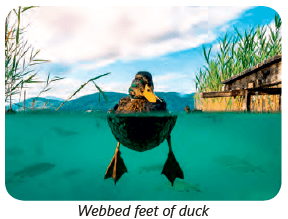
- Feet: Birds have special feet for their needs. Ducks have webbed feet to swim, and eagles have strong feet with claws to catch food.
- Tail: A bird's tail helps it balance and turn while flying. It helps them change direction easily.
- Feathers: Feathers help birds fly, keep them warm, and protect them from rain. Soft feathers keep heat in, and outer feathers keep water away.
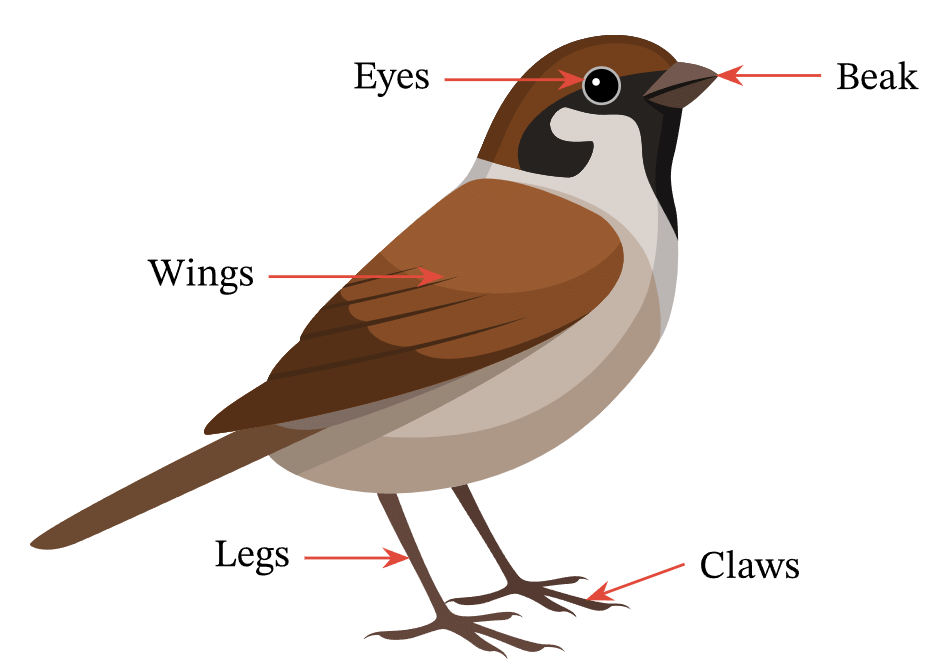 Body parts of a bird
Let us now discuss them in detail:
1. Feathers
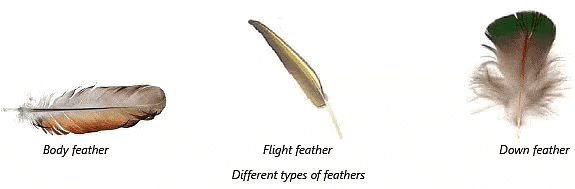
Birds have these tiny, soft feathers covering their bodies. These feathers help keep them warm when it's cold and cool when it's hot, and they're important for flying. There are three types of feathers.
- Down feathers are soft and fluffy, keeping birds warm.
- Flight feathers are strong and help birds fly in the sky.
- Body feathers are smooth feathers that cover the bird's body and protect it, giving shape and color.
2. Feet and Claws
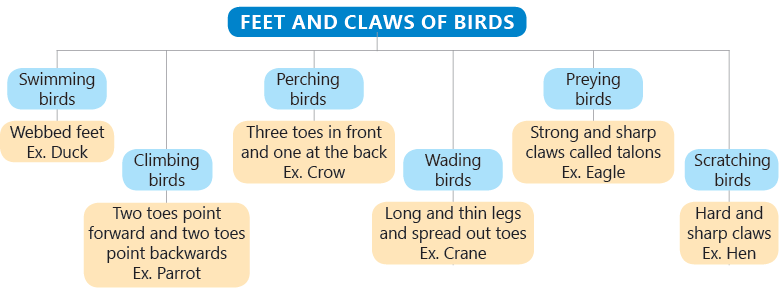
Birds use their claws to do many things. They hold branches, catch food, and stay safe from other animals. Claws help birds just like hands help us.
1. Swimming Birds
Water birds such as ducks and swans have three toes in front and one toe at the back. The front toes are joined together by skin called a web. Such feet are called webbed feet. They help the bird to swim by pushing the water backwards.
2. Climbing Birds
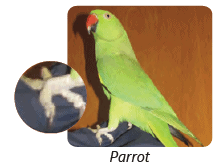
Birds such as parrots and woodpeckers have two toes that point forward and two toes that point backwards. Such toes help them climb trees.
3. Perching Birds
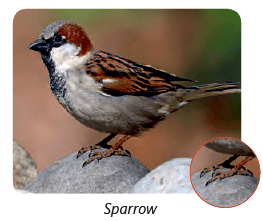
The feet of birds such as crows, sparrows, and mynahs have three toes in front and one at the back. Birds use their toes to sit on high branches without falling, even when they sleep.
4. Wading Birds
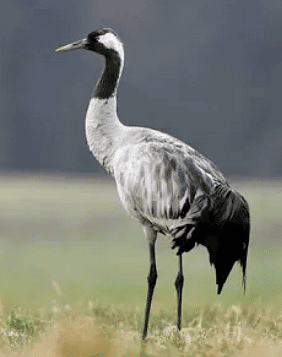
Water birds such as cranes and herons have long and thin legs. They have wide toes that save them from sinking into the muddy water. These help them to walk through water in search of food. This movement is called wading.
 Crane
Crane
5. Scratching Birds
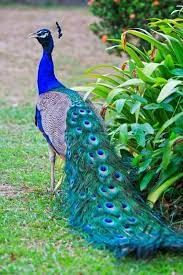
Hen, rooster, and peacock have hard and sharp claws. Their hard claws help them to scratch and dig the ground and pull out insects and worms.
 Peacock
6. Preying Birds (Flesh-Eating Birds)
Eagles, hawks, and vultures are flesh-eating birds. They have strong and sharp claws called talons. They use their claws to catch live rats, toads, and other small animals and hold their prey between their claws while flying.
3. Beak
Just like we use forks and spoons to eat, birds use their beaks for grabbing, holding, and eating food. Some beaks are sharp for picking things, and some are curved for tearing food.
Beaks of Different Birds
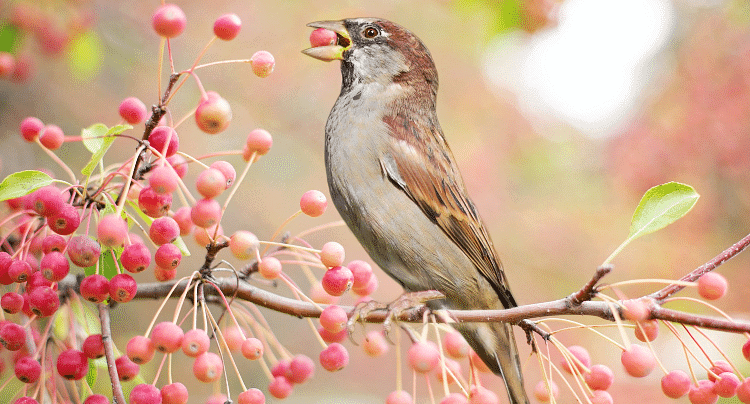
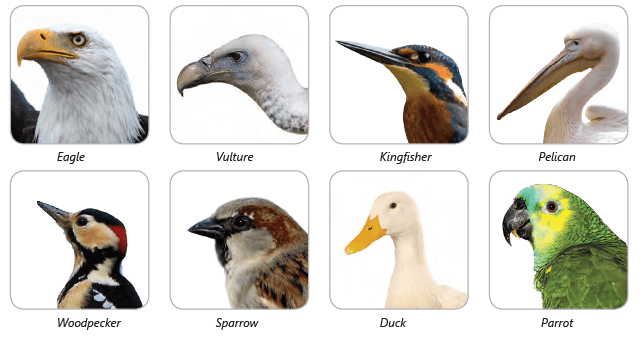
The size and shape of beaks vary based on the type of food birds eat.
- Eagle/Vulture: These birds eat meat and have strong, sharp beaks to tear food.
- Kingfisher/Pelican: They have long, scissor-like beaks to catch small fish.
- Woodpecker: It has a long, sharp beak to tap trees and find insects.
- Swallow: It has a short, wide beak to catch insects while flying.
- Parrot: It eats seeds, nuts, and fruits using its strong, curved beak to break them open.
- Duck: Its beak has small holes to remove mud while eating plants and insects.
- Sparrow: It has a short, strong beak to crack seeds and eat insects.
 Different types of beaks
How Does A Bird Fly?
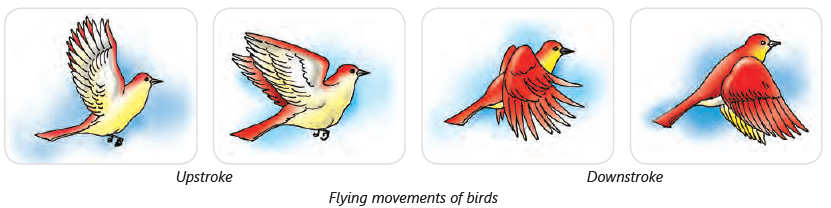
A bird flies by moving its wings up and down to go up in the air. When it reaches the right height, it stops flapping and smoothly moves in the air. The flapping of birds includes:
- Upstroke: When the wings move upward and backward.
- Downstroke: When the wings move downward and forward.
Nesting Habits Of Birds
Birds make nests using small sticks, grass, feathers, cotton, wool, leaves, and sometimes mud. These nests give shelter for the birds.
- Nests protect birds from bad weather.
- They protect birds from their enemies.
- Birds lay their eggs in these nests.
Inside the nests, birds care for their young ones until they are ready to fly. After the young birds grow and fly away, the parents do not reuse the nests. Most birds make a new nest each year.
Types of Nests
- Hole Nests: Woodpeckers make holes in tree trunks with their beaks to build nests.
- Rock Nests: Eagles make nests on high tree branches or rocky places.
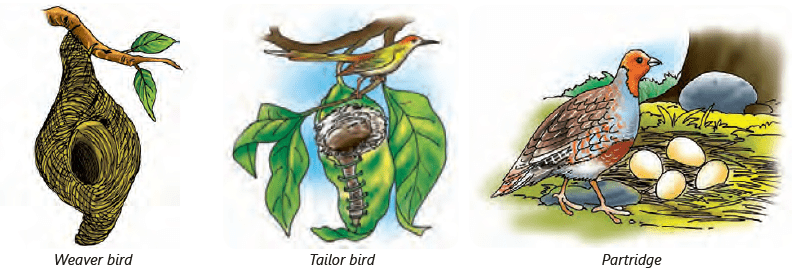
- Woven Nests: Weaver birds make nests with grass, small sticks, and leaves. They weave them on tree branches, and the nests hang down with a tunnel-shaped entrance.
- Stitched Nests: Tailor birds sew big leaves together using their beaks like needles with cotton threads or spider silk. That's why they are called tailor birds.
- Ground Nests: Penguins and partridges make nests on the ground using stones to stop their eggs from rolling away.
How Do Birds Help Us?
Birds offer a number of benefits that help to maintain ecological balance and environment health. Here are some of the key ways in which birds help us:
- Pest Control: Birds eat insects, helping to reduce the number of harmful bugs.
- Seed Dispersal: Birds eat fruits and drop seeds in different places, helping new plants grow.
- Environmental Health: Birds show if a place is clean and healthy. Many birds in an area mean the environment is good.
- Inspiration: Birds look beautiful, sing sweet songs, and amaze us with their flying skills.
In summary, birds help nature by eating insects, spreading seeds, and showing if the environment is healthy. They also inspire us with their beauty and talents.
Conclusion
Birds are wonderful creatures with unique features that help them fly, find food, and survive in different environments. Their feathers, wings, beaks, and claws are specially designed for their way of life. Birds also play an important role in nature by helping with seed dispersal, controlling insects, and keeping the environment balanced.
By watching birds around us, we can learn a lot about their habits, movements, and importance in nature. So next time you see a bird, take a moment to observe it-What is it eating? How is it flying? Where is it building its nest? Every bird has a story to tell!
FAQs on Chapter Notes: Birds: Food and More
| 1. What do different types of birds eat and why do their beaks have different shapes? |  |
| 2. How do birds digest food so quickly compared to humans? | |
| 3. Why do some birds eat seeds while others eat insects or flesh? | |
| 4. What is the purpose of a bird's crop and how does it help with food storage? | |
| 5. How can you tell what a bird eats just by looking at its beak, feet, and other body features? | |