Application of Maxwell Relation | Kinetic Theory & Thermodynamics - Physics PDF Download

First T - dS equation
Let T and V are independent variable, such that S = S(T,V)
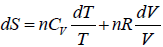
dS = 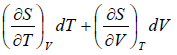
TdS = 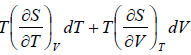 put
put 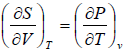
TdS = 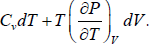
Second T - dS equation
Let T and P are independent variable, such that S = S(T, P).
TdS = 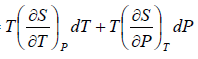
From Maxwell relation
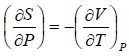
TdS = 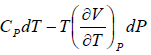
Third T - dS
Equation
Let P, V are independent variable, such that S = S(P, V).
dS = 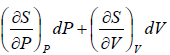
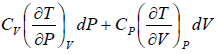
TdS = 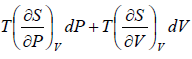 =
= 
= 
The First Energy Equation
Let T and V are independent variable, and U = U (T,V)
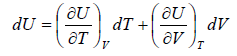
From first law of thermodynamics.
dU = TdS - PdV
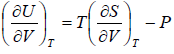
Using Maxwell relation,
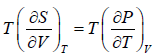
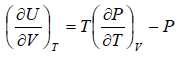

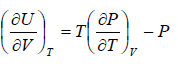
dU = 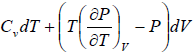
Second Energy Equation

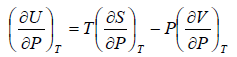
Using Maxwell relation
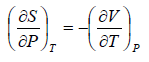
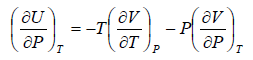
This is popularly known as second energy equation
Application of second energy equation:
If U is function of independent variable of T and P.


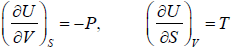
Example 2: From relation, dU = TdS - PdV, derive Maxwell relation, 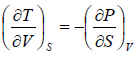
dU = TdS - PdV
Hence, U is exact differential

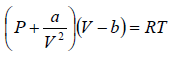
Example 3: A real gas which obey van der Waal’s equation of state are kept in container which has temperature T0 and volume V0 . If volume of container changes to V such that temperature of gas become T , then what is change in entropy?
Assume Cv is specific heat of constant volume
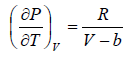
For van der Waal’s gas
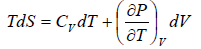
From first T - dS equation
dS =
where, S0 is integration constant

Example 4: For van der Wall gases, prove that 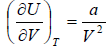 , where U is internal energy
From first energy equation
put the value of
in equation (i)

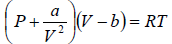
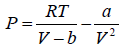
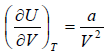
Example 5: Prove that
(a) 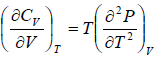
(b) 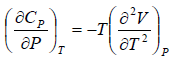
(a) We know that,
Using Maxwell relation,
One can get,
(b)
Use Maxwell relation,
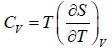

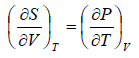
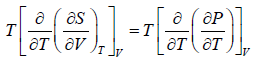
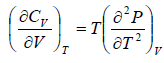
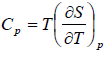

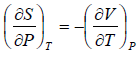
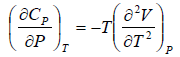
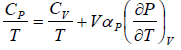
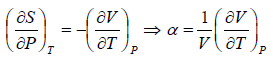
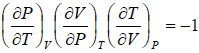
Example 6: If αp is thermal expansivity at constant pressure and KT is isothermal compressibility, then prove that
(a) 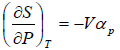
(b) 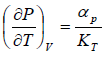
(c) 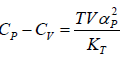
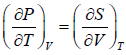
From Maxwell relation
(a)
(b)
(c)
Using Maxwell relation,

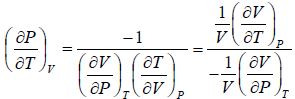



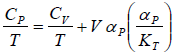
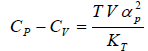
Example 7: Prove that
(a) 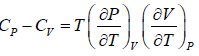
(b) 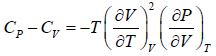
(c) For the van der Waal’s gas, prove that 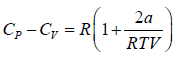
(a)
=
S = S(T,V)
and
Put the value of
in equation (A)
=
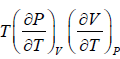
From Maxwell relation
From Maxwell relation
So
Put the value of
(b) For van der Waal’s gas
→ differentiate w.r.t. to T
Differentiate (B) with respect to V
Substituting the value
in equation
=
=
=
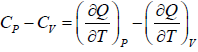

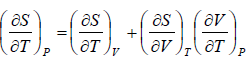

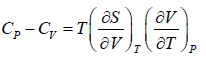
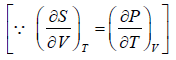
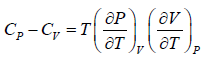

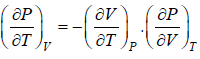
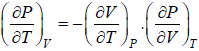
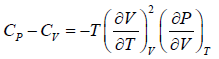

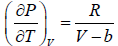

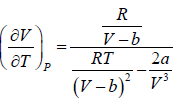
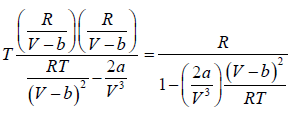
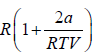
Example 8: From 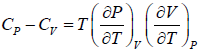
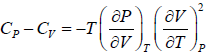
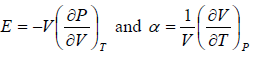
Prove, Cp - Cv = TEα2V, where E is bulk modulus of elasticity and α is coefficient of volume expansion.
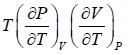
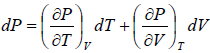
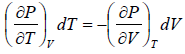
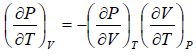
Let Cp - Cv =
P = P(T,V)
For constant pressure dP = 0
Cp - Cv = TVEα2

Example 9: Prove that 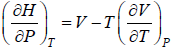
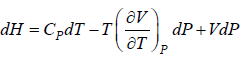
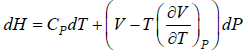
dH = TdS + VdP and put TdS =
dP in equation
Example 10: Over a certain range of pressure and temperature the Equation of a Certain substance is given by the relation V = 
(a) Find the change in enthalpy at constant temperature if pressure change from P1 to P2
(b) Find the change of entropy of this substance in isothermal process
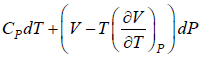
(a) dH =
for Isothermal process dT = 0
dH =
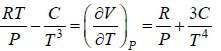
, V =
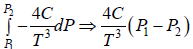
dH = H2 - H1 =
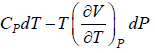
(b) From second TdS equation TdS =
For Isothermal process dT = 0
dS =
=

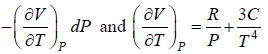

Example 11: For Vander Waal gas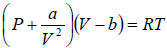
(a) Prove that  for Iso-Entropic process.
(b) If pressure and Volume changes from P1,V1 to P2,V2 at constant temperature then find Change in enthalpy
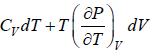
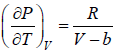
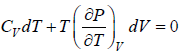
(a) From first TdS equation, TdS =
P =
⇒
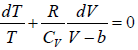
At constant entropy dS = 0 ⇒
or
By integration,
= constant
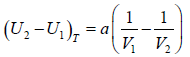
(b) From
H =U + PV Hence enthalpy is point function
So, H1 =U1 + P1V1 and H2 = U2 + P2V2
H2 - H1 = U2 - U1 + P2V2 - P1V


Example 12: If Helmholtz free energy for radiation is given by F = 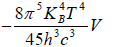
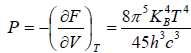
(a) What is radiation pressure?
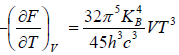
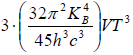
(b) If S is entropy of the system, prove that specific heat at constant volume is given by Cv= 3S
(a) dF = -SdT - PdV
(b) S =
Cv =
=
=
Cv = 3S
Example 13: The internal energy E of a system is given by E =  , where b is constant and other symbols have their usual meaning.
(a) Find the temperature of the system
(b) Find Pressure of the system
From first law of thermodynamics
TdS = dU + PdV ⇒dU = TdS - PdV
As, U = E =
(a) T =
(b) P =

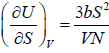
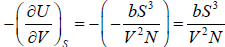
Example 14: Consider an Ideal gas where entropy is given by S =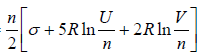 where n = number of moles, R = universal gas constant, U = internal energy V = volume and σ = constant
(a) Calculate specific heat at constant pressure and volume
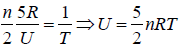
(b) Prove that internal energy is given by U = 5/2PV
(a) From first law of thermodynamics
TdS = dU - PdV, dS =
⇒
∴
Cv =
⇒ Cp = Cv + R ⇒Cp = 7/2nR
(b) U =
⇒
PV = nRT ⇒ V =
⇒ U= 5/2PV



Example 15: Using the equation of state, PV = nRT and the specific heat per mole,  for monatomic ideal gas
(a) Find Entropy of given system.
(b) Find free energy of given system
dU =
, P =
, Cv =
TdS = dU + PdV
dS =
or
S = 3/2
where, S0 is constant
(c) F = U - TS
=
where F0 = T.S0 is again constant

Example 16: From electromagnetic theory, Maxwell found that the pressure P from an isotropic radiation equal to 1/3 the energy density i.e., P =  , where V is volume of the cavity, then using the first energy equation, prove that Energy density u is proportional to T4.

 , where u =
 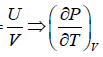 =
= 
 = u and u =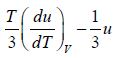
 = 4u ⇒
u ∝T4 ⇒ u = α T4 , where α is a constant.
|
6 videos|20 docs|32 tests
|
FAQs on Application of Maxwell Relation - Kinetic Theory & Thermodynamics - Physics
| 1. What is the first energy equation? |  |
| 2. What is the second energy equation? | |
| 3. How can we apply Maxwell's relation in IIT JAM? | |
| 4. What are some examples of applications of Maxwell's relation in IIT JAM? | |
| 5. What are frequently asked questions about the first and second energy equations in IIT JAM? | |




Application of Maxwell Relation | Kinetic Theory & Thermodynamics - Physics
,Objective type Questions
,Extra Questions
,video lectures
,past year papers
,study material
,Application of Maxwell Relation | Kinetic Theory & Thermodynamics - Physics
,Exam
,mock tests for examination
,shortcuts and tricks
,MCQs
,Viva Questions
,practice quizzes
,Important questions
,Previous Year Questions with Solutions
,Sample Paper
,ppt
,Free
,Summary
,Semester Notes
,Application of Maxwell Relation | Kinetic Theory & Thermodynamics - Physics
;



Application of Maxwell Relation Free PDF Download
Importance of Application of Maxwell Relation
Application of Maxwell Relation Notes
Application of Maxwell Relation Physics Questions
Study Application of Maxwell Relation on the App
|
© EduRev
|
Education Revolution
|


|




