Addition and Subtraction Up to 20 Class 1 Notes Maths
| Table of contents |

|
| Addition |
|
| Addition up to 20 |
|
| Subtraction |
|
| Subtracting within 20 |
|
| Addition and Subtraction Relationship |
|

Addition
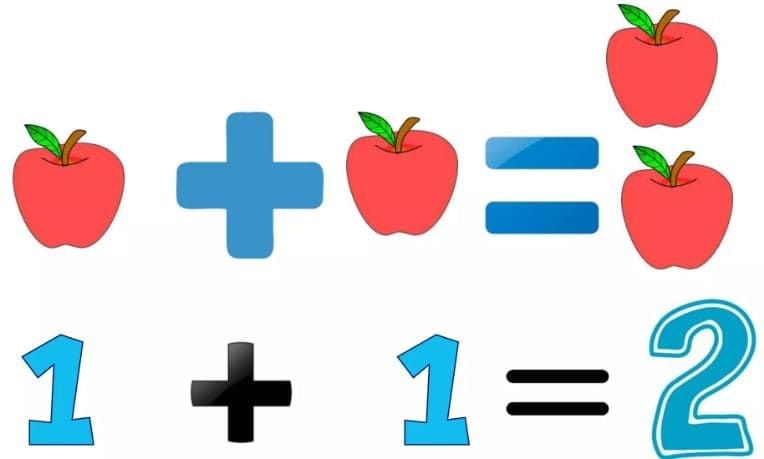
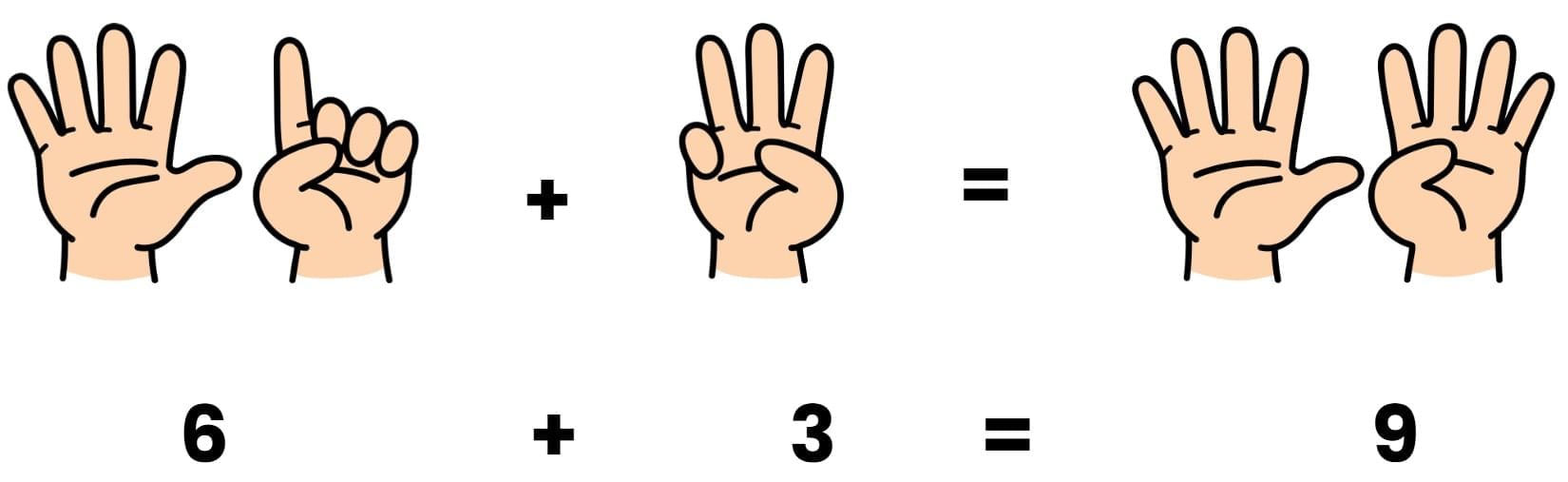
Addition by Counting Forward
- To add 6 and 3, we start from 6 and count forward by 3 as

We reach at 9. So, 6 + 3 = 9.
Addition on a Number Line
- To add 7 and 3, we start from 7 on the number line and move 3 steps (ones) forward.
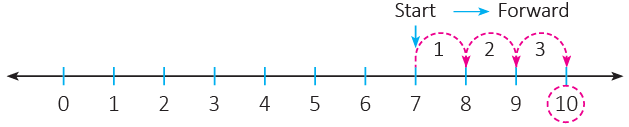 We reach at 10. So, 7 + 3 = 10.
Vertical Addition
- To add 6 and 2, we arrange the numbers one below the other and add as we do by forward counting as shown.
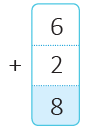 Start from the bigger number 6 and count forward by 2 as
So, 6 + 2 = 8.
Properties of Addition
Let us look at the following situations to know the properties of addition.
1. Adding two numbers by changing their order
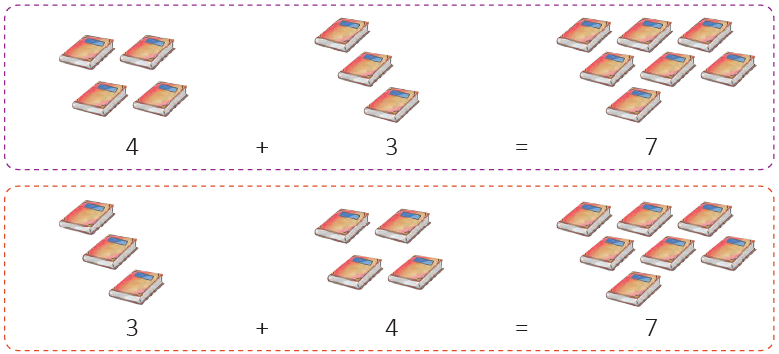
While adding two numbers, the sum does not change, even if we change the order of the numbers.
2. Adding 0 to a number
Four friends are playing. No more friends joined them.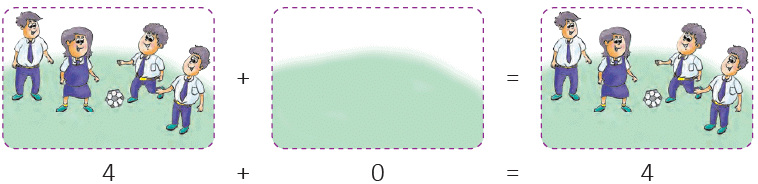
When we add 0 to a number, the sum is the number itself.
Addition up to 20
Adding a 1-digit number to 10
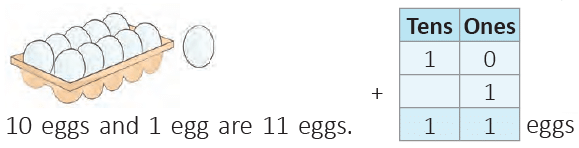
Note: To add 1-digit number to 10, just replace the 0 with the number. It becomes the ones place of the ‘sum’.
Addition: Counting Together by Making a Group of 10
- Let us add two single-digit numbers say 8 and 5 by making tens. 8 X-mas stars and 5 X-mas stars together give 13 X-mas stars.
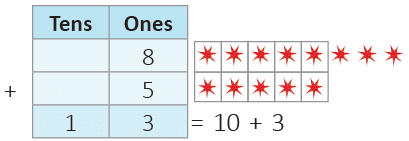
So, the sum of 8 and 5 is 13.
Note: Adding by making a group of 10 changes the question to “adding to 10”.
Addition: Counting Together by Adding Ones First
- Let us add a 2-digit number and a 1-digit number, say, 12 and 5.
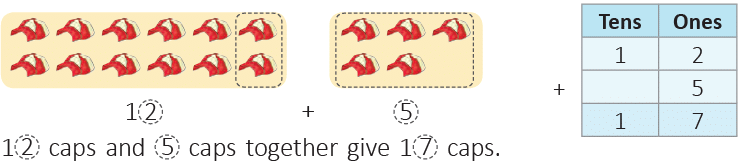
So, the sum of 12 and 5 is 17.
Addition: Counting Forward on a Number Line
- Look at the given number line. It shows the numbers from 0 to 20.

- Let us add 11 and 6 using the number line. To find 11 + 6, start with the bigger number, 11.
- Now, take 6 steps (ones) forward as shown.
 We arrive at 17. So, 11 + 6 = 17.
Adding Three Numbers
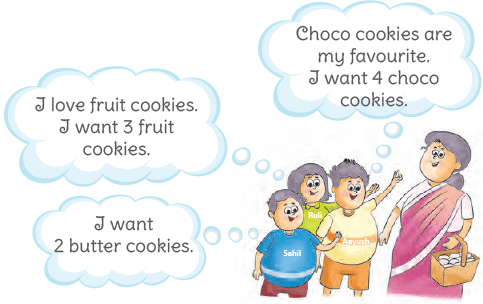 Ms. Yashvi is hosting a holiday cookie party for kids. Ms. Yashvi helps them in adding the number of cookies they want.
Step 1: Add any two numbers first. Get the answer.
Step 2: Now, add the third number to the answer you got in step 1.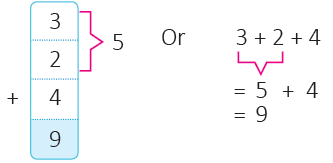 Thus, Ms. Yashvi got the answer of 9 cookies because 3 + 2 + 4 = 9.
Note: While adding three numbers, it makes no difference which two numbers are added first.
Addition Stories in Real-Life Situations
- There are 15 students in Ms. Karki's class. 3 new students join the class. How many students are there in the class now?
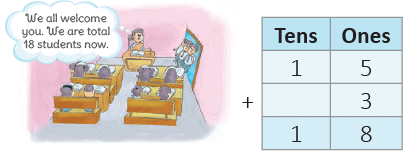 There are 15 + 3 = 18 students in the class now.
Subtraction
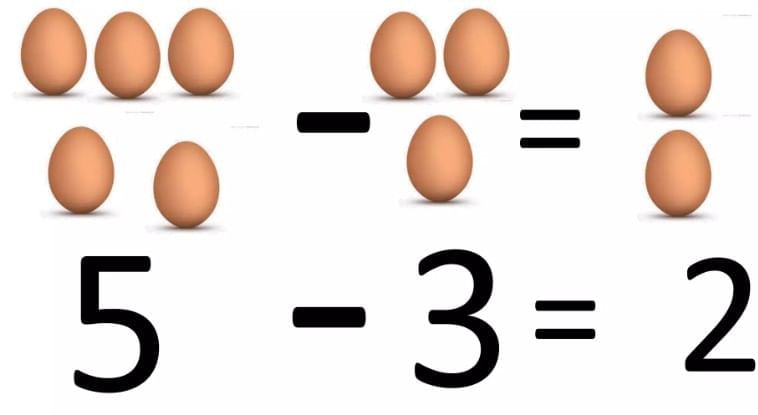
Subtraction by Crossing Out
- There are 8 carrots in the basket. A rabbit takes away 3 carrots. How many carrots are left in the basket now?

Ans: To find how many carrots are left, we cross out 3 carrots and count the remaining uncrossed carrots.
 There are 5 uncrossed carrots.
So, 5 carrots are left in the basket.
We can write it as:
8 - 3 = 5 Or 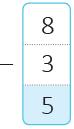
Note: When we write the bigger number below the smaller number for subtraction, it is called vertical subtraction.
Subtraction by Counting Backward
- To subtract 4 from 7 by backward counting, we start with the bigger number 7 and count backward 4 ones as:

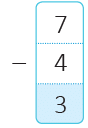
We reach at 3. So, 7 - 4 = 3.
Note: We count backward by ones to subtract. The number we stop at is the difference.
Properties of Subtraction
Let us look at the following situations to know the properties of subtraction.
1. Subtracting 0 from a number
A monkey has 6 bananas. The monkey ate none. Now, 6 bananas are left with him.
When 0 is subtracted from a number, the difference is the same number.
2. Subtracting 1 from a number
A monkey has 5 bananas. The monkey ate 1 banana. Now, 4 bananas are left with him.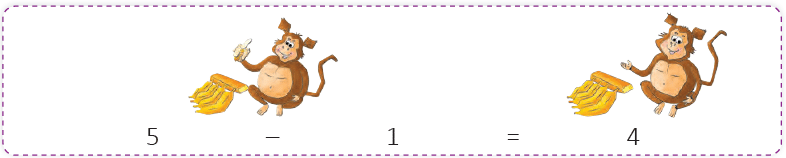
When 1 is subtracted from a number, the difference is the number that is just before it.
3. Subtracting a number from itself
A monkey has 4 bananas. The monkey ate all of them. No bananas are left with him now.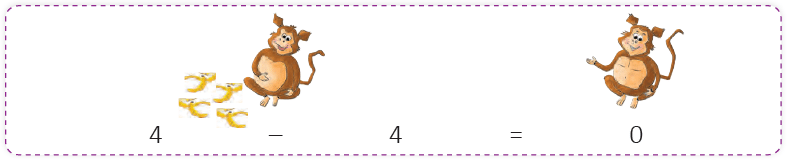
When a number is subtracted from itself the difference is 0.
Subtraction Using Backward Counting on a Number Line
- To subtract 4 from 10, we first start with the bigger number 10 then move 4 steps (ones) backward as shown.
 We reach at 6. So, 10 - 4 = 6.
Subtracting within 20
Subtracting a 1-digit number from a 2-digit number
Case 1: When the ones digit is the same in both the numbers.
- Yajur has 15 paperclips. He lost 5 of them. How many paper clips are left with him?
Ans: To find how many paper clips are left, we subtract the ones digit first. 5 ones - 5 ones = 0 ones. (As subtracting the number from itself gives 0.)
Write the tens digit (1) as it is.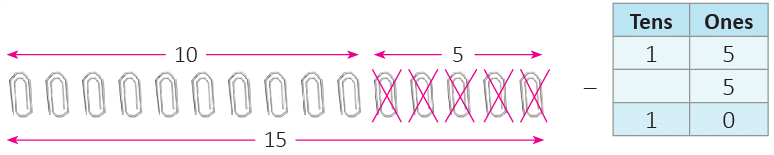 So, 15 - 5 = 10.
Case 2: When the ones digit in a 2-digit number is greater than the 1-digit number.
- There were 16 ants in a line. 4 ants diverged from the line. How many ants are left in the line now?
Ans: To find how many ants are left in the line, we subtract the ones digit first.
6 ones - 4 ones = 2 ones.
Write 2 below the ones column.
Now, write 1 as it is in the tens place as shown.
So, 16 - 4 = 12.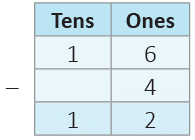
Thus, there are 12 ants left in the line now.
Subtracting by Backward Counting
- To subtract 5 from 17, we begin at 17 and count 5 ones backward.

We reach 12. So, 17 - 5 = 12.
Subtraction: Backward Counting on a Number Line
- Look at the number line shown below. It shows the numbers from 0 to 20.

- Let us subtract 6 from 14. We start with the bigger number 14 and jump back 6 steps (ones).
 We reach at 8. So, 14 - 6 = 8.
Subtraction Stories in Real Life Situations
 Sheetal has 19 pencils. She gave 5 pencils to her brother Parag.
Parag: How many pencils are left with you now?
Sheetal: 14
Parag: How?
Sheetal: I subtracted the pencils given to you from the total number of pencils I had as follows.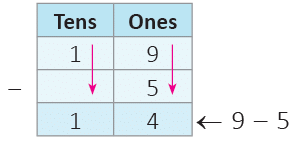
So, 19 - 5 = 14.
You can also count backward to subtract. Start from 19 and count back 5 ones as 19, 18, 17, 16, 15, 14.
Sheetal: This is how I am left with 14 pencils.
Addition and Subtraction Relationship
For example, in the picture below there are 4 pineapples in the first set and 2 pineapples in the second set, so we say there are 6 pineapples altogether and we can write 4 + 2 = 6.

If we start with 6 pineapples and take away 2, we are left with 4.
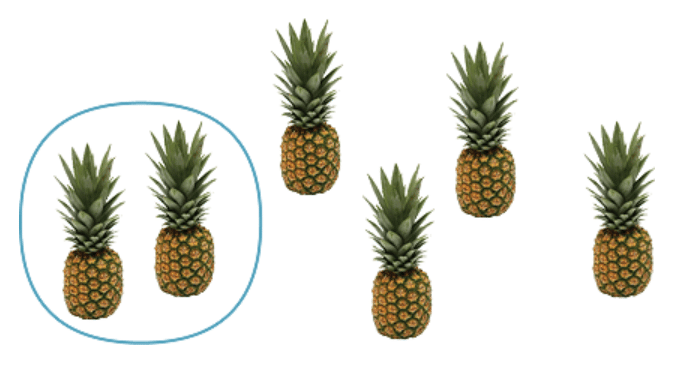
We can write 6 − 2 = 4.
|
15 videos|135 docs|23 tests
|
FAQs on Addition and Subtraction Up to 20 Class 1 Notes Maths
| 1. What is addition? |  |
| 2. How does addition work up to 20? | |
| 3. What is subtraction? | |
| 4. How does subtraction work within 20? | |
| 5. What is the relationship between addition and subtraction? | |




study material
,Previous Year Questions with Solutions
,ppt
,Semester Notes
,mock tests for examination
,Objective type Questions
,Sample Paper
,practice quizzes
,Addition and Subtraction Up to 20 Class 1 Notes Maths
,Viva Questions
,Addition and Subtraction Up to 20 Class 1 Notes Maths
,Summary
,Free
,video lectures
,Important questions
,past year papers
,Addition and Subtraction Up to 20 Class 1 Notes Maths
,Exam
,Extra Questions
,MCQs
,shortcuts and tricks
;




Chapter Notes: Addition and Subtraction Up to 20 Free PDF Download
Importance of Chapter Notes: Addition and Subtraction Up to 20
Chapter Notes: Addition and Subtraction Up to 20
Chapter Notes: Addition and Subtraction Up to 20 Class 1 Questions
Study Chapter Notes: Addition and Subtraction Up to 20 on the App
|
© EduRev
|
Education Revolution
|


|




