Class 8 Maths Chapter 1 Case Based Questions - Number System

Q1: Democracy has given people a powerful right- that is to VOTE. In India, every citizen over 18 years of age has the right to vote. Instead of enjoying it as a holiday, one must vote if he/she truly wants to contribute to the nation-building process and bring about a change.
A survey was done in a small area in which 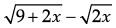 voters were men and
 voters were women.
Read the above statement carefully and answer the following :
Which mathematical concept is used here?
(a) Number system
(b) Circle
(c) Area
(d) Statistics
Sol:
Correct Answer is Option (a)
Number system: A numeral system (or system of numeration) is a writing system for expressing numbers that is, a mathematical notation for representing numbers of a given set, using digits or other symbols in a consistent manner. The number the numeral represents is called its value.
Q2: Democracy has given people a powerful right- that is to VOTE. In India, every citizen over 18 years of age has the right to vote. Instead of enjoying it as a holiday, one must vote if he/she truly wants to contribute to the nation-building process and bring about a change.
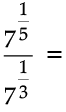
A survey was done in a small area in which voters were men andvoters were women.
Read the above statement carefully and answer the following :
(a)
(b)
(c)
(d)
Sol:
Correct Answer is Option (a)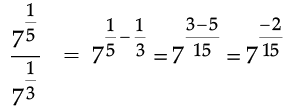
Q3: Democracy has given people a powerful right- that is to VOTE. In India, every citizen over 18 years of age has the right to vote. Instead of enjoying it as a holiday, one must vote if he/she truly wants to contribute to the nation-building process and bring about a change.
A survey was done in a small area in which voters were men andvoters were women.
Read the above statement carefully and answer the following :
Find x, if number of men is equal to number of women.
(a) 6
(b) 5
(c) 8
(d) 9
Sol:
Correct Answer is Option (c)
∴ 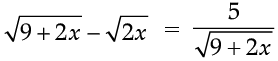
⇒ 
⇒ 
⇒ 9 + 2x – 5 = 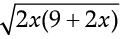
⇒ 4 + 2x = 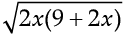
Squaring both sides,
(4 + 2x)2 = 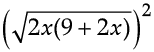
⇒ 16 + 4x2 + 16x = 18x + 4x2
⇒ 16 = 2x
⇒ x = 8
Q4:Democracy has given people a powerful right- that is to VOTE. In India, every citizen over 18 years of age has the right to vote. Instead of enjoying it as a holiday, one must vote if he/she truly wants to contribute to the nation-building process and bring about a change.
A survey was done in a small area in which voters were men andvoters were women.
Read the above statement carefully and answer the following :
Q. ap . aq =
(a) ap + q
(b) ap – q
(c) apq
(d) (pq)a
Sol:
Correct Answer is Option (a)
ap + q
ap . aq = ap + q
Q5:Democracy has given people a powerful right- that is to VOTE. In India, every citizen over 18 years of age has the right to vote. Instead of enjoying it as a holiday, one must vote if he/she truly wants to contribute to the nation-building process and bring about a change.
A survey was done in a small area in which voters were men andvoters were women.
Read the above statement carefully and answer the following :
Q. If r is rational and s is irrational, then which statement is false?
(a) r + s is irrational number.
(b) r – s is rational number.
(c) rs is irrational number.
(d) r/s is irrational number.
Sol:
Correct Answer is Option (b)
r – s is rational number.
Reason : This statement is false. The difference between a rational number (r) and an irrational number (s) can be either rational or irrational. There is no general rule that says the difference of a rational and an irrational number must be rational. Counterexamples can easily be constructed to show that the difference could be either rational or irrational.
Q6: In a school 5 out of every 7 children participated in ‘Save wild life’ campaign organised by the school authorities.
What is the value of 5/7 ?
(a) 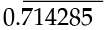
(b) 1.4
(c) 1.414
(d) 1.7142
Sol:
Correct Answer is Option (a)
5 ÷ 7 = 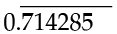
Q7: In a school 5 out of every 7 children participated in ‘Save wild life’ campaign organised by the school authorities.
How many rational numbers are there between 5 and 7.
(a) 0
(b) 1
(c) 2
(d) infinite
Sol:
Correct Answer is Option (d)
There are an infinite amount of irrational numbers between 5 and 7.
Q8:In a school 5 out of every 7 children participated in ‘Save wild life’ campaign organised by the school authorities.
What fraction of the students participated in the campaign.
(a) 2/7
(b) 5/7
(c) 4/7
(d) 7/7
Sol:
Correct Answer is Option (b)
Number of students participated in campaign = 5
Number of total students = 7
Therefore, fraction of the students participated in the campaign. = 5/7
Q9:In a school 5 out of every 7 children participated in ‘Save wild life’ campaign organised by the school authorities.
What kind of decimal expansion it has.
(a) Terminating
(b) non terminating
(c) terminating repeating
(d) non terminating repeating
Sol:
Correct Answer is Option (d)
A non-terminating, non-repeating decimal is a decimal number that continues endlessly, with no group of digits repeating endlessly. Decimals of this type cannot be represented as fractions, and as a result are irrational numbers. Non-terminating, non-repeating decimals can be easily created by using a pattern.
Q10:In a school 5 out of every 7 children participated in ‘Save wild life’ campaign organised by the school authorities.
Every rational number is a _______ number.
(a) Prime
(b) Composite
(c) real
(d) even
Sol:
Correct Answer is Option (c)
Every rational number is a real number.
It can be defined as any number that can be expressed in the p/q form where q ≠ 0. We can also say that any fraction falls under the class of rational numbers, where the denominator and numerator are integers and the denominator is not equal to zero.
|
5 videos|57 docs|20 tests
|
FAQs on Class 8 Maths Chapter 1 Case Based Questions - Number System
| 1. What is the decimal number system? |  |
| 2. What is the binary number system? | |
| 3. How do you convert a decimal number to a binary number? | |
| 4. How do you convert a binary number to a decimal number? | |
| 5. What is the hexadecimal number system? | |





mock tests for examination
,Semester Notes
,Free
,ppt
,Class 8 Maths Chapter 1 Case Based Questions - Number System
,Class 8 Maths Chapter 1 Case Based Questions - Number System
,study material
,Class 8 Maths Chapter 1 Case Based Questions - Number System
,past year papers
,Objective type Questions
,Previous Year Questions with Solutions
,Exam
,shortcuts and tricks
,video lectures
,MCQs
,practice quizzes
,Summary
,Sample Paper
,Important questions
,Viva Questions
,Extra Questions
,



Number System- Case Based Type Questions Free PDF Download
Importance of Number System- Case Based Type Questions
Number System- Case Based Type Questions Notes
Number System- Case Based Type Questions Class 8
Study Number System- Case Based Type Questions on the App
|
© EduRev
|
Education Revolution
|


|




within 7 days!