Subjective Type Questions - AI Project Cycle | Artificial Intelligence for Class 10 PDF Download

Q.1. What do you understand by data exploration? Illustrate the answer with an example.
- Data exploration refer to techniques and tools used to represent data by showing and identifying unique patterns and trends.
- It can be done by using data visualization and some other sophisticated statistical methods.
- For example, If you want to place an order online, you need to collect some facts like product reviews, ratings, and feedback given by others. All these data help to make a decision for the users.
Q.2. What are the types of Data weak AI systems?
The types of data weak AI Systems are as following:
- Heuristics or rule-based: It is a user-defined rule-based system that helps in making decisions
- Brute-Force: It uses a decision tree for analysing every possible option. AI-based chess games use these systems for analysing every possible move to find out the best approach.
- Neural Networks: Neural networks system are made to mimic the human brains. It works on different layers of the network and capable to improve its performance based on data and feedback.
Q.3. What is the importance of visualising data?
- Data visualization provide insights from data in a better way.
- Mostly data visualization is used to discover data and help in evaluation.
- The common forms of data are graphs and charts.
- These graphs are used to present data in a relationship, trends and comparisons.
Q.4. Explain some tools used for data visualization.
The following are some tools used for data visualization.
- MS Excel: It is mostly used software for data analysis and computation. It provides a wide range of features of data visualization.
- Tableau: It is used to create interactive visualization with the large and frequently updated dataset.
- QlickView: It provides some more capabilities and extensive features.
- Fusionchart: It uses javascript and capable of producing near about 100 different types of charts.
Q.5. What do you understand by data acquisition?
- Data acquisition is the second step of AI project cycle.
- It refers to collecting data from various sources and through various activities to train the model.
- The data which is collected as input can be considered as training data and the prediction data provided by the system or project is known as testing data.
Q.6. Explain the training data and testing data with an example.
- The existing data or previous data collected through various activities or sources known as training data and prediction data is known as testing data.
- For example, If someone wants to predict the salary of an employee based on previously drawn salaries into the machine, the previous salary is training data and prediction salary data is known as testing data.
Q.7. Justify the sentence – “For any AI project to be efficient, the training data should be authentic and relevant to the problem statement scoped.”
- For AI project efficiency the data needs to be relevant and authentic.
- If it is not relevant and authentic then the testing data may go wrong or produced irrelevant predictions.
- For example, while processing data for a cricket match for net run rate prediction, the testing data should be provided for batting, not bowling. If the bowler’s data will be processed as testing data then the net run rate will be predicted in the wrong direction.
- Hence, for any AI project to be efficient, the training data should be authentic and relevant to the problem statement scoped.
Q.8. What do you mean by data features?
- Data features refer to the type of data that need to be collected for an AI model or project.
- For example, if we consider an example of a cricket match then runs scored by an individual batsman, runs scored in particular overs, wickets fall, wickets runs conceded, wicket particulars etc. can be considered as data features.
Q.9. Mention the ways to collect data.
The following ways are very common to collect data:
- Surveys
- Web Scrapping
- Sensors
- Cameras
- Observations
- API
- Call or SMS or Email
- Feedback
Q.10. What are some concerns that need to be taken care of while collecting data?
- The data should be authentic
- The data should be accurate
- Collect the data from reliable sources
- Data should be open source not someone’s intellectual property
Q.11. What are the main approaches used for AI modelling?
There are two approaches mainly used for AI modelling:
- Rule-Based Approach
- Learning-Based Approach
Q.12. Explain rule-based approach in detail.
- A Rule-based approach is generally based on the data and rules fed to the machine, where the machine reacts accordingly to deliver the desired output.
- It follows the relationship or patterns in data defined by the developer.
- The machine follows the instructions or rules mentioned by the developer and performs the tasks accordingly.
- It uses coding to make a successful model.
Q.13. Explain learning-based approach in detail.
- The machine is fed with data and the desired output to which the machine designs its own algorithm (or set of rules) to match the data to the desired output fed into the machine to train.
- In the learning-based approach, the relationship or pattern in data is not defined by the developer.
- This approach takes random data which is fed into the machine and it is left to the machine to figure out the patterns or required trends.
- In general this approach is useful when the data is not labelled and random for a human to use them.
- Thus, the machine looks at the data, tries to extract similar features out of it and clusters the same datasets together.
- In the end as output, the machine tells us about the trends which are observed in the training data.
- This approach is used to train the data which is unpredictable or the users have no idea about it.
Q.14. What do you mean by decision tree?
- A decision tree is a very useful for modelling in business.
- It follows a tree like structure of decisions with all possible outputs.
- The top most node of decision tree is known as root node.
- Every node is connected with lines.
- It follows top-bottom approach. The root node is always on top and the terminal node is at the bottom.
Q.15. Define the following terms
- Root Node: The top node of decision tree is known as root node.
- Splitting: Splitting is a process by which a node is divided into two or more sub-nodes.
- Decision or interior node: It is the node where the splitting takes place. In other words, it is a place where the sub-node is divided into another sub-nodes.
- Leaf node or terminal node: The bottom node is known as leaf node or terminal node.
- Branch or Subtree: A subsection of the decision tree is known as a branch or subtree.
- Parent node and child node: The bottom node which derives from the top node is known as child node whereas the top node is known as the parent node.
Q.16. What do you mean by the neural network?
- The neural network is a model that works as neurons works in human brains.
- It is also known as ANN (Artificial Neural Networks)
- It copies the mechanism as working in human brains.
- It can extract the information without any code or programming.
- In a neural network, the machine can learn, recognize and make decisions like human beings.
Q.17. Where the neural network used?
A neural network is used in many fields where a large data set is required..
It can be used in the following:
- Voice Recognition
- Character Recognition
- Signature Verification Applications
- Human face recognition
Q.18. How does the neural network work?
- The input layers inputs or fed data
- The hidden layers process these data and assign weight to each layer randomly
- Every layer process has its own block which accomplishes the task and passes to the next layer.
- Then it comes to the output layer where machine learning executes the data received from input layers.
- Finally, the processed data passed to the output layer.
Q.19. What are the features of a neural network?
- The model of the neural network follows the mechanism of the human brain
- It extracts information without any input from the user
- It basically works on a mathematical way with machine algorithms
- Suitable for large datasets
- The top layers are input layers to fed data, hidden layers process the data, and the output layer generates output from the processed data
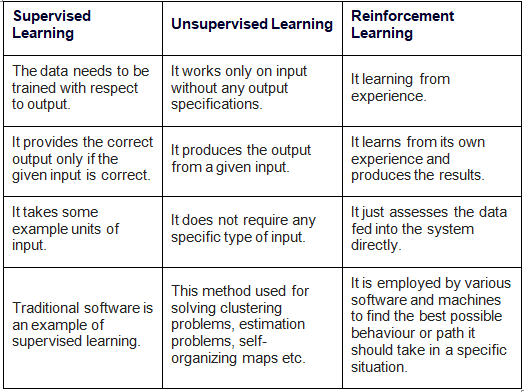
Q.20. Compare the three types of neural network learning.
The three types of neural network learning are as following:
Q.21. What are the main phases of the AI project cycle?
The AI project cycle has mainly following 5 phases:
- Problem Scoping
- Data Acquisition
- Data Exploration
- Modelling
- Evaluation
Q.22. What can be done in each phase of the AI project cycle? Write points.
The following are sub-stages of each phase of the AI project cycle:
- Problem Scoping
- Goal Setting
- Identifying the problem
- Data Acquisition
- Data Collection
- Data Requirements
- Data Exploration
- Representation of Data
- Visualizing Data
- Modelling
- Model Designing
- Feed data into the model
- Evaluation
- Project Testing
- Project Deployment
- Project Review
Q.23. What do you mean by problem scoping?
Problem scoping refers to the identification of the problem and the vision to solve it.
Problem scoping involves the following activities:
- Setting the goal
- Identifying the problem
- Problem Definition
- Brainstorming, designing, building, testing
- Showcasing or sharing the task
Q.24. What is the importance of problem scoping in the AI project cycle?
- The problem scoping mainly focus on the identification of the problem and setting the goal.
- It starts with a problem definition followed by brainstorming, designing, building, testing and showcasing or sharing the task.
- Without problem scoping, all other stages turn out to be useless.
- If the problem scoping has some errors it either results in the failure of the project or delay in the project.
Q.25. How goal setting can be helpful in problem scoping?
- Goal setting always helps to solve a specific problem.
- In problem scoping, the goal can be set to be achieved after determining the problem.
- Sometimes goals help us to find out the reasons for the problem.
- Goal setting can be also helpful in reducing the challenges to solve any problem.
- Goal setting also makes the procedures easy and specific.
Q.26. What do you mean by 4Ws canvas?
The 4Ws canvas helps in getting a better understanding before actually start the project.
It includes the following four questions:
- who – refers to the people getting affected directly or indirectly by the problem
- what – determine the nature of the problem
- where – the context/situation/location
- why – solution or benefits of the solution
Q.27. Explain all 4Ws in details for 4Ws canvas.
- Who
- Under this w, the stakeholders and related things can be explored
- Stakeholders are the people who are facing the problem and can be benefited after the solution
- Here two questions are very important
(i) Who are the stakeholders?
(ii) What do you know about them?- What
- Here you need to look into the problem and understand what is the problem
- How do you know that it is the problem
- Where
- This question focuses on the context/situation/location
- Why
- Why canvas focuses on the solutions and benefits to the stakeholders from the solutions.
|
24 videos|64 docs|8 tests
|
FAQs on Subjective Type Questions - AI Project Cycle - Artificial Intelligence for Class 10
| 1. What is the AI project cycle? |  |
| 2. What is the importance of problem identification in the AI project cycle? | |
| 3. How does data collection and preprocessing contribute to the AI project cycle? | |
| 4. What is model training and evaluation in the AI project cycle? | |
| 5. Why is continuous improvement important in the AI project cycle? | |




Subjective Type Questions - AI Project Cycle | Artificial Intelligence for Class 10
,Semester Notes
,past year papers
,study material
,Subjective Type Questions - AI Project Cycle | Artificial Intelligence for Class 10
,Exam
,mock tests for examination
,Viva Questions
,video lectures
,Previous Year Questions with Solutions
,ppt
,Objective type Questions
,Subjective Type Questions - AI Project Cycle | Artificial Intelligence for Class 10
,Sample Paper
,practice quizzes
,shortcuts and tricks
,Extra Questions
,Important questions
,MCQs
,Free
,Summary
;



Subjective Type Questions - AI Project Cycle Free PDF Download
Importance of Subjective Type Questions - AI Project Cycle
Subjective Type Questions - AI Project Cycle Notes
Subjective Type Questions - AI Project Cycle Class 10
Study Subjective Type Questions - AI Project Cycle on the App
|
© EduRev
|
Education Revolution
|


|




