CBSE Class 7  >  Class 7 Notes  >  English Grammar   >  Modal Auxiliaries

Modal Auxiliaries - English Grammar Class 7 PDF Download

Fundamentals

Modals are helping verbs that show the mode or manner of the action expressed by the main verb. They express ideas such as ability, possibility, probability, permission, obligation, advice, intention, and wish. The commonly used modals include shall, should, will, would, can, could, may, might, must, ought to, used to, need, and dare.

Uses of Modals

Modals are used in specific situations. Below are the main uses with examples.

Ask permission

  • May, can, could
  • May I come in?
  • Could I use your pen, please?

Make a request

  • Can, could
  • Could you please give me the doctor’s telephone number?

Express a possibility

  • May, might, could
  • It might rain during the night.

Give advice or suggestion

  • Should
  • You should wear a helmet while riding your motorbike.

Express necessity or compulsion

  • Must, have to
  • We must slow down while driving in front of the school.
  • I have to submit my project by tomorrow.

Express prohibition

  • Must not (mustn't)
  • You must not talk loudly in the library.

Express a promise or intention

  • Will, shall
  • I will mail you my address.

Express a wish

  • May
  • May you have a long life!

General Rules about Modals

Unchanging form: A modal does not change according to the person or number of the subject. For example:

  • He can learn. I can learn. You can learn. They can learn. We can learn.

With base verb: A modal is always followed by the main verb in its base (infinitive without to) form.

  • I can run. I may run. I could run. I might run.

Used alone in responses: Modals can be used without repeating the main verb when replying to questions.

  • Can you sing? - I can.
  • Will you sing? - I will.
  • Will you come? - I may. / I will.

Negatives and contractions: When a modal is joined with not to form a negative, common contractions are used.

  • I cannot run. - I can’t run.
  • I will not run. - I won’t run.
  • Note: ordinary verbs use do-support for negatives (I do not run - I don’t run).

Model Verb: Can

Model Verb: Can

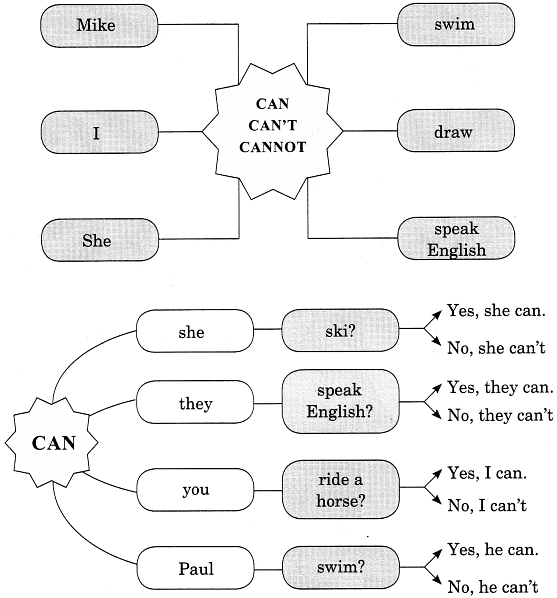
Can primarily expresses ability, permission, and sometimes possibility. Could is the past form for ability, and it is also used as a polite form for requests.

  • Ability (present): She can swim very well.
  • Ability (past): When he was younger, he could run fast.
  • Permission: You can go now. / Could I leave early?
  • Polite request: Could you open the window, please?
  • Possibility (less certain): It could snow tonight.

Would / Will and May / Might

Would / Will and May / Might

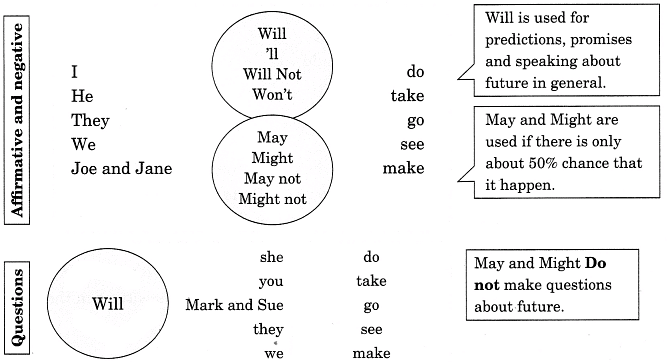
Will is used for future actions, promises, and decisions made at the moment of speaking. Would is the past form of will in reported speech and is used for polite offers, requests, and hypothetical situations.

  • Future / promise: I will mail you my address.
  • Polite request / hypothetical: Would you help me with this?
  • Reported speech: He said he would come.

May expresses permission and possibility (often slightly more formal). Might is the past form or a weaker form of may, used to show lower probability.

  • Permission / formal: May I leave the room?
  • Possibility (medium): It may rain later.
  • Possibility (weaker): It might rain during the night.

Should and Must

Should and Must

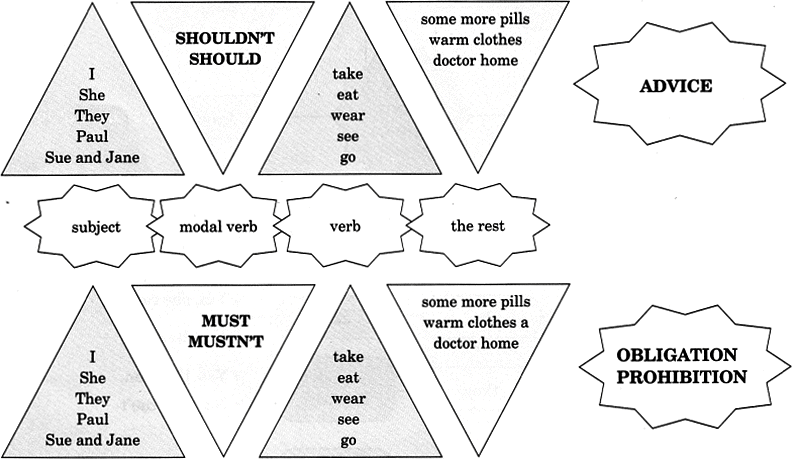
Should is used to give advice, suggestions, or to indicate what is the right or sensible thing to do. Must expresses strong obligation, necessity, or logical conclusion. For obligations that come from external rules, people often use have to.

  • Advice / suggestion: You should wear a helmet while riding your motorbike.
  • Obligation / necessity: We must slow down while driving in front of the school.
  • External necessity: I have to submit my project by tomorrow. (The obligation comes from a rule or situation.)
  • Prohibition: You must not talk loudly in the library. (Must not = mustn’t = not allowed)

Semi‑modals and Other Forms

Certain expressions behave like modals but have slightly different grammar. These include ought to, used to, need and dare.

  • Ought to - advice or moral obligation: You ought to apologise.
  • Used to - past habits or states: I used to live near the station.
  • Need - necessity; when used as a modal in negatives/questions it can omit do-support: Need we go now? / You need not come. (But often we use do-support: Do we need to go now?)
  • Dare - courage to do something; can be modal in negative/question forms: Dare he go alone? / She dare not speak. (Often we use the full verb: She does not dare to speak.)

Formation of Questions and Negatives with Modals

To form a question with a modal, invert the modal and the subject. The main verb remains in the base form.

  • Can you swim?
  • Will she come tomorrow?
  • Should we start now?

To form a negative, place not after the modal. Many negatives use contractions in speaking and informal writing (can’t, won’t, mustn’t).

  • I cannot (can’t) go.
  • She will not (won’t) agree.
  • You must not (mustn’t) enter.

Common Confusions and Clarifications

Must vs have to: Use must when the speaker imposes the necessity or when an obligation is strong and internal. Use have to for obligations coming from regulations, rules, or external situations.

May vs can for permission: May is more formal than can. In spoken English, can is used commonly for permission (Can I go out?).

Could vs would: Could is often used for polite requests or past ability. Would is used for polite offers/requests and hypothetical situations.

Mind Map of Modals

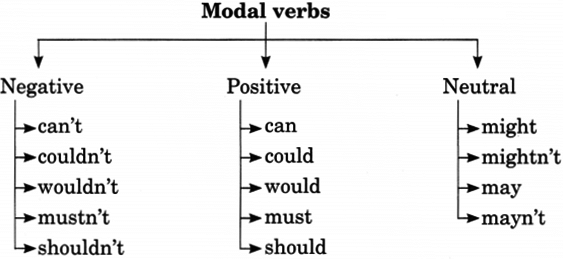
Mind Map of Modals

Summary

Modals are special helping verbs that do not change with person or number and are followed by the base form of the main verb. They express ability, permission, possibility, obligation, advice, intention, and wishes. Learn the common modals and their typical uses, practise forming questions and negatives, and note the slight differences between similar modals (for example, may/might, must/have to, can/could).

The document Modal Auxiliaries - English Grammar Class 7 is a part of the Class 7 Course English Grammar Class 7.
All you need of Class 7 at this link: Class 7
39 videos|317 docs|61 tests

FAQs on Modal Auxiliaries - English Grammar Class 7

1. What are modal auxiliaries?
Ans. Modal auxiliaries are a type of auxiliary verb that is used to express various meanings such as ability, possibility, permission, and obligation. They include words like can, could, may, might, must, shall, should, will, would, and ought to.
2. How are modal auxiliaries different from regular verbs?
Ans. Modal auxiliaries are different from regular verbs in several ways. Firstly, they do not change their form for different subjects - they remain the same regardless of whether the subject is singular or plural. Secondly, they are always followed by a base form of the main verb without the addition of "to." Lastly, they do not have past tense forms or infinitive forms.
3. What are some examples of sentences using modal auxiliaries?
Ans. Here are some examples of sentences using modal auxiliaries: - She can play the piano. - We should go to the park. - They must finish their homework. - He might come to the party. - I will help you with your project.
4. Can modal auxiliaries be used to express past actions?
Ans. No, modal auxiliaries cannot be used to express past actions on their own. To express past actions, a combination of modal auxiliaries and the perfect infinitive form of the main verb is used. For example, "She could have finished the race" or "They should have studied harder."
5. How do modal auxiliaries change in question form?
Ans. To form a question using modal auxiliaries, the modal verb is placed at the beginning of the sentence before the subject. The order of the subject and verb is inverted. For example, "Can she play the piano?" or "Should we go to the park?"
Related Searches
mock tests for examination, Objective type Questions, Semester Notes, Modal Auxiliaries - English Grammar Class 7, Previous Year Questions with Solutions, Viva Questions, ppt, past year papers, shortcuts and tricks, Summary, Sample Paper, video lectures, Exam, Important questions, Modal Auxiliaries - English Grammar Class 7, Extra Questions, pdf , MCQs, practice quizzes, study material, Modal Auxiliaries - English Grammar Class 7, Free;