Missing Number in box problems | SSC CGL Tier 2 - Study Material, Online Tests, Previous Year PDF Download
Problem 1
Find the missing number ?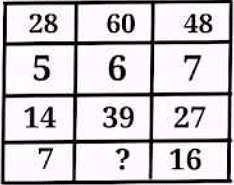
a) 27
b) 24
c) 18
d) 23
Step 1.
Subtract the number in first column from the number in third column of every row. i. e. C3 - C1 = S
Step 2 .
Multiply the the above difference with 3 to get the numbers in second column of every row i. e. C2 = 3S.
1st row 3 (48 - 28 ) = 3 × 20 = 60
2nd row 3 (7 - 5) = 2 × 3 = 6
3rd row 3(27 - 14) = 3 × 13 = 39
4th row 3(16 - 7 ) = 3 × 9 = 27
Hence required number is 27
Option (A) 27 is correct option
Problem 2
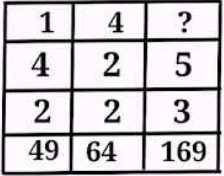
Find the missing number ?
 a) 4
a) 4
b) 3
c) 5
d) 6
Every number in fourth row has been written as the square of all the numbers in 1st three rows in any particular column.
Take the square of addition of the elements of 1st three rows of 1st column like this(1 + 4 + 2 )² = 7² = 49Take the Take the square of addition of the elements of 1st three rows of 1st column like this(4 + 2 + 2 )² = 8² = 64Take the square of addition of the elements of 1st three rows of 1st column like this
(? + 5 + 3 )² = (? + 8 )² = 169
(? + 8 )² = (13)² = 169 , Taking Square root
? + 8 = 13
? = 13 - 5
? = 5
So required number will be 5
Option (C) 5 is correct option

Problem 3
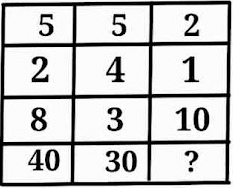
Find the missing number ?
a) 20
b) 13
c) 12
d) 10
Multiply all the numbers in the first three rows of every column and then divide the product by 2 to get the number in last row like this
(5×2×8)÷2 = 80÷2 = 40 ( Last number in 1st column )
(5×4×3)÷2 = 60÷2 = 30 ( Last number in 2nd column )
(2×1×10)÷2 = 20÷2 = 10 ( Last number in 3rd column )
So required number will be 10
Option (D)10 is correct option.
Problem 4
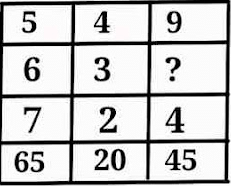
Find the missing number ?
a) 1
b) 2
c) 4
d) 3
Adding both the numbers in second and third rows then multiply it with the number in First row to get the number in last row ,the process will be repeated for all the three columns
( 6 + 7 ) × 5 = 65
( 3 + 2 ) × 4 = 20
( ? + 4 ) × 9 = 45
This implies ( ? + 4 ) = 45/9 = 5
? = 5 - 4 = 1
Hence required number is 1
Option (A) 1 is correct option.
Problem 5
Find the missing number ?
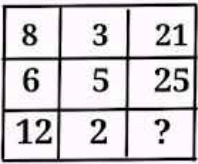
a) 24
b) 22
c) 20
d) 19
Decrease the numbers in first columns of every row by 1 then multiply it to get the number in third column of every row.
1st Row ( 8 - 1) × 3 = 7 × 3 = 21
2nd Row ( 6 - 1) × 5 = 5 × 5 = 25
3rd Row ( 12 - 1) × 2 = 11 × 2 = 22
Hence required answer is 22
Option (B) 22 is correct option.
Problem 6
Find the missing number ?
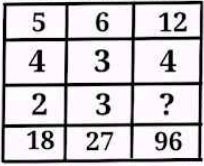
a) 4
b) 3
c) 5
d) 6
Add 1st two rows of each column to multiply with the number in 3rd column to get fourth number in every row.
(5 + 4 ) × 2 = 9 × 2 = 18 (1st column 3rd row )
(6 + 3 ) × 3 = 9 × 3 = 27 ( 2nd column 3rd row )
(12 + 4 ) × ? = 16 × ? = 96 (3rd column 3rd row )
16 × ? = 96
? = 6
Hence required number is 6
Option (D) 6 is correct option.
 |
Download the notes
Missing Number in box problems
|
Download as PDF |
Problem 7
Find the missing number ?
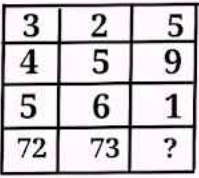
a) 74
b) 63
c) 65
d) 60
First of all multiply 1st three numbers in every Column then add the sum of 1st three numbers in every row to get the numbers in 4th row. i. e. formula for this problem is [ if a, b ,c and d are numbers in any column then d = abc + (a+b+c) ]
[ ( 3 + 4 + 5) + (3 × 4 × 5 ) ] = 12 + 60 = 72
[ ( 2 + 5 + 6) + (2 × 5 × 6 ) ] = 13 + 60 = 73
[ ( 5 + 9 + 1) + (5 × 9 × 1 ) ] = 15 + 45 = 60
Hence required number is 60
Option (D)60 is correct option.
Problem 8
Find the missing number ?
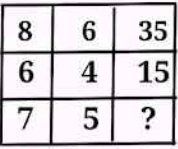
a) 24
b) 35
c) 12
d) 37
Decrease both the numbers in first and second columns of every row then multiply the reduced numbers to get the numbers in third column of every row
{ 8 - 1 }×{ 6 - 1 } = 7 × 5 = 35
{ 6 - 1 }×{ 4 - 1 } = 5 × 3 = 15
{ 7 - 1 }×{ 5 - 1 } = 6 × 4 = 24
Hence required number is 24.
Option (A)24 is correct option.
 |
Take a Practice Test
Test yourself on topics from SSC CGL exam
|
Practice Now |
Problem 9
Find the missing number ?
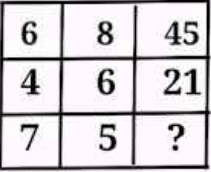
a) 66
b) 24
c) 36
d) 37
Decrease the numbers in first column of every row and increase the numbers in second column of every row when multiplying both the reduced number of first and second column to get the numbers in third column of every row
{ 6 - 1 } × { 8 + 1 } = 5 × 9 = 45
{ 4 - 1 } × { 6 + 1 } = 3 × 7 = 21
{ 7 - 1 } × { 5 + 1 } = 6 × 6 = 36
Hence required number is 36
Option (C)36 is correct option.
Problem 10
Find the missing number ?
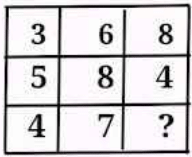
a) 7
b) 9
c) 8
d) 6
Total of 1st row is 3 + 6 + 8 = 17
Total of 2nd row is 5 + 6 + 8 = 17
Total of 3rd row is 4 + 7 + ? = 17
Therefore replacing ? with 6 to get required answer.
Option (D)6 is correct option
|
1366 videos|1313 docs|1016 tests
|

FAQs on Missing Number in box problems - SSC CGL Tier 2 - Study Material, Online Tests, Previous Year
| 1. What are missing number in box problems? |  |
| 2. How do I solve missing number in box problems? | |
| 3. Are there any specific strategies to solve missing number in box problems? | |
| 4. Can missing number in box problems be solved using trial and error? | |
| 5. Where can I find additional missing number in box problems to practice? | |




Semester Notes
,Previous Year
,Missing Number in box problems | SSC CGL Tier 2 - Study Material
,Missing Number in box problems | SSC CGL Tier 2 - Study Material
,Online Tests
,study material
,Sample Paper
,Viva Questions
,past year papers
,Summary
,video lectures
,Previous Year Questions with Solutions
,ppt
,Extra Questions
,Online Tests
,MCQs
,Previous Year
,Free
,shortcuts and tricks
,Exam
,mock tests for examination
,Online Tests
,Missing Number in box problems | SSC CGL Tier 2 - Study Material
,Previous Year
,practice quizzes
,Important questions
,Objective type Questions
;




Missing Number in box problems Free PDF Download
Importance of Missing Number in box problems
Missing Number in box problems Notes
Missing Number in box problems SSC CGL Questions
Study Missing Number in box problems on the App
|
© EduRev
|
Education Revolution
|


|




