Syllabus and Strategy for Reasoning


Reasoning checks your mental ability as in your decision-making skills or your ability to analyze different aspects. Reasoning makes you think rationally, it will help you to make decisions efficiently and effectively. So as to make sure you excel in this skill during exams and in everyday life ahead, EduRev has prepared this step by step guide for the Reasoning Section to help aspirants like you score great marks in the Reasoning section of your Banking Exam.
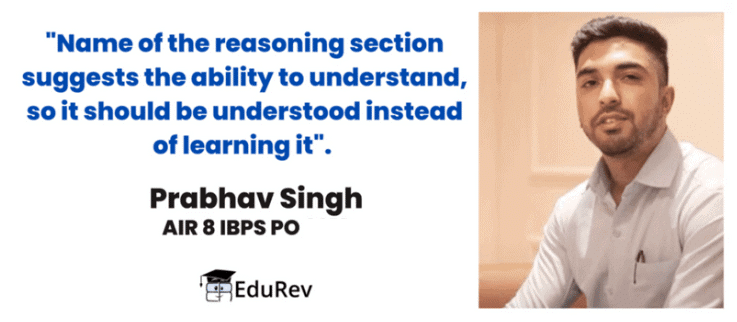 Importance of Reasoning Section in banking exams
We all know that reasoning aptitude helps in measuring the mental, verbal and numerical ability of an individual to evaluate his/her inborn skills and capacity for learning and acquiring new skills.
You will need logical reasoning ability in future to make important decisions of bank you are working in
It is a vital element included in every competitive exam to judge the mental strength of the aspirants.
Due to these reasons, Reasoning aptitude is included to enhance the mental skills of the candidates.
Through EduRev's Step-by-step guide you'll be able enhance your skills in the reasoning section of banking exams
Step by Step guide for Reasoning
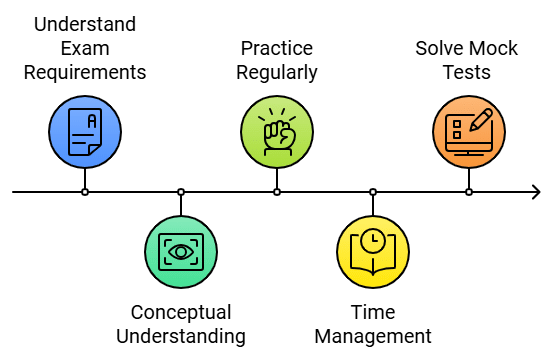
Step 1: Understand the Weightage, Exam Pattern and Syllabus of the section
It's critical to have a thorough understanding of the exam's specific requirements before beginning to study.
Weightage of Reasoning
- It is present at both stages. It is for 35 marks in prelims and in mains, it is for 60 marks which includes computer aptitude as well.
- There is a negative marking of 0.25 marks per incorrect option.
- The average time to solve this section is 20 minutes in prelims and 60 minutes in mains.
- There is one mark for the correct answer.
Exam Pattern of Reasoning
| Exam | No. of Questions | Maximum Marks | Duration |
| Prelims | 35 | 35 | 20 Minutes |
| Mains (PO) | 45 | 60 | 60 Minutes |
| Mains (Clerk) | 50 | 60 | 45 Minutes |
Syllabus of Reasoning
| For Prelims | For Mains |
Verbal Reasoning | |
Double line-up | |
Scheduling | |
| Syllogism | |
| Data sufficiency | |
| Coding Decoding | |
| Analytical Decision Making |
According to the latest trend of examinations, 60-70 % of questions of reasoning asked in the exam are only puzzles. Other important topics like Logical Reasoning, Syllogism, Data Sufficiency, Direction and Distance, Blood Relation, Ranking, Direction Sense, etc.
Step 2: Conceptual understanding is important!
- No questions should be solved without acquiring the knowledge of the concept first. You need to understand the basics of the topics. You should understand that if he/she does not focus on concept learning, it'll take a longer time to attempt the question and the accuracy level will not be high
- You should refer to the videos in the Reasoning Ability playlist to understand and test your abilities.
First focus on puzzles and seating arrangement as 60-70% of the questions of reasoning are from these two topics only. One needs to build strong basics on these topics so to be able to attempt the maximum number of questions.
Once you've built a strong foundation of these two topics, move on to the other topics like:
These topics are very easy to understand. These are just one liner questions which help you score more while occupying less time. You SHOULD practice puzzles and seating arrangement questions while practising these topics.
Once you're done with concept learning, move on to practising these topics.
Step 3: Practice more often
Acquired the knowledge? Time to enhance your skills.
Once you've learnt the concept, keep practising the different sets of questions.
1. Puzzle / Seating Arrangement
- Start with an easy level of questions. Don't jump to mains-level questions
- Solve at least 2-3 sets of such types of questions each.
- Once you're a little confident about the topics, move on to the main level of questions along with the pre-level questions. Solve 1 set of mains level and 5-6 sets of pre-level.
- Aim to get to 10+ sets of pre-level sets and 1 set of mains level questions daily.
2. Syllogism
- Syllogism will help you to get a score if you are good at it.
- It is true that syllogism is one of the scoring and easiest topics of the reasoning section.
- Solve at least 10 questions daily
3. Coded inequalities
- Direct and coded inequality questions are frequently asked in the prelims of banking exams.
- For this, you should be aware of the symbol's fundamental meanings and their relative importance, such as the difference between < and >= or and =.
- While practising, be clear when dealing with either-or and neither-nor cases.
- Solve at least 10 questions daily
4.Coding Decoding
- Questions can be asked from both old as well as new patterns.
- You have to learn all the basic rules of the topic before attempting the questions.
- Revise all the basic rules of the topic and practice its questions for deep understanding.
- This topic generally comes under the easy category. Hence, it will be easier to get good marks on this topic.
- Solve at least 10 questions daily
5. Blood Relation
- Understand All Patterns: Questions can be asked from both old and new patterns, so be prepared for both.
- Master Basic Rules: Learn the fundamental rules of blood relations before attempting the questions.
- Revise Regularly: Revisit the basic rules and practice questions to gain a deeper understanding.
- Easy to Score: Blood relation questions are generally easier, making it a scoring section.
- Daily Practice: Solve at least 10 blood relation questions every day to improve your speed and accuracy.
6. Direction Sense
- Direction sense questions are commonly asked in the prelims of banking exams.
- For this, you should understand the basic concepts of directions (North, South, East, West) and how to calculate movements based on given information.
- Be clear on concepts like straight, right, and left turns, and how to determine distances and angles.
- Practice interpreting complex directional problems and solving them efficiently.
- Solve at least 10 direction sense questions daily to enhance your accuracy and speed.
7. Alphanumeric Series
- For this, you should be familiar with the arrangement of numbers and letters in a sequence and how they follow a specific pattern.
- Understand the logic behind the patterns, whether it's based on letter positioning, numeric operations, or both combined.
- Be clear on handling alternating sequences, skipped sequences, and identifying the next character in the series.
- Solve at least 3 set of alphanumeric series daily to improve your speed and understanding of the patterns.
8. Logical reasoning
- The questions asked from this topic are based on assumptions, a course of action, cause and effect, conclusions, the strength of arguments, interference, etc.
It is important to practice Reasoning verbal as much as possible.
The questions asked from this topic are always of a moderate level. Hence, it is easy to attempt more questions without wasting time.
Puzzles may occasionally be blended with other exam topics, such as age categories and blood relation, etc to raise the exam's difficulty level. After answering the other, less challenging questions, you simply need to try these last. You can attempt EduRev's practice test series.
Step 4: Manage your time wisely
The main aim of any aspirant should be to conquer the speed in such questions.
Once you've built the foundation of your concepts and have practiced enough, your speed will automatically increase. But now it's time to enhance that speed.
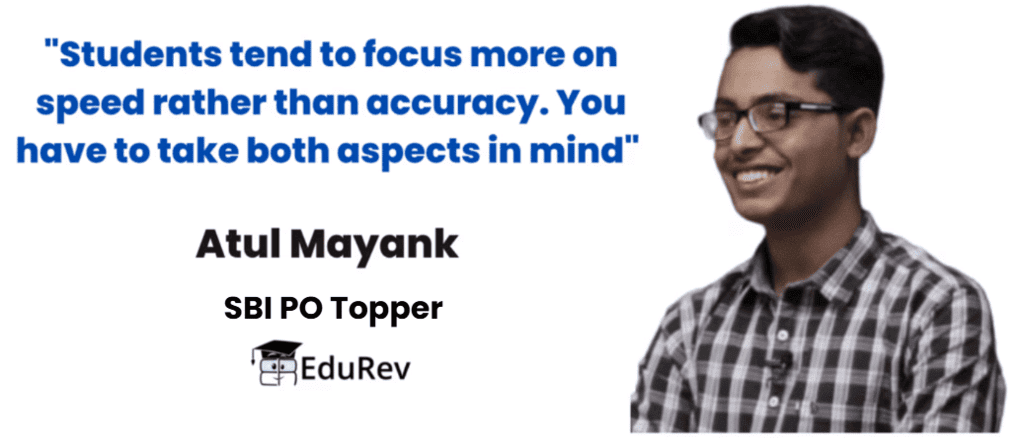
While answering questions, set a timer so you can evaluate how much practise you still need to get. EduRev provides you to test your skills. You can check the Mock Test for Banking and Past year papers playlist here
Step 5: Solve a lot of Mock Tests
- Start giving mocks. Initially, you need not give many mock tests but week by week give at least 2 Mock tests. Gradually increase the frequency of the Mocks. This will help you identify your weak and strong areas.
- Gradually start giving 1 mock test everyday.
- Once you start giving a lot of tests, you will discover in your analysis the strong and the weak areas in your preparation.
- You can practice your Mock test from the EduRev platform with a time limit.
- EduRev automatically analyzes your exam based on your speed and accuracy.
Tips to score more in the Reasoning Section for Banking Exam:
- As puzzle carry the highest weightage, practice different number of puzzles and Seating Arrangement for the Reasoning section in IBPS, SBI, RRB, Insurance Exams.
- Questions from other topics like blood relations and direction can also be asked in the form of a puzzle. Do not ignore any of the kind. This will make you lose marks in the Reasoning section for IBPS PO.
- An important tip to solve difficult puzzles with 100% accuracy is to make 2-3 possibilities for the same puzzle and keep cancelling them out as you proceed. Another important point to bear in mind while doing puzzles is not to ignore the important key points while reading the question.
- If you are good at grasping the information and reading, go for the puzzle first in the exam. Assuming you manage to solve a single puzzle, it will fetch you at least 5 marks depending on the number of questions that are being asked based on that puzzle.
- If you are good at miscellaneous topics or verbal reasoning, go for them. This will help you secure marks for yourself.
- Do not waste too much of your time on a single question. If you can not solve it within seconds, skip it for later.
- The questions asked from Logical Reasoning are based on cause and effect, a course of action, assumptions, conclusions, the strength of arguments, inferences, etc. The number of expected questions on this topic is typically 5 to 6. The level of questions has always been moderate, so you can easily attempt the questions without wasting much of time on them.
The more you practice, the better you will become. Only practice can lead to reaching your goal. So, to let you practice and ace the score in the Reasoning Section in SBI, IBPS , Insurance exam, EduRev provides you with detailed course for Mock Tests and Previous Year Questions, check it out here.
Knowledge is of no value unless you put it in practice. Work hard, keep practicing, and everything will come up roses in the end.
Check out the sectional strategies here:
FAQs on Syllabus and Strategy for Reasoning
| 1. What are the main topics covered in the reasoning section for RBI Grade B exams? |  |
| 2. How should I prepare for seating arrangement and puzzle questions in RBI Grade B reasoning? | |
| 3. What's the best strategy for coding-decoding problems in RBI Grade B mock tests? | |
| 4. Why am I struggling with blood relations and logical reasoning concepts? | |
| 5. How much time should I spend practising reasoning questions before the RBI Grade B exam? | |