Study Notes: Intelligence Tests


Intelligence tests are standardised instruments designed to measure an individual's cognitive abilities relative to a defined population. They provide an estimate of a person's intellectual functioning often expressed as an Intelligence Quotient (IQ) or a profile of abilities. Tests differ in how they are administered (to one person or many), the medium used (language-based or non‐verbal), the skills they assess, and their uses in educational and psychological practice.
Classification of intelligence tests
- Individual tests: Administered to a single examinee at one time by a qualified examiner. They permit flexible probing, observation of behaviour during testing, and usually provide a detailed profile of strengths and weaknesses.
- Group tests: Administered to many examinees simultaneously by one proctor. They are efficient for screening or surveying large numbers, but do not allow individual probing or observation during the test.
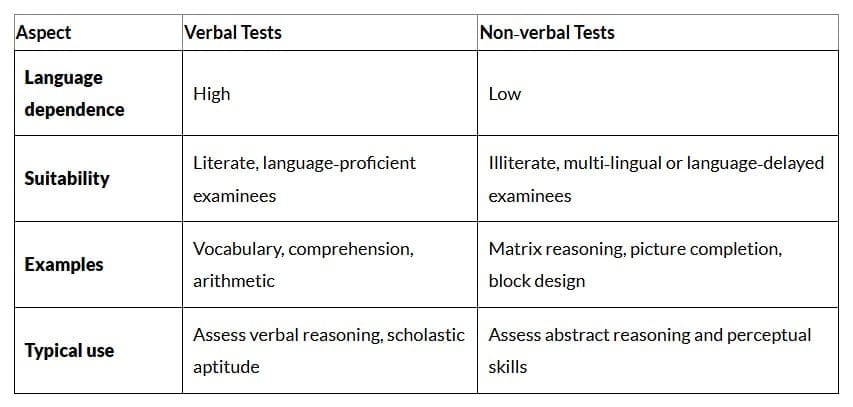
- Verbal tests: Rely primarily on language-oral or written-for items and instructions. Typical tasks include vocabulary, comprehension, arithmetic word problems, similarities, and verbal analogies.
- Non‐verbal (performance) tests: Minimise use of language and rely on visual, spatial or practical problem solving. Typical tasks include picture completion, pattern assembly, block design, and matrix reasoning. Useful for examinees with limited language proficiency or literacy.
Structure and components of intelligence tests
- Subtests: Most modern tests are composed of several subtests each targeting a specific ability (e.g., verbal reasoning, working memory, processing speed, perceptual organisation).
- Standardisation: Administered and scored in a consistent way with reference norms based on a representative sample.
- Scoring and norms: Raw scores on subtests are converted to scaled scores and compared to normative data to produce standard scores such as IQ or percentile ranks.
- Administration time: Ranges from short group-administered screening tests (20-60 minutes) to extensive individual batteries that may take 1-3 hours or more.
Difference between individual and group intelligence tests
Individual and group tests are suited to different purposes. Teachers and psychologists should select the format that best meets assessment goals, resources and the examinee's needs.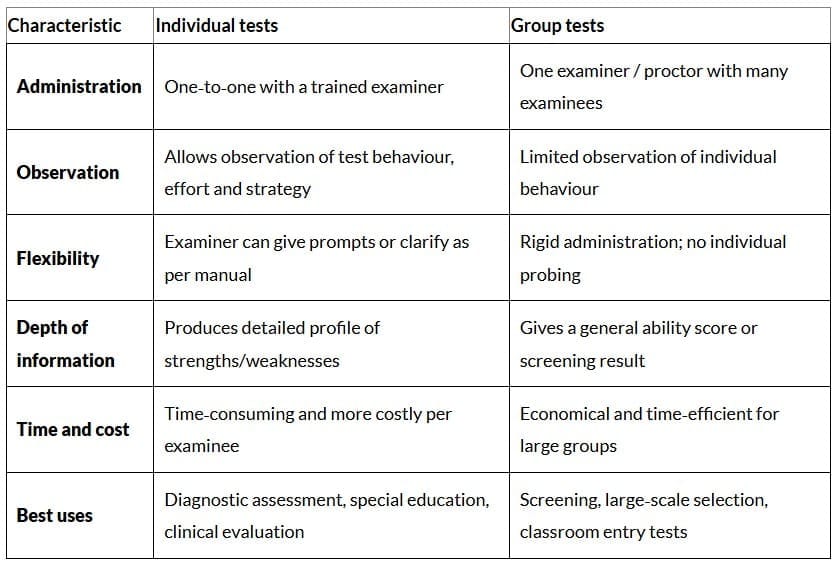
Difference between verbal and non‐verbal intelligence tests
Verbal and non‐verbal tests differ in content, mode of administration and the influence of language or culture on performance. Selection should consider the examinee's language proficiency and educational background.
- Verbal tests assess abilities that are expressed in language. They suit examinees comfortable with the test language and are useful when verbal reasoning itself is of interest.
- Non‐verbal tests assess reasoning with minimal linguistic demand. They are effective for examinees who are illiterate, have limited language proficiency, or when a culture‐reduced measure of abstract reasoning is needed.
- Examples of test items - verbal: vocabulary, sentence completion, comprehension, arithmetic word problems, similarities and information questions.
- Examples of test items - non‐verbal: pattern matrices, picture series, block designs, symbol substitution and mazes.
- Advantages of non‐verbal tests: reduced language bias, suitability for multi‐lingual contexts, and usefulness with some neurodevelopmental disorders. They do not eliminate cultural influences entirely.
- Limitations of verbal tests: performance may reflect schooling and cultural exposure rather than pure reasoning ability.
Examples of commonly used intelligence tests
- Stanford-Binet Intelligence Scales: One of the earliest individually administered intelligence tests, often used in clinical and educational settings to measure general intellectual ability and specific cognitive functions.
- Wechsler scales: Widely used individual batteries with separate indices (e.g., verbal comprehension, perceptual reasoning, working memory, processing speed) that provide an overall IQ and subscale scores.
- Raven's Progressive Matrices: A non‐verbal test of abstract reasoning often used when language bias is a concern; suitable for group or individual administration.
- Group school ability tests: Many standardised group tests are used for screening and selection in schools; examples include abilities tests and scholastic aptitude batteries (local test names vary by region).
Scoring, norms and interpretation
- IQ and standard scores: Raw scores are transformed into scaled scores and compared to age‐based norms to produce an IQ or standard score. An IQ of 100 is typically the population mean with a standard deviation (commonly 15 or 16 depending on the test).
- Profiles and indexes: Modern tests report subscale scores and index scores so that patterns of cognitive strengths and weaknesses can be identified.
- Percentiles: Indicate the percentage of the normative sample scoring at or below an examinee's score and are helpful for communicating results to non‐specialists.
Reliability, validity and bias
- Reliability: Consistency of test scores across time, items and raters. Group tests and well‐standardised individual tests generally show acceptable reliability for most practical purposes.
- Validity: The degree to which a test measures what it intends to measure-content validity, predictive validity (e.g., correlation with academic achievement), and construct validity are important considerations.
- Cultural and linguistic bias: Tests can be biased by language, culture, experience, and educational opportunities. Non‐verbal tests reduce but do not remove bias entirely. Practitioners must interpret scores in context and, where necessary, use supplementary information.
Uses of intelligence tests in educational settings
- Identification of intellectual giftedness and learning potential for enrichment and acceleration programmes.
- Diagnosis of intellectual disability or specific learning difficulties, informing individual education plans (IEPs).
- Placement decisions in special education, extension, remedial programmes or vocational guidance.
- Screening large groups of students for further individual assessment.
- Research into cognitive development, group comparisons and program evaluation.
Limitations and ethical considerations
- Intelligence tests provide estimates of certain cognitive abilities but do not capture the entire range of human talents, creativity, motivation or socio‐emotional skills.
- Scores can be affected by test anxiety, health, motivation, cultural background and familiarity with testing situations.
- Use of tests must respect confidentiality, informed consent, and a clear explanation of purpose and consequences for the examinee and parents/caregivers.
- Decisions about education and placement should not rely solely on test scores; they should incorporate classroom performance, teacher reports, parent input and developmental history.
Guidelines for teachers and examiners
- Select tests appropriate for the examinee's language, age, cultural background and the assessment purpose.
- Follow standard administration and scoring procedures to ensure validity and reliability of results.
- Interpret results in the context of the whole child-consider socio‐economic, educational and health background.
- Use test results to inform instruction, remediation, enrichment and to set realistic educational goals.
- Communicate results sensitively to students and parents and provide practical recommendations rather than labels.
Summary
Intelligence tests are valuable tools when chosen and interpreted appropriately. Understanding the differences between individual and group tests, and between verbal and non‐verbal formats, helps educators and psychologists select the right instrument for assessment goals. Test scores should always be integrated with other information about the learner to support fair, useful and ethical educational decisions.
FAQs on Study Notes: Intelligence Tests
| 1. What are the main classifications of intelligence tests? |  |
| 2. How do individual intelligence tests differ from group intelligence tests? | |
| 3. What is the difference between verbal and non-verbal intelligence tests? | |
| 4. What are the key components of scoring, norms, and interpretation in intelligence tests? | |
| 5. What are some limitations and ethical considerations when using intelligence tests in educational settings? | |




