Bar Graphs CAT Previous Year Questions with Answer PDF

2024
Direction: Answer the following questions based on the information given.
The chart below shows the price data for seven shares – A, B, C, D, E, F, and G as a candlestick plot for a particular day. The vertical axis shows the price of the share in rupees. A share whose closing price (price at the end of the day) is more than its opening price (price at the start of the day) is called a bullish share; otherwise, it is called a bearish share. All bullish and bearish shares are shown in green and red colour respectively.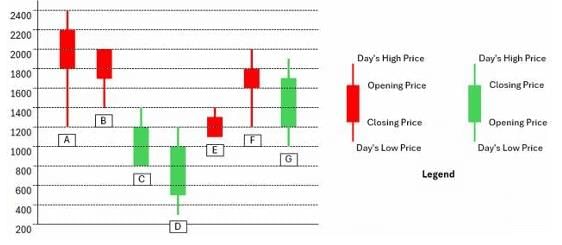 Q1: Daily Share Price Variability (SPV) is defined as (Day’s high price - Day’s low price) / (Average of the opening and closing prices during the day). Which among the shares A, C, D and F had the highest SPV on that day?
(a) F
(b) A
(c) C
(d) D
Ans: d
Sol: For Stock A,|
SPV = 2400 – 1200/ (2200+1800/2) = 1200/2000 = 6/10
For stock C,
SPV = 1400 – 800/ (1200+800/2) = 600/1000 = 6/10
For stock D,
SPV = 1200 – 300/ (1000+500/2) = 900/750 = 90/75
For stock F,
SPV = 2000 – 1200/ (1800+1600/2) = 800/1700 = 8/17We can see that stock D has the highest SPV among the four given stocks.
Q2: Daily Share Price Variability (SPV) is defined as (Day’s high price - Day’s low price) / (Average of the opening and closing prices during the day). How many shares had an SPV greater than 0.5 on that day?
Ans: 4
Sol: For Stock A,
SPV = 2400 – 1200/ (2200+1800/2) = 1200/2000 = 6/10For stock B,
SPV = 2000 – 1400/ (2000+1700/2) = 12/37For stock C,
SPV = 1400 – 800/ (1200+800/2) = 600/1000 = 6/10For stock D,
SPV = 1200 – 300/ (1000+500/2) = 900/750 = 90/75For stock E,
SPV = 1400 – 1100/ (1100+1300/2) = 300/1200 = ¼For stock F,
SPV = 2000 – 1200/ (1800+1600/2) = 800/1700 = 8/17For stock G,
SPV = 1900 – 1000/ (1200+1700/2) = 1800/2900 = 18/29We can see the stocks A, C, D, and G the SPV is more than 0.5.
So, a total of four stocks have an SPV of more than 0.5
Q3: Daily loss for a share is defined as (Opening price – Closing price) / (Opening price). Which among the shares A, B, F and G had the highest daily loss on that day?
(a) F
(b) A
(c) G
(d) B
Ans: b
Sol: For stock A,
Daily loss = 2200 – 1800/2200 = 400/2200 = 2/11For stock B,
Daily loss = 2000 – 1700/2000 = 3/20For stock F,
Daily loss = 1800 – 1600/1800 = 1/9We don’t need to calculate for stock G, since it is bullish.
So, stock A has the highest loss for the day.
Q4: What would have been the percentage wealth gain for a trader, who bought equal numbers of all bullish shares at opening price and sold them at their day’s high?
(a) 50%
(b) 80%
(c) 72%
(d) 100%
Ans: b
Sol: Let's say that the trader bought exactly one share of each stock at the opening price and sold them at their day’s high, then the wealth gain = 600+ 700+ 700/800+500+1200 = 20/25 = 80%
2021
Passage - 1
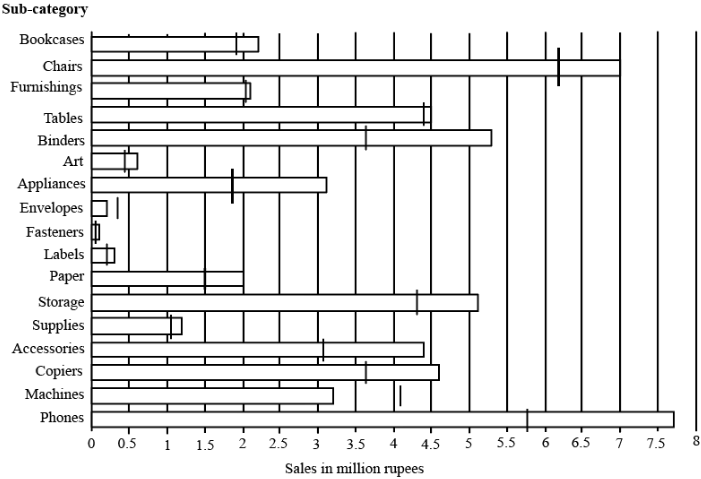 The horizontal bars in the above diagram represent 2020 aggregate sales (in ₹ million) of a company for the different subcategories of its products. The top four product subcategories (Bookcases, Chairs, Furnishings, Tables) belong to furniture product category; the bottom four product subcategories (Accessories, Copiers, Machines, Phones) belong to the technology product category while all other product subcategories belong to the office supply product category. For each of the product subcategories, there is a vertical line indicating the sales of the corresponding subcategory in 2019.
Q1: The total sales (in ₹ million) in 2019 from products in office supplies category is closest to
(a) 18.0
(b) 16.5
(c) 13.5
(d) 12.5
Ans: c
Sol: The total sales from products in the office supply category in 2019 is :
Sum of sales of :
Binders: 3.6 million
Art : 0.4 million.
Appliances: 1.9 million
Envelops: 0.3 million
Fasteners: 0.1 million
Labels: 0.2 million
Paper = 1.5 million.
Storage: 4.3 million.
Supplies: 1.1 million.
The sum of sales of these products = 3.6+0.4+1.9+0.3+0.1+0.2+1.5+4.3+1.1 = 13.4 million.
The closest among the option is 13.5 million.
Q2: How many subcategories had sales of ₹ 4 million or more in 2019 and registered an increase in sales in excess of 25% in 2020?
Ans: 1
Sol: The number of subcategories had sales of ₹ 4 million or more in 2019 and registered an increase in sales in excess of 25% in 2020 :
The subcategories with more than 4 million in sales in 2019 are :
Chairs: 6.2 million in 2019 and 7 million in 2020. (For a 25 percent increase the sales must be at least 7.8 million and hence fails)
Tables: 4.4 million in 2019 and 4.5 million in 2020. (For a 25 percent increase the sales must be at least 5.5 million and hence fails)
Storage: 4.3 million sales in 2019 and 5.1 million in 2020. (For a 25 percent increase the sales must be at least 5.4 and hence fails)
Phones: 5.75 million in 2019 and 7.5 million in 2020. (An increase of 30.5 percent)
Hence only one subcategory satisfies the condition.
Q3: The percentage increase in sales in Furniture category from 2019 to 2020 is closest to
(a) 20%
(b) 8%
(c) 25%
(d) 1%
Ans: b
Sol: The percentage increase in sales in the furniture category from 2019 to 2020 are :
Bookcases: 1.9 million in 2019 and 2.2 million in 2020.
Chairs: 6.2 million in 2019 and 7 million in 2020.
Furnishings: 2.05 million in 2019 and 2.1 million in 2020.
Tables: 4.4 million in 2019 and 4.5 million in 2020.
Hence the percentage increase is given by :
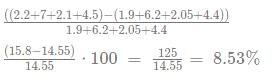
Q4: The improvement index for a category is the maximum percentage increase in sales from 2019 to 2020 among any of its subcategories. The correct order of categories in increasing order of this improvement index is
(a) furniture, technology, office supply
(b) 3technology, furniture, office supply
(c) office supply, technology, furniture
(d) office supply, furniture, technology
Ans: a
Sol: The improvement index for a category is the maximum percentage increase in sales from 2019 to 2020 among any of its subcategories.
Hence based on the information provided in the tabular data we need to look for the different subcategories where the rise in sales from 2019 to 2020 is higher.
Based on the visual data :
In the furniture category :
Bookcases and Chairs have a relatively high percentage increase :
Books cases: 1.9 million to 2.2 million (15.7 percent increase)
Chairs: 6.2 million to 7 million (12.9 percent increase)
In the office supply category :
Binders and Appliances have a relatively high percentage increase :
Binders: 3.6 million to 5.3 million (47 percent increase)
Appliances: 1.9 million to 3.15 million (65.7 percent increase)
In technology product category :
Accessories: 3.1 to 4.4 million. (41.9 percent increase)
Phones: 5.8 million to 7.7 million (32.7 percent increase)
Hence among the categories :
The highest increase among them is in the order :
Furniture < Technology product < office supply.
Passage - 2
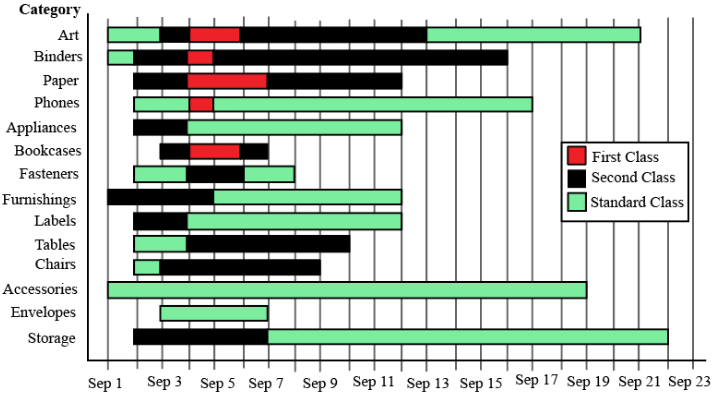
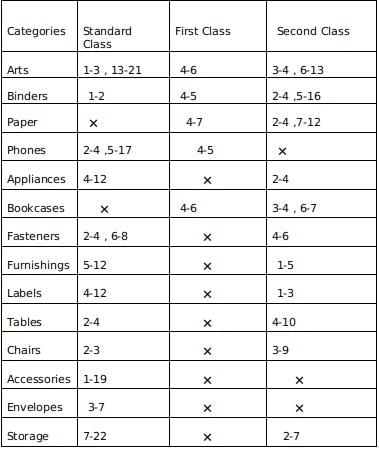
The different bars in the diagram above provide information about different orders in various categories (Art, Binders, ….) that were booked in the first two weeks of September of a store for one client. The colour and pattern of a bar denotes the ship mode (First Class / Second Class / Standard Class). The left end point of a bar indicates the booking day of the order, while the right end point indicates the dispatch day of the order. The difference between the dispatch day and the booking day (measured in terms of the number of days) is called the processing time of the order. For the same category, an order is considered for booking only after the previous order of the same category is dispatched. No two consecutive orders of the same category had identical ship mode during this period.
For example, there were only two orders in the furnishing category during this period. The first one was shipped in the Second Class. It was booked on Sep 1 and dispatched on Sep 5. The second order was shipped in the Standard class. It was booked on Sep 5 (although the order might have been placed before that) and dispatched on Sep 12. So the processing times were 4 and 7 days respectively for these orders.
Q1: How many days between Sep 1 and Sep 14 (both inclusive) had no booking from this client considering all the above categories?
Ans: 6
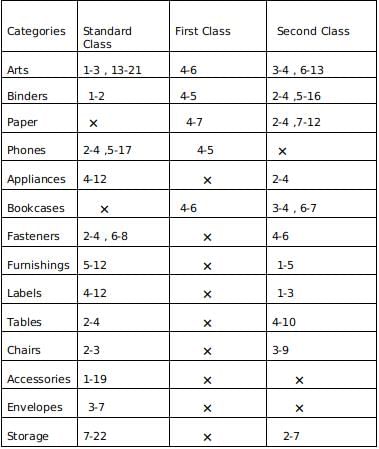
Sol: Accumulating all the data :
We get the following table :
Note a-b : represents the duration where a is the day when order is booked and b is the day when it is dispatched .
Now No booking days from the table are : September 8,9,10,11,12 and 14.
So a total of 6 days .
Q2: The sequence of categories -- Art, Binders, Paper and Phones -- in decreasing order of average processing time of their orders in this period is:
(a) Art, Binders, Paper, Phones
(b) Phones, Art, Binders, Paper
(c) Phones, Binders, Art, Paper
(d) Paper, Binders, Art, Phones
Ans: b
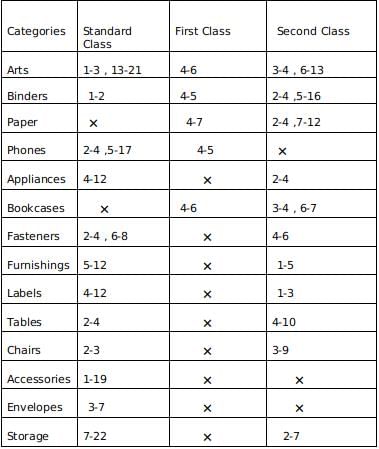
Sol: Accumulating all the data :
We get the following table :Note a-b : represents the duration where a is the day when order is booked and b is the day when it is dispatched.
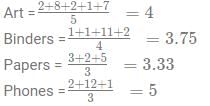
Now taking average processing time per order for the above mentioned categories we get:
So in decreasing order we get Phones , Art ,Binder , Paper.
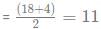
Q3: What was the average processing time of all orders in the categories which had only one type of ship mode?
Ans: 11
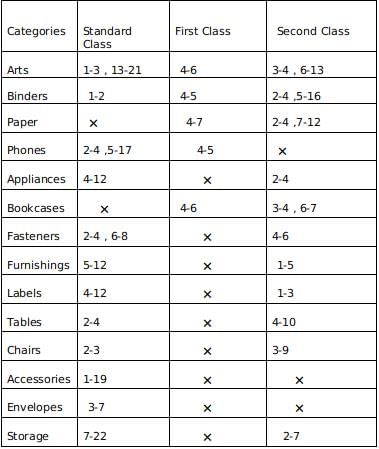
Sol: Accumulating all the data :
We get the following table :
Note a-b : represents the duration where a is the day when order is booked and b is the day when it is dispatched .
Now Envelopes and Accessories has only 1 ship mode i.e Standard class .
So therefore processing days for envelopes = 7-3 =4
and processing days for accessories = 19-1 =18
Therefore average
Q4: Approximately what percentage of orders had a processing time of one day during the period Sep 1 to Sep 22 (both dates inclusive)?
(a) 22%
(b) 16%
(c) 20%
(d) 25%
Ans: c
Sol: Accumulating all the data :
We get the following table :
Note a-b : represents the duration where a is the day when order is booked and b is the day when it is dispatched .
Now from the table we observe that the total number of orders are 35 and 7 orders have a processing time of 1 unit
The 7 orders are : Arts Standard class,Binders First class and standard class, Phones First class, Bookcases second class ( 2 orders) and Chairs standard class.
So the percentage

Passage - 3
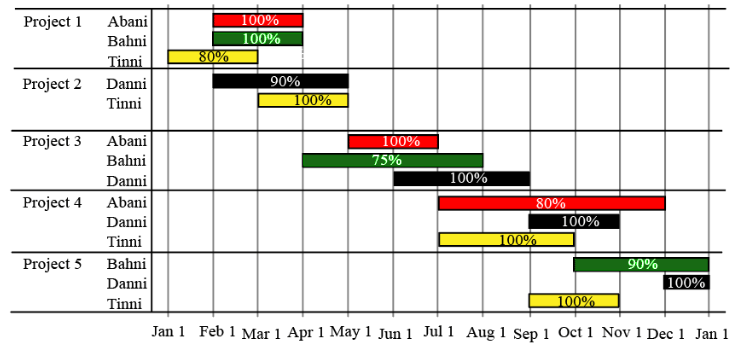 The figure above shows the schedule of four employees - Abani, Bahni, Danni, and Tinni - whom Dhoni supervised in 2020. Altogether there were five projects which started and concluded in 2020 in which they were involved. For each of these projects and for each employee, the starting day was at the beginning of a month and the concluding day was the end of a month, and these are indicated by the left and right end points of the corresponding horizontal bars. The number within each bar indicates the percentage of assigned work completed by the employee for that project, as assessed by Dhoni.
For each employee, his/her total project-month (in 2020) is the sum of the number of months (s)he worked across the five projects, while his/her annual completion index is the weightage average of the completion percentage assigned from the different projects, with the weights being the corresponding number of months (s)he worked in these projects. For each project, the total employee-month is the sum of the number of months four employees worked in this project, while its completion index is the weightage average of the completion percentage assigned for the employees who worked in this project, with the weights being the corresponding number of months they worked in this project.
Q5: The list of employees in decreasing order of annual completion index is:
(a) Danni, Tinni, Bahni, Abani
(b) Bahni, Abani, Tinni, Danni
(c) Danni, Tinni, Abani, Bahni
(d) Tinni, Danni, Abani, Bahni
Ans: c
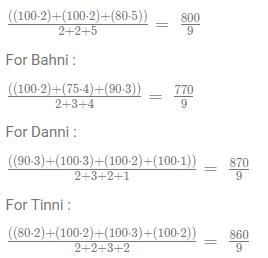
Sol: The annual completion index for different people is :
The weightage average of the completion percentage assigned from the different projects, with the weights being the corresponding number of months (s)he worked in these projects.
For Abani :
The descending order for the four people is :
Danni, Tinni, Abani, Bahni.
Q6: Which employees did not work in multiple projects for any of the months in 2020?
(a) Only Abani, Bahni and Danni
(b) Only Abani and Bahni
(c) All four of them
(d) Only Tinni
Ans: a
Sol: Abani, Banni, and Danni did not work on multiple projects simultaneously in a month
Tinni was the only person who worked on multiple projects which are project 4 and project 5 in the month of september.
Q7: Which of the following statements is/are true?
I: The total project-month was the same for the four employees.
II: The total employee-month was the same for the five projects.
(a) Only II
(b) Both I and II
(c) Neither I nor II
(d) Only I
Ans: d
Sol: The total project month is the number of months Abani, Bahni, Danni, and Tinni individually worked for all the projects combined :
Abani - 2+2+5 = 9 months
Bahni - 2+4+3 = 9 months
Danni - 3+3+2+1 = 9 months
Tinni - 2+2+3+2 = 9 months.
The total employee month for all the five projects is the sum of the total employee-month is the sum of the number of months four employees worked in this project.
Project -1 = 2+2+2 = 6 months
Project -2 = 3+2 = 5 months
Project - 3 = 2+4+3 = 9 months.
Project - 4 = 5+2+3 = 10 months.
Project - 5 = 3+1+2 = 6 months.
Only statement 1 is true.
Q8: The project duration, measured in terms of the number of months, is the time during which at least one employee worked in the project. Which of the following pairs of the projects had the same duration?
(a) Project 1, Project 5
(b) Project 4, Project 5
(c) Project 3, Project 5
(d) Project 3, Project 4
Ans: d
Sol: Considering the information provided :
For project 1 : 3 months.
Project - 2: 3 months.
Project - 3: 5 months.
Project - 4: 5 months.
Project - 5: 4 months.
Among the given options option D is true which is project 3, project 4.
|
77 videos|180 docs|96 tests
|
FAQs on Bar Graphs CAT Previous Year Questions with Answer PDF
| 1. How to interpret a bar graph? |  |
| 2. What is the purpose of using a bar graph? | |
| 3. How to create a bar graph from given data? | |
| 4. What are the different types of bar graphs? | |
| 5. How can a bar graph help in making data-driven decisions? | |





Bar Graphs CAT Previous Year Questions with Answer PDF
,study material
,mock tests for examination
,Summary
,shortcuts and tricks
,Objective type Questions
,Viva Questions
,Sample Paper
,Bar Graphs CAT Previous Year Questions with Answer PDF
,Important questions
,Extra Questions
,practice quizzes
,Exam
,past year papers
,Previous Year Questions with Solutions
,Free
,Semester Notes
,video lectures
,MCQs
,Bar Graphs CAT Previous Year Questions with Answer PDF
,ppt
;




CAT Previous Year Questions: Bar Graphs Free PDF Download
Importance of CAT Previous Year Questions: Bar Graphs
CAT Previous Year Questions: Bar Graphs Notes
CAT Previous Year Questions: Bar Graphs CAT
Study CAT Previous Year Questions: Bar Graphs on the App
|
© EduRev
|
Education Revolution
|


|




