

Best Study Material for SSC CGL Exam
SSC CGL Exam > SSC CGL Notes > SSC CGL Tier 1 Mock Test Series 2025 > Syllabus for SSC CGL 2025
Syllabus for SSC CGL 2025 | SSC CGL Tier 1 Mock Test Series 2025 PDF Download
The Staff Selection Commission (SSC) has introduced the syllabus for the SSC Combined Graduate Level (CGL) Exam 2025 which accompanies the official notification set to be released in June 2025 for both Tier 1 and Tier 2 examinations. This extensive syllabus plays a crucial role in assisting candidates in their preparation for the upcoming SSC CGL Exam. Understanding the importance of a thorough grasp of the SSC CGL Syllabus 2025 as a crucial foundation for success in the CGL exam.
For your better understanding, EduRev has compiled this guide where the syllabus of all the Tier 1 and Tier 2 exam subjects is given in easy language.
SSC CGL Syllabus 2025
The syllabus for the SSC CGL exam is divided into two distinct phases known as Tier I and Tier II. Both Tier 1 and Tier 2 exams for SSC CGL 2025 are conducted online. Importantly, the Tier 1 exam in SSC CGL is considered qualifying, and the final selection depends on the results of the SSC CGL Tier 2 Exam. To assist candidates, the SSC CGL Syllabus 2025 PDF is available in English in the provided article. Additionally, the SSC CGL Exam Pattern 2025 is explained in the following table for a comprehensive breakdown of information.
| SSC CGL Syllabus 2025 | |
| Exam Name | SSC CGL 2025 |
| SSC CGL Full Form | Staff Selection Commission Combined Graduate Level |
| Conducting Body | Staff Selection Commission |
| Exam Type | National Level |
| Mode of Application | Online |
| Application Dates | April 22, 2025 to May 21, 2025 |
| Exam Dates | June-July 2025 |
| Mode of Exam | Online |
| Basic Eligibility | Indian citizenship & Graduate (bachelor’s degree in relevant discipline) |
| Selection Process | Tier 1 (Qualifying) & Tier 2 |
| Official Website | https://ssc.nic.in/Portal/Syllabus |
Scheme of the Examination
The Computer Based Examination will be conducted in two tiers as indicated below Tier-I & Tier-II
Marks scored by candidates in Computer Based Examinations, if conducted in multiple shifts, will be normalized by using the formula published by the Commission vide Notice No: 1-1/2018-P&P-I dated 07-02-2019 and such normalized scores will be used to determine final merit and cut-off marks.
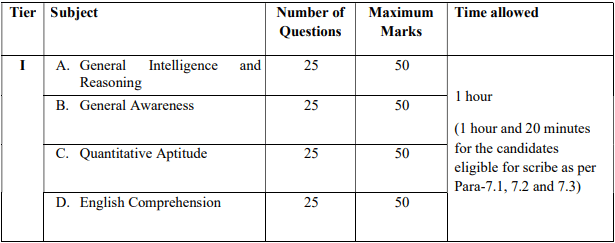
Scheme of Tier-I Examination:
- Tier-I will consist of Objective Type, Multiple choice questions. The questions will be set both in English & Hindi except for English Comprehension.
- There will be negative marking of 0.50 for each wrong answer.
 Scheme of Tier-I Examination
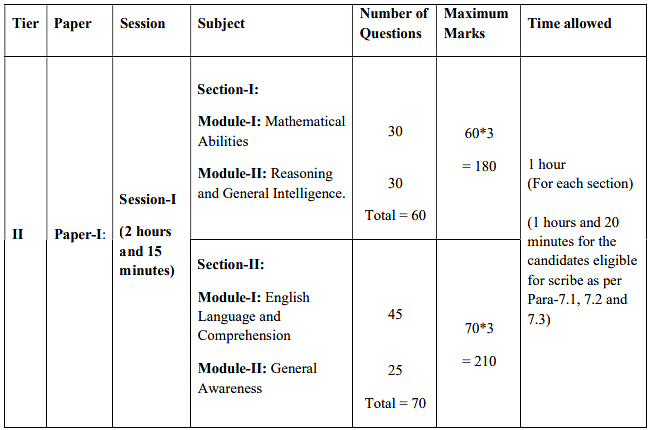
Scheme of Tier-II Examination:
- Tier-II will include conducting of Paper-I, Paper-II and Paper-III in separate shift(s)/ day(s).
- Paper-I is compulsory for all the posts.
- Paper-II will be for only those candidates who apply for the posts of Junior Statistical Officer (JSO) in the Ministry of Statistics and Programme Implementation and Statistical Investigator Grade-II in the office of Registrar General of India (M/o Home Affairs) and who are shortlisted in Tier-I for these Posts.
- Paper-III will be for only those candidates who are shortlisted in Tier-I for Paper-III i.e. for the posts of Assistant Audit Officer/ Assistant Accounts Officer.
 Scheme of Tier-II Examination
SSC CGL Tier I Syllabus 2025
The SSC CGL Tier 1 examination consists of a total of 100 questions, with a maximum achievable score of 200. The allotted time for the SSC CGL Tier 1 exam is 60 minutes. This Tier I exam is structured into four sections, each containing 25 questions, and has a maximum score potential of 50 marks.
| SSC CGL Tier I Syllabus 2025 | |
| Subjects | Topics |
| General Intelligence and Reasoning |
|
| General Awareness |
|
| Quantitative Aptitude |
|
| English Language |
|
SSC CGL Tier II Syllabus 2025 for Paper I
The online SSC CGL Tier 2 examination will consist of three papers:
| SSC CGL Syllabus 2025 for Tier II | ||
| Section-I of Paper-I (Mathematical Abilities) | ||
| Module | Subject | Topics |
Module I | Number Systems |
|
| Fundamental arithmetical operations |
| |
| Algebra |
| |
| Geometry |
| |
| Mensuration |
| |
| Trigonometry |
| |
| Statistics and probability |
| |
| Module II | Reasoning and General Intelligence | Semantic Analogy Symbolic operations, Symbolic/ Number Analogy, Trends Figural Analogy Space Orientation Semantic Classification Venn Diagrams Symbolic/ Number Classification Drawing inferences Figural Classification Punched hole/ pattern-folding & unfolding Semantic Series Figural Pattern Folding and completion Number Series Embedded figures Figural Series Critical Thinking Problem-Solving Emotional Intelligence Word Building Social Intelligence Coding and decoding Numerical operations Other subtopics, if any. |
| Section-II of Paper-I | ||
| Module I | English Language And Comprehension | Vocabulary One word substitution Sentence structure Shuffling of Sentences in a passage, Fill in the Blanks, Synonyms/Homonyms Shuffling of Sentence parts Spellings/ Detecting misspelt words Idioms & Phrases Improvement of Sentences, Antonyms Active/ Passive Voice of Verbs Conversion into Direct/ Indirect narration Spot the Error English Grammar Cloze Passage |
| Module II | General Awareness |
|
| Section-III of Paper-I (Computer Proficiency) | ||
| Module | Subject | Topics |
| Module I | Computer Basics |
|
| Software | Windows Operating system including basics of Microsoft Office like MS word, MS Excel and Power Point etc | |
| Working with the Internet and e-mails | Web Browsing & Searching, Downloading & Uploading, Managing an E-mail Account, e-Banking | |
| Basics of networking and cyber security | Networking devices and protocols, Network and information security threats (like hacking, virus, worms, Trojan etc.) and preventive measures | |
 |
Download the notes
Syllabus for SSC CGL 2025
|
Download as PDF |
Download as PDF
SSC CGL Tier II Syllabus 2025 for Paper II
Candidates are advised to go through the detailed syllabus of SSC CGL 2025 Tier II Syllabus for Paper II from the below table:-
| SSC CGL Tier 2 Syllabus- Statistics (Paper II) | |
| Subjects | Topics |
| Collection, Classification and Presentation of Statistical Data | Primary and Secondary data, Tabulation of data; Frequency distributions; Graphs and charts; Methods of data collection; Diagrammatic presentation of frequency distributions. |
| Measures of Central Tendency | Common measures of central tendency – mean median and mode; Partition values- quartiles, deciles, percentiles. |
| Measures of Dispersion- Common measures of Dispersion | range, quartile deviations, mean deviation and standard deviation; Measures of relative dispersion. |
| Moments, Skewness and Kurtosis | Different types of moments and their relationship; the meaning of skewness and kurtosis; different measures of skewness and kurtosis. |
| Correlation and Regression | Scatter diagram; simple correlation coefficient; simple regression lines; Spearman‟s rank correlation; Measures of association of attributes; Multiple regression; Multiple and partial correlation (For three variables only). |
| Probability Theory | Meaning of probability; Different definitions of probability; Conditional probability; Compound probability; Independent events; Bayes‟ theorem. |
| Random Variable and Probability Distributions | Random variable; Probability functions; Expectation and Variance of a random variable; Higher moments of a random variable; Binomial, Poisson, Normal and Exponential distributions; Joint distribution of two random variable (discrete). |
| Sampling Theory | Concept of population and sample; Parameter and statistic, Sampling and non-sampling errors; Probability and nonprobability sampling techniques (simple random sampling, stratified sampling, multistage sampling, multiphase sampling, cluster sampling, systematic sampling, purposive sampling, convenience sampling and quota sampling); Sampling distribution (statement only); Sample size decisions. |
| Statistical Inference | Point estimation and interval estimation, Properties of a good estimator, Methods of estimation (Moments method, Maximum likelihood method, Least squares method), Testing of hypothesis, Basic concept of testing, Small sample and large sample tests, Tests based on Z, t, Chi-square and F statistic, Confidence intervals. |
| Analysis of Variance | Analysis of one-way classified data and two-way classified data. |
| Time Series Analysis | Components of time series, Determination of trend components by different methods, Measurement of seasonal variation by different methods. |
| Index Numbers | Meaning of Index Numbers, Problems in the construction of index numbers, Types of index number, Different formulae, Base shifting and splicing of index numbers, Cost of living Index Numbers, Uses of Index Numbers. |
SSC CGL Tier II Syllabus 2025 for Paper III
Candidates are advised to go through the detailed syllabus of SSC CGL 2025 Tier II Syllabus for Paper III from the below table:-
| SSC CGL Tier 2 Syllabus- Paper 3(General Studies-Finance and Economics) | ||
| Part | Subject | Topics |
| Part A: Finance and Accounts (80 marks) | Financial Accounting |
|
| Basic concepts of accounting |
| |
| Part B: Economics and Governance (120 marks) | Comptroller & Auditor General of India | Constitutional provisions, Role and responsibility |
| Finance Commission | Finance Commission-Role and functions | |
| Basic Concept of Economics and introduction to Microeconomics |
| |
| Theory of Demand and Supply |
| |
| Theory of Production and cost |
| |
| Forms of Market and price determination in different markets |
| |
| Indian Economy |
| |
| Economic Reforms in India |
| |
| Money and Banking |
| |
| Information Technology | Role of Information Technology in Governance | |
 |
Take a Practice Test
Test yourself on topics from SSC CGL exam
|
Practice Now |
Practice Now
SSC CGL Syllabus 2025 Book List
Certainly, here are the recommended resources for your SSC CGL preparation, with the book names listed first:
- “Word Power Made Easy” by Norman Lewis and “Objective General English” by S.P. Bakshi are highly recommended for English in SSC CGL.
- “SSC Mathematics 5800+” by Kiran Prakashan Publication is a valuable choice for Mathematics in SSC CGL.
- For Reasoning in SSC CGL, R S Aggarwal, BS Sijwali, Indu Sijwal, Nishit K. Sinha is an excellent resource.
- “Lucent G.K.” authored by Dr. Binay Karna and Manwendra Mukul is a comprehensive General Knowledge book for SSC CGL.
The document Syllabus for SSC CGL 2025 | SSC CGL Tier 1 Mock Test Series 2025 is a part of the SSC CGL Course SSC CGL Tier 1 Mock Test Series 2025.
All you need of SSC CGL at this link: SSC CGL
|
274 docs|133 tests
|




FAQs on Syllabus for SSC CGL 2025 - SSC CGL Tier 1 Mock Test Series 2025
| 1. What is the syllabus for SSC CGL 2024 exam? |  |
| 2. What is the scheme of the SSC CGL 2024 examination? | |
Ans. The SSC CGL 2024 examination consists of Tier I, Tier II, Tier III, and Tier IV. Tier I is a computer-based examination, Tier II is also a computer-based examination with four papers, Tier III is a descriptive paper, and Tier IV is a skill test.
| 3. What topics are covered in SSC CGL Tier I syllabus 2024? | |
Ans. The SSC CGL Tier I syllabus for 2024 includes General Intelligence & Reasoning, General Awareness, Quantitative Aptitude, and English Comprehension.
| 4. Can you provide the detailed syllabus for SSC CGL Tier II Paper I for 2024? | |
Ans. SSC CGL Tier II Paper I syllabus for 2024 includes Quantitative Abilities with topics such as Algebra, Geometry, Trigonometry, etc.
| 5. Is there a specific book list recommended for SSC CGL 2024 preparation? | |
Ans. Yes, there is a recommended book list for SSC CGL 2024 preparation. It is important to refer to these books to cover all the topics effectively.
Related Exams
About this Document

54.3K Views

4.86/5
Rating

Apr 21, 2025
Last updated
Document Description: Syllabus for SSC CGL 2025 for SSC CGL 2025 is part of SSC CGL Tier 1 Mock Test Series 2025 preparation.
The notes and questions for Syllabus for SSC CGL 2025 have been prepared according to the SSC CGL exam syllabus. Information about Syllabus for SSC CGL 2025 covers topics
like SSC CGL Syllabus 2025, Scheme of the Examination, SSC CGL Tier I Syllabus 2025, SSC CGL Tier II Syllabus 2025 for Paper I, SSC CGL Tier II Syllabus 2025 for Paper II, SSC CGL Tier II Syllabus 2025 for Paper III, SSC CGL Syllabus 2025 Book List and Syllabus for SSC CGL 2025 Example, for SSC CGL 2025 Exam. Find important definitions, questions, notes, meanings, examples, exercises and tests below for Syllabus for SSC CGL 2025.
Introduction of Syllabus for SSC CGL 2025 in English is available as part of our SSC CGL Tier 1 Mock Test Series 2025
for SSC CGL & Syllabus for SSC CGL 2025 in Hindi for SSC CGL Tier 1 Mock Test Series 2025 course.
Download more important topics related with notes, lectures and mock test series for SSC CGL
Exam by signing up for free. SSC CGL: Syllabus for SSC CGL 2025 | SSC CGL Tier 1 Mock Test Series 2025
Description
Full syllabus notes, lecture & questions for Syllabus for SSC CGL 2025 | SSC CGL Tier 1 Mock Test Series 2025 - SSC CGL | Plus excerises question with solution to help you revise complete syllabus for SSC CGL Tier 1 Mock Test Series 2025 | Best notes, free PDF download
Information about Syllabus for SSC CGL 2025
In this doc you can find the meaning of Syllabus for SSC CGL 2025 defined & explained in the simplest way possible. Besides explaining types of
Syllabus for SSC CGL 2025 theory, EduRev gives you an ample number of questions to practice Syllabus for SSC CGL 2025 tests, examples and also practice SSC CGL
tests
Related Searches
study material
,shortcuts and tricks
,Syllabus for SSC CGL 2025 | SSC CGL Tier 1 Mock Test Series 2025
,video lectures
,Summary
,Syllabus for SSC CGL 2025 | SSC CGL Tier 1 Mock Test Series 2025
,past year papers
,Viva Questions
,Exam
,Free
,Sample Paper
,Extra Questions
,Previous Year Questions with Solutions
,practice quizzes
,mock tests for examination
,ppt
,Semester Notes
,Important questions
,Objective type Questions
,Syllabus for SSC CGL 2025 | SSC CGL Tier 1 Mock Test Series 2025
,MCQs
;



Additional Information about Syllabus for SSC CGL 2025 for SSC CGL Preparation
Syllabus for SSC CGL 2025 Free PDF Download
The Syllabus for SSC CGL 2025 is an invaluable resource that delves deep into the core of the SSC CGL exam.
These study notes are curated by experts and cover all the essential topics and concepts, making your preparation more efficient and effective.
With the help of these notes, you can grasp complex subjects quickly, revise important points easily,
and reinforce your understanding of key concepts. The study notes are presented in a concise and easy-to-understand manner,
allowing you to optimize your learning process. Whether you're looking for best-recommended books, sample papers, study material,
or toppers' notes, this PDF has got you covered. Download the Syllabus for SSC CGL 2025 now and kickstart your journey towards success in the SSC CGL exam.
Importance of Syllabus for SSC CGL 2025
The importance of Syllabus for SSC CGL 2025 cannot be overstated, especially for SSC CGL aspirants.
This document holds the key to success in the SSC CGL exam.
It offers a detailed understanding of the concept, providing invaluable insights into the topic.
By knowing the concepts well in advance, students can plan their preparation effectively.
Utilize this indispensable guide for a well-rounded preparation and achieve your desired results.
Syllabus for SSC CGL 2025 Notes
Syllabus for SSC CGL 2025 Notes offer in-depth insights into the specific topic to help you master it with ease.
This comprehensive document covers all aspects related to Syllabus for SSC CGL 2025.
It includes detailed information about the exam syllabus, recommended books, and study materials for a well-rounded preparation.
Practice papers and question papers enable you to assess your progress effectively.
Additionally, the paper analysis provides valuable tips for tackling the exam strategically.
Access to Toppers' notes gives you an edge in understanding complex concepts.
Whether you're a beginner or aiming for advanced proficiency, Syllabus for SSC CGL 2025 Notes on EduRev are your ultimate resource for success.
Syllabus for SSC CGL 2025 SSC CGL Questions
The "Syllabus for SSC CGL 2025 SSC CGL Questions" guide is a valuable resource for all aspiring students preparing for the
SSC CGL exam. It focuses on providing a wide range of practice questions to help students gauge
their understanding of the exam topics. These questions cover the entire syllabus, ensuring comprehensive preparation.
The guide includes previous years' question papers for students to familiarize themselves with the exam's format and difficulty level.
Additionally, it offers subject-specific question banks, allowing students to focus on weak areas and improve their performance.
Study Syllabus for SSC CGL 2025 on the App
Students of SSC CGL can study Syllabus for SSC CGL 2025 alongwith tests & analysis from the EduRev app,
which will help them while preparing for their exam. Apart from the Syllabus for SSC CGL 2025,
students can also utilize the EduRev App for other study materials such as previous year question papers, syllabus, important questions, etc.
The EduRev App will make your learning easier as you can access it from anywhere you want.
The content of Syllabus for SSC CGL 2025 is prepared as per the latest SSC CGL syllabus.
|
© EduRev
|
Education Revolution
|


|




Signup to see your scores
go up
within 7 days!
within 7 days!
Takes less than 10 seconds to signup