SSC CGL Exam > SSC CGL Notes > Tier 2 - Study Material, Online Tests, Previous Year > Mind Map: Money & Banking
Mind Map: Money & Banking

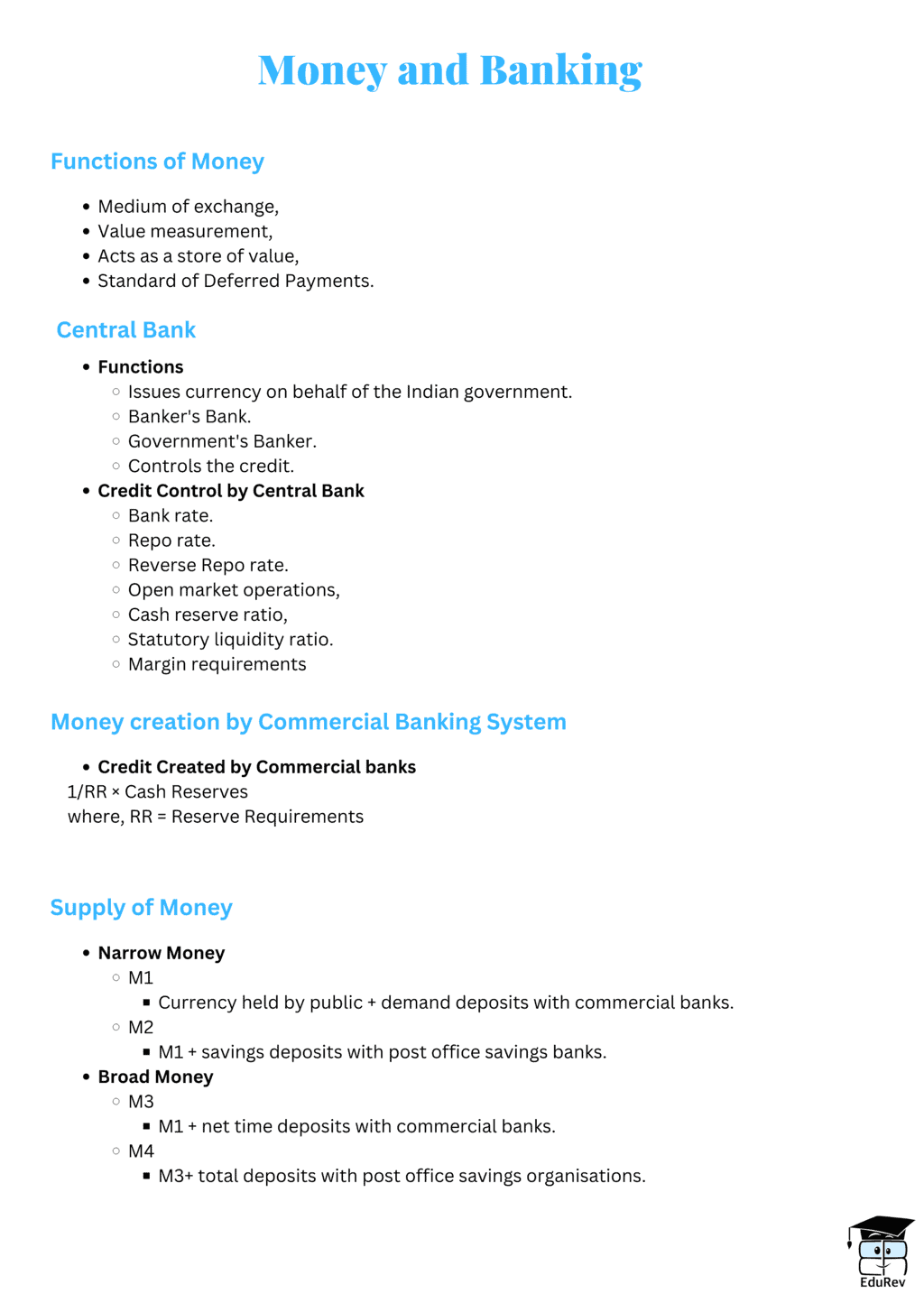
The document Mind Map: Money & Banking is a part of the SSC CGL Course SSC CGL Tier 2 - Study Material, Online Tests, Previous Year.
All you need of SSC CGL at this link: SSC CGL
FAQs on Mind Map: Money & Banking
| 1. What is money and what are its main functions in an economy? |  |
Ans. Money is any medium of exchange that holds value and facilitates transactions. Its primary functions include serving as a medium of exchange, store of value, unit of account, and standard of deferred payment. Money eliminates the inefficiencies of barter systems by enabling easier trade and economic activity in modern economies.
| 2. How do central banks like the RBI control money supply and inflation? | |
Ans. The Reserve Bank of India controls money supply through monetary policy tools including open market operations, changing repo rates, and adjusting the cash reserve ratio. By increasing or decreasing liquidity in the banking system, the RBI influences inflation levels and economic growth. These mechanisms help stabilise prices and maintain financial stability.
| 3. What's the difference between narrow money and broad money in Indian banking? | |
Ans. Narrow money (M1) includes currency in circulation and demand deposits-the most liquid forms of money. Broad money (M3) encompasses narrow money plus savings deposits and other less liquid assets. The distinction matters for understanding money supply measurements and monetary policy effectiveness in controlling inflation and credit availability.
| 4. Why do banks charge different interest rates, and how is the repo rate connected to it? | |
Ans. Banks set lending rates based on the repo rate, which is the RBI's benchmark interest rate for short-term borrowing. When the repo rate increases, banks raise their lending rates; when it decreases, they lower rates. This transmission mechanism affects home loans, personal loans, and savings accounts across the entire banking system.
| 5. What are the different types of money like fiat money, commodity money, and credit money? | |
Ans. Fiat money has value by government decree without intrinsic worth, like Indian rupees. Commodity money derives value from the material itself, such as gold or silver coins. Credit money represents claims on banks or financial institutions. Understanding these distinctions clarifies how modern economies function using digital and paper currency systems.
About this Document

4.95/5 Rating

Apr 20, 2026 Last updated
Related Exams
Document Description: Mind Map: Money & Banking for SSC CGL 2026 is part of SSC CGL Tier 2 - Study Material, Online Tests, Previous Year preparation. The notes and questions for Mind Map: Money & Banking have been prepared according to the SSC CGL exam syllabus. Information about Mind Map: Money & Banking covers topics like and Mind Map: Money & Banking Example, for SSC CGL 2026 Exam. Find important definitions, questions, notes, meanings, examples, exercises and tests below for Mind Map: Money & Banking.
Introduction of Mind Map: Money & Banking in English is available as part of our SSC CGL Tier 2 - Study Material, Online Tests, Previous Year for SSC CGL & Mind Map: Money & Banking in Hindi for SSC CGL Tier 2 - Study Material, Online Tests, Previous Year course. Download more important topics related with notes, lectures and mock test series for SSC CGL Exam by signing up for free. SSC CGL: Mind Map: Money & Banking
Description
Mind Map: Money & Banking of SSC CGL Tier 2 provides you one-page visual summary of the chapter covering all the important topics. Download the PDF from EduRev.
Information about Mind Map: Money & Banking
In this doc you can find the meaning of Mind Map: Money & Banking defined & explained in the simplest way possible. Besides explaining types of Mind Map: Money & Banking theory, EduRev gives you an ample number of questions to practice Mind Map: Money & Banking tests, examples and also practice SSC CGL tests
Top Courses for SSC CGL
Related Searches
video lectures, practice quizzes, pdf , Exam, Previous Year Questions with Solutions, Viva Questions, Important questions, Mind Map: Money & Banking, mock tests for examination, past year papers, MCQs, Objective type Questions, shortcuts and tricks, Sample Paper, Free, Summary, Mind Map: Money & Banking, Extra Questions, Mind Map: Money & Banking, ppt, Semester Notes, study material;