Commerce Exam > Commerce Notes > Business Studies (BST) Class 12 > Mind Map: Principles of Management
Mind Map: Principles of Management

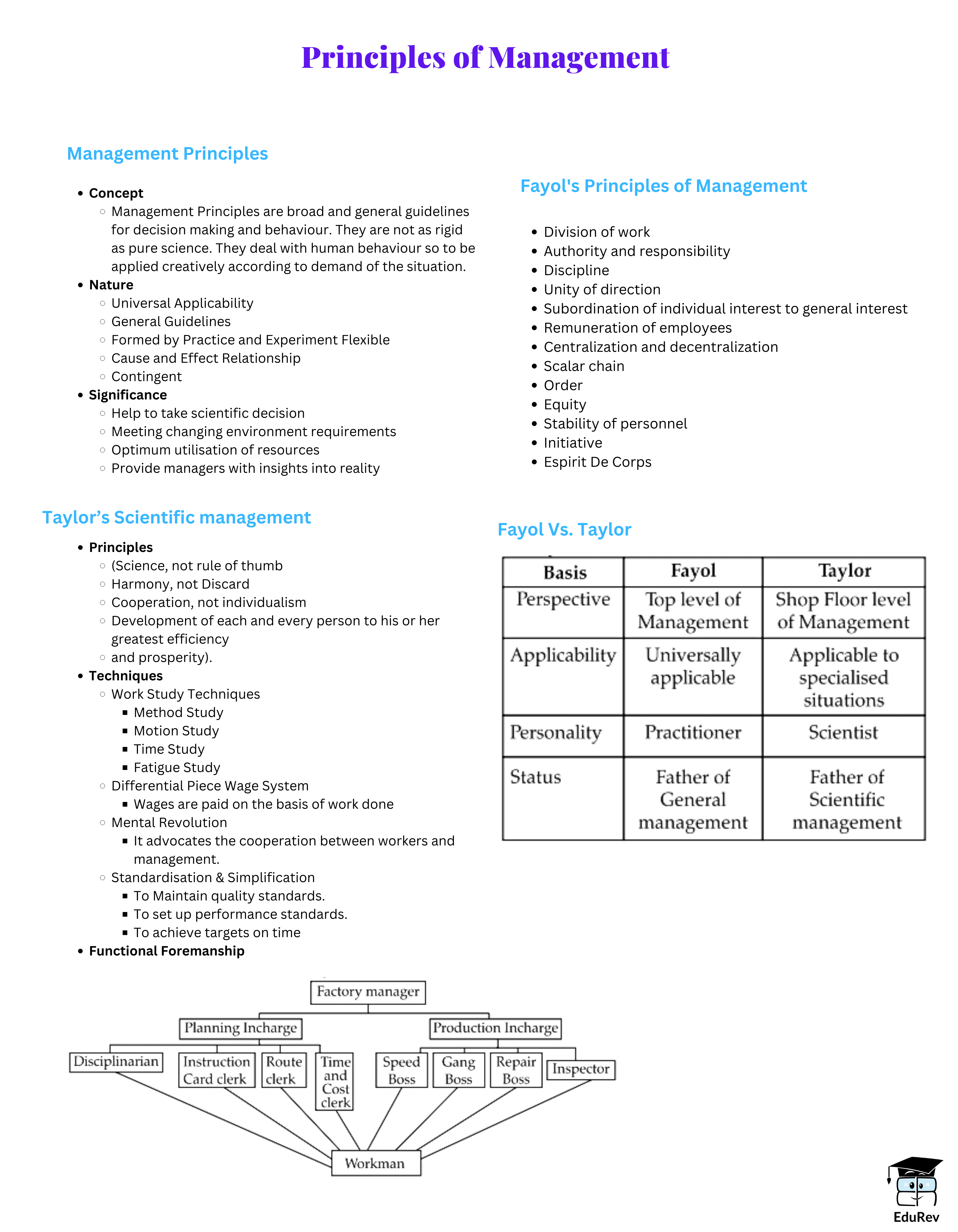
The document Mind Map: Principles of Management is a part of the Commerce Course Business Studies (BST) Class 12.
All you need of Commerce at this link: Commerce
FAQs on Mind Map: Principles of Management
| 1. What are the 14 principles of management by Henri Fayol and why do they matter for Class 12 exams? |  |
Ans. Henri Fayol's 14 principles of management form the foundation of modern organisational theory and are crucial CBSE exam topics. These principles-including division of labour, authority, discipline, unity of command, and centralisation-provide a framework for effective administration. Understanding each principle's application helps students score well in short and long answer questions, as examiners frequently test conceptual clarity and real-world relevance of these management fundamentals.
| 2. How do the principles of scalar chain and span of control differ from each other? | |
Ans. Scalar chain refers to the unbroken line of authority from top to bottom in an organisation, ensuring clear communication flow. Span of control, conversely, determines how many subordinates one manager can effectively supervise. While scalar chain emphasises vertical hierarchy and command relationships, span of control focuses on the capacity and supervisory limits. Both principles work together to create balanced organisational structures and are commonly compared in Business Studies assessments.
| 3. What's the difference between centralisation and decentralisation in management principles? | |
Ans. Centralisation concentrates decision-making authority at higher management levels, while decentralisation distributes authority across multiple management tiers. Centralised systems offer consistent control but slower decision-making; decentralised approaches empower lower-level managers and encourage faster responses. The choice depends on organisational size, complexity, and objectives. Students should understand how these opposing principles balance to create effective governance structures within businesses.
| 4. Why is the principle of unity of command so important in organisational management? | |
Ans. Unity of command dictates that each employee should receive instructions from only one superior, preventing confusion and conflicting directives. This principle eliminates dual authority, reduces accountability confusion, and strengthens discipline within organisations. When employees report to multiple managers, productivity suffers and responsibility becomes unclear. CBSE examiners value answers that explain how this principle prevents organisational chaos and maintains efficient workflow management in modern enterprises.
| 5. How can I use a mind map to understand and remember all 14 principles of management effectively? | |
Ans. Mind maps visually organise Fayol's 14 principles by grouping related concepts-such as structural principles (scalar chain, span of control) and behavioural principles (discipline, unity of command). Colour-coding, connecting branches, and adding examples strengthen retention. Students can refer to mind maps and flashcards on EduRev to see how professional educators structure these complex management concepts, making revision faster and examination preparation more efficient for Class 12 Business Studies.
About this Document

4.94/5 Rating

Apr 29, 2026 Last updated
Related Exams
Document Description: Mind Map: Principles of Management for Commerce 2026 is part of Business Studies (BST) Class 12 preparation. The notes and questions for Mind Map: Principles of Management have been prepared according to the Commerce exam syllabus. Information about Mind Map: Principles of Management covers topics like and Mind Map: Principles of Management Example, for Commerce 2026 Exam. Find important definitions, questions, notes, meanings, examples, exercises and tests below for Mind Map: Principles of Management.
Introduction of Mind Map: Principles of Management in English is available as part of our Business Studies (BST) Class 12 for Commerce & Mind Map: Principles of Management in Hindi for Business Studies (BST) Class 12 course. Download more important topics related with notes, lectures and mock test series for Commerce Exam by signing up for free. Commerce: Mind Map: Principles of Management
Description
Mind Map: Principles of Management of Business Studies provides you one-page visual summary of the chapter covering all the important topics. Download the PDF from EduRev.
Information about Mind Map: Principles of Management
In this doc you can find the meaning of Mind Map: Principles of Management defined & explained in the simplest way possible. Besides explaining types of Mind Map: Principles of Management theory, EduRev gives you an ample number of questions to practice Mind Map: Principles of Management tests, examples and also practice Commerce tests



Related Searches
MCQs, Objective type Questions, past year papers, video lectures, Extra Questions, Semester Notes, shortcuts and tricks, mock tests for examination, Viva Questions, Important questions, Free, Exam, Mind Map: Principles of Management, Previous Year Questions with Solutions, Summary, ppt, pdf , Sample Paper, Mind Map: Principles of Management, Mind Map: Principles of Management, practice quizzes, study material;